The Hidden Costs of Managing Your Own Logistics: Why Outsourcing to a 3PL Saves You Money
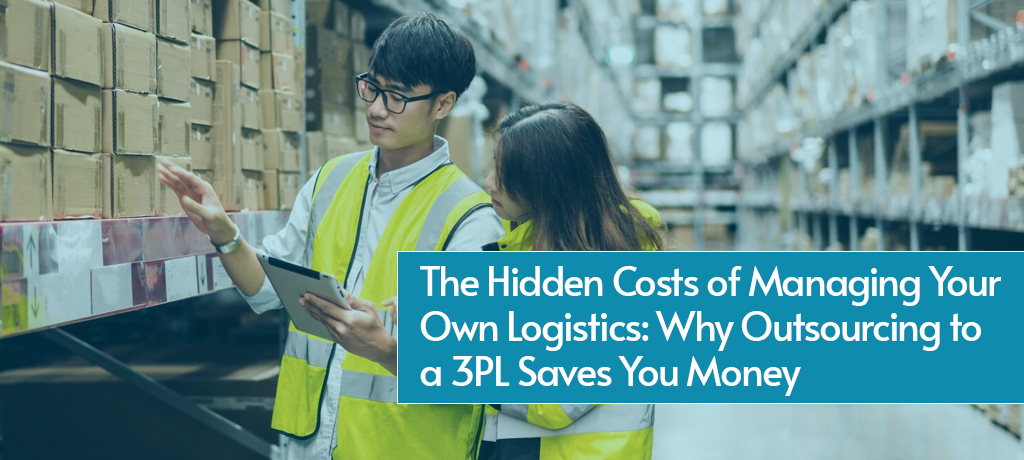
Managing your own logistics may seem cost effective but it comes with hidden expenses that can quickly add up to the costs. Many ecommerce brands start by managing logistics in-house to stay in contr…
Managing your own logistics may seem cost effective but it comes with hidden expenses that can quickly add up to the costs. Many ecommerce brands start by managing logistics in-house to stay in control of costs. Initially, self-fulfillment often feels cheaper because you don't have to pay third-party fees and keep operations under your control.
However, hidden expenses begin to appear once sales volume grows. A third party logistics (3PL) partner helps you cut on these hidden expenses by offering scalable warehousing, labor and fulfillment services. With a 3PL, you not only reduce costs but also improve accuracy as managing logistics on your own can result in operation errors.
The reality is that logistics is not just about shipping orders. It requires trained staff, technology, and constant optimization. These factors are managed smoothly by 3PL. This is why many brands move to 3PL outsourcing.
In this guide we will break down the hidden costs of managing your own logistics, compare 3PL vs in-house fulfillment cost and explain how outsourcing to a professional fulfillment partner saves money.
Hidden Cost of Managing Your Own 3PL Operations
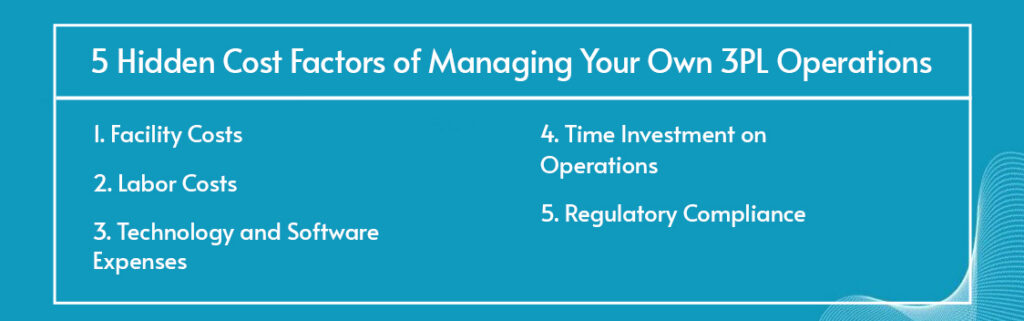
Here are the cost factors that most businesses don't notice when deciding to manage logistics in house.
1. Facility Costs
Running your own logistics operation requires physical space, and facility expenses are one of the biggest hidden costs. Warehouse rent, property taxes, insurance, maintenance and security costs all add up quickly.
These are just baseline costs as you also need to invest in racking and shelves systems, repairs and upgrades, and climate control for sensitive inventory. Taking into account all these expenses, the overall cost becomes much higher than what businesses expect.
2. Labor Costs
In-house logistics requires hiring staff. Hiring and training warehouse employees takes time and money. Labor expenses often become one of the largest ongoing costs for growing brands and it also comes with challenges including managing seasonal spikes, and changing workloads. Labor shortages can delay orders, while overstaffing wastes the budget.
3. Technology and Software Expenses
Modern logistics heavily depends on technology. Maintaining these in your system can be expensive. Inventory management software, warehouse management systems (WMS), order tracking tools, and reporting dashboards all require setup, and ongoing maintenance. These costs are often underestimated when businesses decide to manage fulfillment themselves.
If you choose to move forward without the right technology, you risk inventory discrepancies and poor customer experience.
4. Time Investment on Operations
Managing logistics internally requires constant attention. Business owners and managers often spend hours dealing with inventory issues, shipment delays, returns, carrier problems, and warehouse coordination. This time investment reduces the ability to focus on growth activities such as marketing, product development, and customer acquisition.
The opportunity cost of time is one of the most overlooked expenses. When leadership is busy solving operational problems, the business grows slower and misses potential revenue opportunities.
5. Regulatory Compliance
In house fulfillment management needs to meet a long list of regulations. Businesses handling fulfillment on their own must ensure compliance with carrier rules, labeling, and safety standards. Falling short puts your business at risk of fines, delays, or rejected shipments, which increase costs and affect customer satisfaction.
How Partnering With a 3PL Saves Money
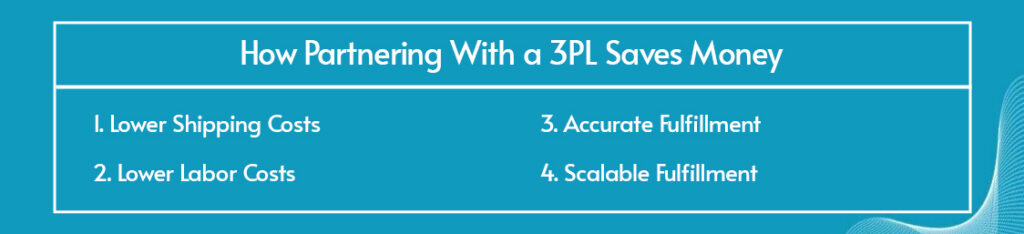
Outsourcing fulfillment to a third-party logistics provider can significantly reduce cost. Understanding the real 3PL outsourcing benefits helps businesses see how professional fulfillment services lower costs in the long run.
1. Lower Shipping Costs
Partnering with a 3PL helps reduce shipping expenses because fulfillment providers ship large volumes daily and they are open to negotiate rates. They often provide bulk shipping discounts that lower per order costs. 3PL providers also have multiple warehouse locations which reduce expenses on expensive long distance deliveries. Over time, these savings make outsourced fulfillment services option more cost efficient.
2. Lower Labor Costs
You don’t have to recruit, train, or manage warehouse staff. A 3PL provides skilled labor and handles shifts, benefits, so you only pay for the labor directly tied to your operations. That means you don't have to take HR responsibilities and worry about payroll or turnover costs.
3. Accurate Fulfillment
Integrated workflows and trained staff reduce fulfillment mistakes. You can expect fewer picking errors, shipping mistakes, and stock mismatches. This ultimately leads to fewer returns and customer complaints which can quietly reduce profit.
4. Scalable Fulfillment
One of the biggest cost advantages of working with a 3PL is the ability to scale without investing in new space, or equipment. As order volume grows, the 3PL can handle additional storage and shipments without requiring large upfront costs. This flexibility allows businesses to expand during peak seasons and reduce usage during slower periods.
3PL vs In-House Fulfillment Cost
At first glance, in-house fulfillment may seem cheaper as it does not require you to pay a third party fee. However when you calculate full operational cost, the cost difference becomes clear.
In-house fulfillment includes warehouse rent, utilities, insurance, equipment, labor, packaging materials, software, and shipping charges. These expenses exist even when order volume is low. This means your cost per order can become very high, especially during slow periods.
With a 3PL, most of these costs are not fixed. You only pay for storage, pick and pack and shipping only when orders are processed. This makes cost forecasting easier and reduces the risk of overpaying for unused warehouse space or staff.
Shipping is another major factor in the in-house vs 3PL fulfillment comparison. Third-party providers usually have better carrier contracts, which can reduce shipping rates significantly. Even a small difference per order can save you a good amount per month.
Return handling is another hidden expense in self-fulfillment. Processing returns requires labor, inspection, restocking, and system updates. A 3PL already has processes for returns, which reduces the cost and time required.
When brands calculate the true cost of logistics, many realize that outsourcing to a 3PL is not an extra expense but is a smart way to reduce total fulfillment cost.
Why Choose PRS for Ecommerce Fulfillment Outsourcing
3PL is the best choice to reduce cost and boost efficiency. But you can enjoy these benefits when you choose the right 3PL provider. Not all third-party logistics value-added services are created equal. You have to evaluate experience, technology, pricing transparency, and the ability to scale with your business before choosing any.
PRS provides the best professional 3PL services for brands that need reliable, cost-efficient, and scalable ecommerce fulfillment. We have skilled labor and experts who handle operations with high accuracy at competitive rates. We have advanced technology systems that are transparent and easy to integrate.
We also help you to scale your business across multiple channels with expert support at every step. As a trusted 3PL partner for Amazon and Walmart fulfillment, PRS understands marketplace requirements and ensures your orders are processed accurately. With our simplified logistics handling, you can rest assured that your inventory is in competent hands and you can focus more on growth.
Conclusion
In house fulfillment management might seem cost-effective at first glance. But once you add up the hidden expenses, outsourcing becomes the smarter choice. With a trusted 3PL partner, you get access to modern warehouse infrastructure, experienced staff, and fulfillment workflows designed to scale with your business.
This results in lower costs, higher efficiency and saves you time so you can focus on brand growth. If you are ready to cut costs and improve performance, contact PRS to learn how 3P marketplace services can help.
Frequently Asked Questions
When to stop self-fulfilling and hire a 3PL provider?
You should consider hiring a 3PL when it becomes hard to manage fulfillment on your own. Outsourcing to 3PL providers can help you save money, reduce operational workload, and avoid the growing costs of storage, labor, and shipping.
Why brands outsource 3PL fulfillment operations?
Brands outsource 3PL fulfillment to reduce operational costs, access lower shipping rates, and improve order accuracy. Outsourcing also allows businesses to focus on sales and product growth while logistics is handled by professionals.
Is outsourcing logistics to a 3PL cheaper than managing fulfillment in-house?
In many cases, yes. A 3PL can reduce costs by offering lower shipping rates, shared warehouse space, trained staff, and built-in technology, which removes the need for large upfront investments and ongoing operational expenses.
What types of businesses should use ecommerce fulfillment outsourcing?
Any growing ecommerce brand, marketplace seller, or retail business that is struggling with storage, shipping, or order management can benefit from outsourcing.
What services are included in professional 3PL fulfillment?
Most 3PL providers offer warehousing, inventory management, picking and packing, shipping, returns handling, and tracking systems. Some also provide value-added services such as labeling, bundling, kitting, and marketplace preparation.
Ready to talk
operations?
Tell us about your marketplace footprint. We'll respond within one business day.
Laguna Beach, CA 92651