Jun
Amazon
Amazon Listing Hijacking Explained: A Complete Guide for Sellers
You’ve spent months building your Amazon business. You’ve researched your product, optimized your listing, gathered reviews, and finally started seeing consistent sales. Then one day, something feels off. Your Buy Box disappears. Sales drop without explanation. A customer complains about receiving a cheap knockoff. You check your listing and find an unfamiliar seller has jumped on it, selling what appears to be a counterfeit or unauthorized version of your product.
This is Amazon listing hijacking, and it’s one of the most frustrating threats a seller can face on the platform.
The impact goes beyond lost revenue. Hijackers damage your brand reputation, confuse your customers, and can undo months of hard work in a matter of days. Whether you’re a private label seller, a brand owner, or someone who has built a strong product presence on Amazon, understanding how hijacking works and how to fight back is no longer optional. It’s essential.
This guide breaks everything down for you: what Amazon listing hijacking is, how to detect it early, how to remove a hijacker from your Amazon listing, and most importantly, how to stop Amazon listing hijacking before it ever happens.
What Is Amazon Listing Hijacking?
Amazon listing hijacking occurs when an unauthorized third-party seller adds themselves to your product listing and begins selling their own version of your product, often a counterfeit, an inferior imitation, or a completely different item under your brand name and ASIN.
Here’s how Amazon’s marketplace is structured: multiple sellers can list under the same ASIN. This is intentional for resellers who are legitimately selling the same product. However, bad actors exploit this open system to piggyback on successful listings without authorization.
An Amazon listing hijacker typically targets listings that are:
- Ranking well organically
- Generating strong, consistent sales
- Associated with a recognizable or growing brand
- Not yet protected under Amazon Brand Registry
Once a hijacker attaches to your listing, they compete for the Buy Box, the “Add to Cart” button that drives the majority of Amazon purchases. If they undercut your price, they can win the Buy Box and intercept your customers entirely.
What makes this particularly damaging is that your listing’s title, images, and description remain unchanged. To a shopper, everything looks normal. They think they’re buying from you or your brand. In reality, they’re buying from someone selling a substandard or entirely fake product, and your brand takes the hit when they’re disappointed.
How to Tell If Your Amazon Listing Has Been Hijacked
Catching hijacking early is critical. The longer a hijacker stays on your listing, the more damage they can do. Here are the clearest signs your Amazon listing has been hijacked:
You’ve Lost the Buy Box
If your sales have suddenly dropped and you’re no longer winning the Buy Box on your own listing, it’s worth investigating. Go to your listing as a customer would and check who currently holds the Buy Box. If it’s not you, check the “Other Sellers on Amazon” section.
An Unknown Seller Appears on Your Listing
Click on “New” under the seller options on your product page if you see an unfamiliar seller offering the same product, especially at a lower price; that’s a major red flag.
Customer Complaints About Product Quality
If you start receiving negative reviews or messages about poor product quality, wrong items, or counterfeit packaging, and you know your fulfillment is in order, a hijacker may already be fulfilling orders in your place.
A Sudden, Unexplained Sales Drop
A sharp decline in units sold without any change to your listing, pricing, or ad spend is often the first quiet signal that someone is stealing your Buy Box.
Your Listing Content Has Changed
In more aggressive cases, hijackers alter listing titles, images, or bullet points to favor their counterfeit product. If your listing content looks different from what you originally uploaded, treat it as a serious alert.
Make it a habit to check your active listings at least once a week. For high-volume products, daily monitoring is worth the time.
The Real Damage: How Hijacking Hurts Your Business
Amazon listing hijacking isn’t just an inconvenience; it can cause deep, lasting harm to your brand and bottom line. Here’s what’s really at stake:
Direct Revenue Loss
Every sale a hijacker intercepts is a sale you don’t make. If they’re winning the Buy Box, they’re collecting the revenue that should be yours on a listing you built, with reviews you earned.
Brand Reputation Damage
Customers don’t always check who’s actually fulfilling their order. When they receive a low-quality knockoff, they associate that experience with your brand. Negative reviews accumulate on your listing, not the hijacker’s. You end up paying the reputational price for someone else’s fraudulent behavior.
Loss of Customer Trust
A customer who receives a counterfeit product is unlikely to return. Worse, they may file an A-to-Z Guarantee claim, leave a one-star review, or report the product, all of which reflect directly on your listing’s standing on Amazon. Understanding how to protect your brand on Amazon before trust erodes is far less costly than rebuilding it after the damage is done.
Erosion of Listing Performance
Negative reviews, increased return rates, and A-to-Z claims all signal to Amazon’s algorithm that your listing is underperforming. This can suppress your organic ranking, increase your PPC costs, and directly undermine the Amazon product listing conversions you’ve worked hard to build.
Long-Term Brand Equity Damage
For brand builders, the long-term effect is even more concerning. Customers who had a bad experience may actively avoid your brand in the future, even after the hijacker is removed and your product quality is restored.
The bottom line: a single hijacker, left unchecked, can unravel months of brand-building effort. Acting quickly is not just advisable, it’s necessary.
How to Remove a Hijacker from Your Amazon Listing
If your listing has been hijacked, don’t panic, but do act fast. There’s a clear process for how to remove a hijacker from your Amazon listing, and following this methodically gives you the best chance of a quick resolution.
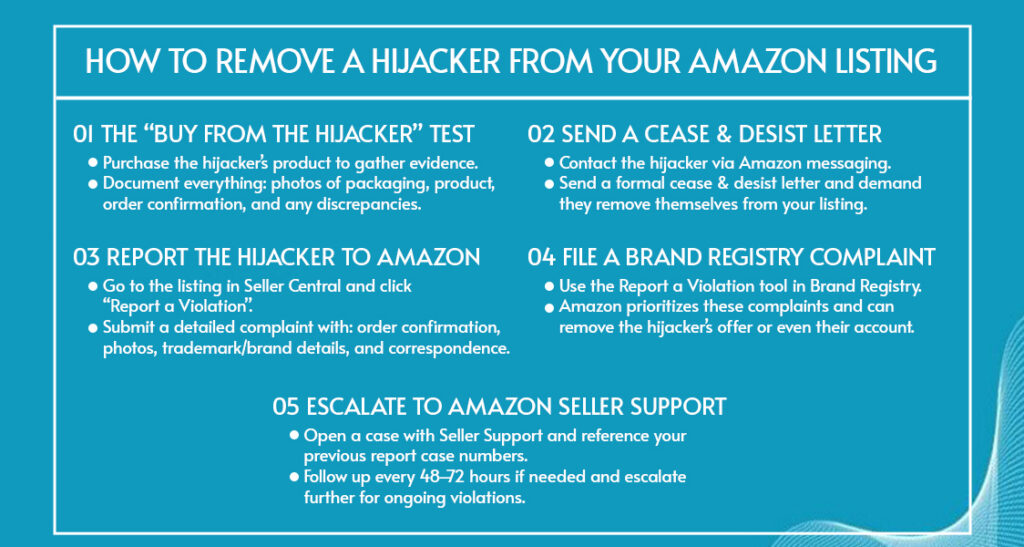
1. The “Buy From the Hijacker” Test
Before you take any formal action, gather evidence. Purchase the hijacker’s product yourself. This gives you a physical record of what they’re selling: counterfeit packaging, wrong product, inferior quality, or misrepresentation. This purchase record and the product itself will serve as concrete evidence when you report the issue to Amazon.
Document everything: take photos of the packaging, the product, the order confirmation, and any discrepancy between what was advertised and what was delivered.
2. Send a Cease & Desist Letter
Once you have evidence, reach out to the hijacker directly through Amazon’s messaging system. Send a formal cease and desist letter informing them that they are selling an unauthorized or counterfeit version of your product, that they are infringing on your intellectual property, and that you are prepared to escalate to Amazon and pursue legal action if they do not remove themselves from your listing immediately.
Many smaller-scale hijackers back down at this stage to avoid the legal risk. Keep the tone firm and professional. Avoid emotional language, treat it as a legal communication, not a personal dispute.
3. Report the Hijacker to Amazon
If the hijacker doesn’t respond or refuses to remove themselves, escalate to Amazon. Navigate to the listing in Seller Central, click “Report a Violation,” and submit a detailed complaint. Include:
- Your order confirmation shows the counterfeit product
- Photos of the product and packaging discrepancy
- Your trademark or brand registration details (if applicable)
- Any correspondence with the hijacker
Be specific and factual in your complaint. Amazon receives a high volume of reports, and a well-documented case with clear evidence gets resolved faster than a vague complaint.
4. File a Brand Registry Complaint
If you are enrolled in Amazon Brand Registry, you have access to a significantly more powerful set of tools. Use the Report a Violation tool within Brand Registry to file a formal IP infringement complaint. Amazon treats Brand Registry complaints with higher priority than standard seller reports.
Through Brand Registry, you can report counterfeit products, unauthorized use of your brand name, and listing manipulation. Amazon’s brand protection team will review your case and can remove the hijacker’s offer or, in serious cases, remove their account entirely.
This is one of the strongest arguments for enrolling in Brand Registry before a problem occurs, not after.
5. Escalate to Amazon Seller Support
If your Brand Registry complaint or standard report doesn’t yield results within a reasonable timeframe, escalate through Seller Support. Open a case directly and reference your previous complaint case numbers. Be persistent, politely follow up every 48 to 72 hours if needed.
In serious cases involving ongoing counterfeiting or repeated violations, you may also consider involving Amazon’s legal team by reaching out through their official IP infringement reporting channels or consulting with an Amazon-specialized attorney who can apply external pressure.
How to Stop Amazon Listing Hijacking Before It Happens
The best strategy against hijacking is prevention. Here’s how to build a strong defense around your listings so that hijackers either can’t attach to them or find it far too risky to try.
1. Enroll in Amazon Brand Registry
Amazon Brand Registry is your single most important line of defense against hijacking. Once enrolled, you gain access to proactive brand protection tools, priority complaint handling, and greater control over your listing content.
To qualify, you need a registered trademark in the country where you’re selling. The process takes time, but the protection it provides is well worth the investment. Brand Registry also gives you access to Enhanced Brand Content (A+ Content), Sponsored Brands ads, and the Amazon Storefront, all of which strengthen your brand presence on the platform.
2. Use the Amazon Transparency Program
The Amazon Transparency Program takes protection a step further. It assigns unique, scannable barcodes to each unit of your product. When a customer or Amazon scans the code, they can verify the product’s authenticity.
More importantly, any unit without a valid Transparency code cannot be listed or sold on your ASIN. This effectively blocks hijackers from being able to fulfill orders on your listing, since their counterfeit units won’t carry legitimate codes.
Transparency is particularly valuable for high-demand products that attract repeat hijacking attempts.
3. Add Custom Branding and Packaging Inserts
Make your product harder to counterfeit. Invest in distinctive, branded packaging, custom colors, logo placement, unique design elements, and security features like holographic stickers or branded tape. Include packaging inserts with personalized messages, warranty registration cards, or QR codes that link back to your official website.
These elements serve two purposes: they make your authentic product immediately distinguishable from a knockoff, and they give you stronger grounds when reporting a hijacker, since the difference between your product and theirs becomes visually undeniable.
4. Monitor Your Listings Regularly
Prevention requires consistent attention. Set up monitoring systems so you’re alerted the moment an unauthorized seller appears on your listing. Tools like Helium 10’s Alerts feature, SellerAlert, or similar third-party monitoring software can notify you in real time when a new seller joins your ASIN, your Buy Box changes hands, or your listing content is modified.
The faster you detect hijacking, the faster you can act, and the less damage gets done.
5. Register Your Trademark
A registered trademark is the legal foundation of all your brand protection efforts on Amazon. Without one, your ability to enroll in Brand Registry is limited, and your IP infringement complaints carry less weight.
File for a trademark with the USPTO (for US sellers) or the relevant authority in your target marketplace. Amazon also accepts trademarks through the IP Accelerator program, which can fast-track your Brand Registry enrollment while your trademark application is still pending.
Think of your trademark as the legal backbone of your entire Amazon brand protection strategy.
What to Do If You’re a Private Label Seller vs. Reseller
Your approach to handling hijacking depends significantly on your seller model.
If You’re a Private Label Seller
Private label sellers are the most common targets of hijacking, and fortunately, the most empowered to fight back. Since you own the brand and manufacture (or source) the product exclusively, you have clear legal standing to claim IP infringement and pursue removal through Brand Registry.
Your priority actions should be: get your trademark registered, enroll in Brand Registry, and use the Transparency Program for your best-selling ASINs. You have every right to the exclusive Buy Box on your own branded listings, and Amazon’s tools are designed to support you. Many private label brands also find that working with a single Amazon selling partner adds another layer of control, eliminating the multi-seller chaos that attracts hijackers in the first place.
If You’re a Reseller
Resellers operate in a gray area. Since you don’t own the brand, you cannot file brand-based IP complaints against other sellers on a shared listing. In most cases, multiple sellers legitimately competing on the same ASIN is simply how the reseller model works.
However, if another seller is misrepresenting the product, listing a counterfeit, or violating Amazon’s policies in how they’re selling, you can still report the violation through Seller Central. Focus on policy violations, inaccurate product descriptions, counterfeit claims, or listing manipulation rather than brand infringement.
If you are a reseller who has also developed a private label product alongside your reselling business, protect that product aggressively using all the brand protection tools available to you.
Conclusion
Amazon listing hijacking is a serious threat that can impact your sales, Buy Box ownership, customer trust, and brand reputation. However, with the right safeguards in place, such as trademark registration, Amazon Brand Registry, the Transparency Program, and ongoing listing monitoring, you can significantly reduce the risk and respond quickly when issues arise.
Protecting your listings is only one part of building a successful marketplace business. As your brand grows, managing fulfillment, logistics, marketplace compliance, and sales performance becomes equally important. That’s why many brands partner with Prime Retail Solution, a trusted exclusive 3P marketplace partner that helps businesses streamline operations, strengthen marketplace performance, and support sustainable growth across major online channels.
If you’re looking to build a more secure, scalable, and profitable marketplace presence, explore Prime Retail Solution’s 3P marketplace services and discover how the right partner can help protect your brand while driving long-term growth.
Get connected with the experts now!
FAQs
1. What is Amazon listing hijacking?
Amazon listing hijacking happens when an unauthorized seller joins your product listing and sells counterfeit, imitation, or unauthorized versions of your product under the same ASIN. These sellers often compete for the Buy Box and can negatively impact your sales and brand reputation.
2. How do I know if my Amazon listing has been hijacked?
Some common signs include losing the Buy Box, seeing unfamiliar sellers on your listing, receiving complaints about product quality, experiencing unexplained sales declines, or noticing unauthorized changes to your listing content.
3. How to remove a hijacker from an Amazon listing?
If you’re wondering how to remove a hijacker from an Amazon listing, start by gathering evidence. Purchase the suspected counterfeit product, document any discrepancies, send a cease-and-desist notice to the seller, and report the violation through Amazon Seller Central. If you’re enrolled in Amazon Brand Registry, use the Report a Violation tool for faster and more effective enforcement.
4. How long does Amazon take to remove a hijacker?
The timeline varies depending on the strength of your evidence and the complexity of the case. Some cases are resolved within a few days, while others may require multiple follow-ups with Seller Support or Brand Registry teams.
5. Does Amazon Brand Registry help prevent listing hijacking?
Yes. Amazon Brand Registry provides brand owners with advanced protection tools, priority support, and the ability to report counterfeit products and unauthorized sellers more effectively.
6. How to stop Amazon listing hijacking?
To understand how to stop Amazon listing hijacking, sellers should proactively protect their brand by registering trademarks, enrolling in Amazon Brand Registry, using the Amazon Transparency Program, monitoring listings regularly, and investing in distinctive product packaging that is difficult to counterfeit.
7. Are private label sellers more vulnerable to listing hijacking?
Private label sellers are frequent targets because they often build successful branded listings. However, they also have stronger protection options through trademarks, Brand Registry, and intellectual property enforcement tools.
Share