Apr
Amazon
Full Service Amazon Agency vs In House Team: Which Delivers Better ROI?
Managing an Amazon business is not an easy task especially when the marketplace is evolving at an aggressive pace. As a seller, you have to choose one of the two ways: hiring Amazon marketing management agency or in-house team. Each approach offers benefits and comes with challenges so making the right choice is crucial.
Before picking one side, it is crucial to understand what each option offers and know what you are actually signing up for.
This blog serves as a comprehensive guide for sellers stuck between Amazon full service agency vs in house support. In this guide, we’ll break down the costs, advantages, disadvantages, and ROI potential each option carries and highlight the factors that influence your choice. By the end, you’ll have a clear understanding to determine which solution aligns best with your business goals
Full Service Amazon Agency vs In House
Managing an Amazon account requires a combination of expertise, time, and resources. Amazon account management agency handles all aspects of your seller account. Agencies bring experience with Amazon’s ever-changing algorithms and best practices, making it easier to scale your business efficiently. The service providers have extensive experience in navigating Amazon’s ever-changing algorithms and guidelines.
On the other hand, choosing in house management means you handle everything yourself. An in-house team gives you complete control over every aspect of your Amazon operations. From listing products to managing inventory and dealing with customers, you are in charge of your Amazon store.
Here is a comparison table to provide a better understanding of both options:
| Factor | Full Service Amazon Agency | In-House Team |
| Expertise | Access to experienced specialists across PPC, SEO, and operations | Limited to the skills of hired employees |
| Cost Structure | Fixed monthly fee, % of ad spend or hybrid | Salaries, benefits, training, and tools |
| Tools & Software | Uses premium tools (often included in service) | Must purchase and manage tools separately |
| Scalability | Easily scalable based on business growth | Requires hiring and training new staff |
| Control | Less direct control, depends on communication | Full control over strategy and execution |
| Speed of Execution | Faster due to established processes and team | Slower due to limited resources or experience |
| Flexibility | Can adjust strategies quickly across accounts | Changes may take longer to implement |
Full Service Amazon Agency vs In House Cost Comparison
When evaluating Amazon agency vs in house cost, it’s essential to consider not just the upfront expenses, but also ongoing costs that can significantly impact overall ROI.
Amazon PPC Agency Pricing Models
Most Amazon-focused agencies use three primary pricing models on which Amazon PPC management cost relies on.
Percentage of Ad Spend: This is the most common pricing model agencies follow. Agencies charge a percentage (often 10–20%) of your Amazon ad spend. If you are spending $100k per month, expect to pay $10k to $20k in management fees.
Flat Monthly Fee: Some agencies charge a fixed monthly fee depending on the scope of support and account complexity. This pricing model works best for brands with stable ad spend and clearly defined service requirements. Mid-market brands typically pay between $1,500 and $5,000 per month, while enterprise-level accounts can expect fees closer to $10,000 or more, depending on the level of management involved.
Hybrid Pricing Models: Hybrid pricing models blend fixed fees with a percentage-of-ad-spend structure. Typically, this approach includes a base monthly fee plus a variable fee based on ad spend. For example, a business might pay a $1,000 fixed monthly fee in addition to 5% of any ad spend exceeding $10,000.
In-House Amazon PPC Management Costs
Managing Amazon PPC in-house offers greater control, but it comes with significant costs and resource demands. Building a team that truly understands Amazon’s advertising ecosystem requires both time and investment.
Recruiting and Training: Hiring a mid-level marketing professional can cost between $10,000 and $20,000 when accounting for job postings, recruiter fees (typically 15–25% of the first-year salary for specialized roles), interview time, and onboarding.
Tools and Tech Stack: In addition to salaries, maintaining an effective PPC operation requires investing in advanced tools and ongoing training. Analytics software, bid automation platforms, keyword research tools, and creative testing resources can collectively cost up to $5,000 per month. Staying current with Amazon’s rapidly evolving platform is essential, making this an ongoing investment rather than a one-time expense.
Full Service Amazon Agency vs In House: Advantages & Disadvantages Breakdown
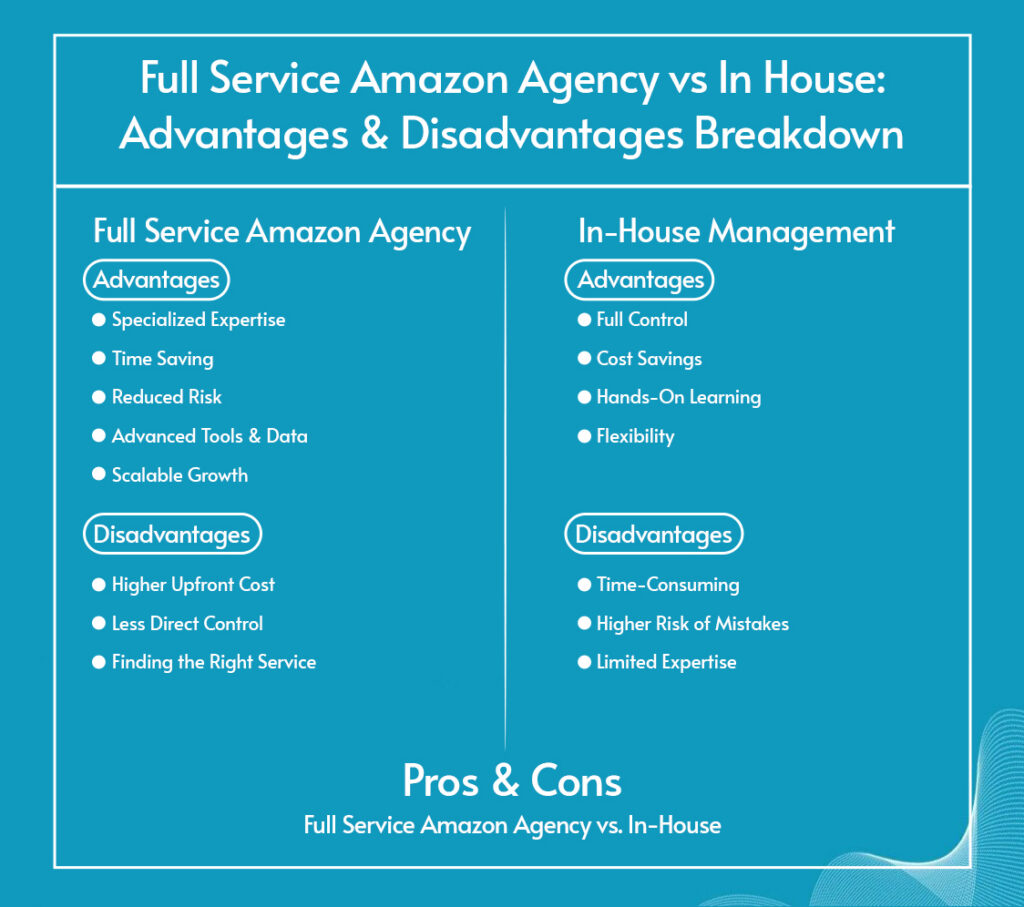
Here is the breakdown of the key benefits and drawbacks of both approaches, helping you clearly evaluate which model aligns better with your brand.
Advantages of Full Service Amazon Marketing Agency
Specialized expertise: Professionals understand Amazon’s marketplace, trends, and adopt best practices, which can help increase sales.
Time saving: Managing an Amazon account requires time and effort. By assigning the responsibilities of account management to experts you can save time to focus on other aspects of your business.
Reduced risk: Experience teams proactively manage your business adhering to policies, minimizing the chances of compliance related issues that can sometimes result in account suspension.
Advanced tools & data: Agencies rely on premium tools and effective Amazon reporting frameworks for better decision making.
Scalable growth: Experienced teams can efficiently handle expansion across ASINs and marketplaces enabling you to scale on Amazon for faster growth.
Disadvantages of Amazon Full Service Marketing Agency
Higher upfront cost: Agencies charge monthly or revenue based fees that require consistent investment which can be expensive for new or small businesses.
Less direct control: You are trusting someone else to manage your business, which might mean losing control over day to day operations and decision making.
Challenge of finding the right service: Not all Amazon management services are the same. Results depend on finding the right one that aligns with your expectations and that can be challenging.
Advantages of In House Management
Full control: You have full control over daily operations and can make decisions about everything from pricing to management.
Cost savings: You don’t have to pay management fees or share your revenue which keeps your expenses low.
Hands-on learning: Managing your account helps you understand how Amazon works, which can be valuable for future growth.
Flexibility: You are in full control and can experiment with different strategies without relying on a third party.
Disadvantages of In House Management
Time-consuming: Managing an Amazon account on your own can be overwhelming as it demands daily involvement including optimization.
Higher risk of mistakes: Without Amazon business knowledge, you may make errors that affect your rankings or even get your account suspended.
Limited expertise: Internal teams may lack specialization and learning mastering Amazon account management requires significant time and effort.
Full Service Amazon Agency vs In House ROI Comparison
When evaluating ROI, the real question is “Which option generates higher profitable growth over time?”
Agencies are often able to deliver faster and higher ROI due to their expertise, access to analytics, and ability to test and optimize quickly across campaigns. They can identify high-performing products and optimize ad spend to maximize returns. Many clients report measurable improvements in sales, visibility, and conversion rates within the first few months of agency engagement.
In-house teams may take longer to achieve similar ROI, especially if the team lacks prior experience or advanced Amazon skills. While long-term ROI can be strong as teams gain expertise, companies must weigh the initial investment in hiring, training, and tools against the potential gains. For businesses looking for rapid growth and immediate returns, agencies often provide a more predictable ROI.
Outsourcing Amazon account management to agencies is the best option for brands prioritizing faster growth while in house management suits sellers who value control and are willing to sacrifice speed for lower upfront costs.
Factors to Consider to Determine Best Fit
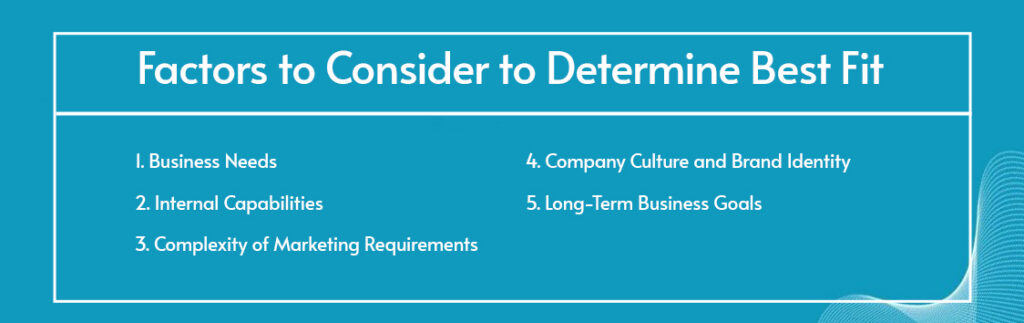
Choosing between Amazon agency vs in house team is a pivotal decision that depends on factors like your company’s size, industry, budget, and long-term goals. Assessing your unique needs and capabilities is essential to making the right choice.
1. Business Needs
Your business needs are a crucial factor and it is highly recommended to access as the first step. Businesses with ongoing, comprehensive strategies may benefit from an in-house team, while those with specific needs might prefer an agency.
2. Internal Capabilities
Consider your internal team’s current capabilities when deciding between an in-house team or an agency. Building an in-house team can be costly and time-consuming, especially for smaller businesses if there are skill gaps. A marketing agency can provide specialized expertise and advanced tools, often offering solutions that an internal marketing team may struggle to achieve.
3. Complexity of Marketing Requirements
The complexity of your Amazon marketing needs is a key factor in deciding between an agency or in-house team. If your product portfolio is large, and campaigns require constant optimization, agencies with specialized teams and advanced tools are often better equipped to handle the workload efficiently.
For businesses with simpler marketing requirements or a limited product catalog, an in-house team may be sufficient. When the marketing strategy is straightforward and does not require advanced analytics or constant experimentation, internal staff can manage operations effectively while maintaining control over every decision.
4. Company Culture and Brand Identity
In-house teams are fully immersed in your company culture and can represent your brand voice consistently across all Amazon touchpoints. This ensures that every piece of content, campaign, or customer interaction aligns perfectly with your organizational values.
Agencies, while highly skilled, may require additional effort to understand and reflect your brand identity accurately. Clear communication, onboarding, and regular collaboration are essential to bridge this gap.
5. Long-Term Business Goals
Companies aiming for rapid growth, or experimentation with multiple strategies may benefit from an agency’s expertise and flexibility. Agencies can adapt quickly to market changes and execute campaigns that align with aggressive expansion plans.
For businesses focused on sustainable growth and developing internal capabilities, an in-house team may be a better fit. Building internal expertise supports long-term independence and allows for greater control over processes, and decision-making.
Choosing Between Full Service Amazon Agency vs In House
An agency makes sense when:
- You want to scale quickly
- You work data-driven but lack internal specialists
- You want to stay flexible
In-house is a fit when:
- You want to build your own Amazon team long-term
- You need 100% control over every detail
- You already have Amazon expertise internally
Conclusion
Deciding between a full service Amazon account management vs in house team ultimately depends on your business priorities, resources, and long-term goals. Agencies provide fast, data-driven results, specialized expertise, and access to advanced tools, making them ideal for businesses seeking rapid growth or scalability. They help minimize risk, save time, and optimize campaigns efficiently, though they require a willingness to share control and invest in professional services.
In-house teams, by contrast, offer complete control, brand alignment, and the opportunity to build internal expertise. This approach suits businesses that prioritize long-term independence and hands-on learning, though growth may be slower initially and requires significant investment in hiring and training. For sellers looking to combine expert support, our team at Prime Retail Solution as a 3rd party marketplace service provider is the best choice. Contact us to get in touch with our experts now!
Frequently Asked Questions
1. What is the difference between a full service Amazon management agency and an in-house team?
A full-service Amazon marketing agency provides expert management of all aspects of your Amazon business, including PPC, SEO, listings, and inventory management. In-house teams are internal staff that handle Amazon operations themselves, giving the business full control but requiring more time, training, and resources.
2. Which option delivers better ROI: Amazon agency or in-house team?
Agencies often provide faster ROI due to their experience, advanced tools, and ability to quickly optimize campaigns. In-house teams can achieve strong ROI over time but may take longer to reach similar results, especially if the team lacks specialized Amazon expertise.
3. How much does it cost to hire a full-service Amazon marketing agency compared to building an in-house team?
Agency costs typically include a monthly fee, a percentage of ad spend, or a hybrid model. In-house management requires salaries, benefits, training, and investment in tools. Agencies offer predictable costs and faster scaling, while in-house teams may save on fees but require significant upfront investment.
4. What are the advantages of using an Amazon marketing agency over an in-house team?
Agencies bring specialized expertise, save time, reduce risk, provide access to advanced tools and data, and can scale growth across ASINs and marketplaces efficiently. They are ideal for businesses seeking rapid growth without investing heavily in building internal capabilities.
5. When should a business choose an in-house team instead of an Amazon agency?
An in-house team is best for businesses that want complete control over Amazon operations, aim to build long-term internal expertise, or have a company culture that requires consistent brand alignment. It’s suitable for those willing to invest time and resources for sustainable growth.
Share