

Apr
Amazon
Multi-Channel Selling: A Complete Guide for Amazon Sellers
If you are currently only selling your products on Amazon, you are missing out on major opportunities. Although Amazon remains the largest marketplace for many brands, it only accounts for 37.6% of e-commerce sales. That means a significant share of online buyers are shopping elsewhere and you are limiting your business to less than half its potential.
As an Amazon seller, you have the opportunity to expand into additional sales channels, and the results can be significant. Sellers who sell on more than one marketplace generate approximately 190% higher revenue on average, all while increasing brand exposure and promoting their brand.
In this guide, we will break down what multi-channel selling is, the biggest benefits and challenges, the top platforms Amazon sellers should consider in 2026, and how to build an ecommerce marketplace strategy that supports long-term growth.
What is Multi Channel Selling
Multi-channel selling is the process of selling products across more than one platform instead of relying on a single marketplace. For Amazon sellers, this can include selling on Amazon alongside platforms such as Shopify, Walmart, eBay, Etsy, TikTok Shop, Facebook Marketplace, or even a brand’s own website. The goal is to reach customers wherever they prefer to shop rather than depending on just one sales channel.
6 Benefits of Multi Channel Selling

Multi channel online selling unlocks meaningful business advantages and allows sellers to:
1. Reach More Customers Across Platforms
Selling on multiple channels allows your brand to appear in more places where customers already spend their time. Your potential buyers can be everywhere beyond Amazon and you may benefit from being present on platforms like Walmart, eBay, Shopify, social media shops, and niche marketplaces where different audiences prefer to browse and buy. By expanding your presence, you reduce the risk of missing out on customers who search for your products on these platforms.
2. Reduce Dependence on Amazon Alone
Relying entirely on Amazon can put you at a disadvantage as you will be missing opportunities as well as exposing your business to unnecessary risk. Policy changes, rising fees, increased competition, account suspensions, or sudden ranking drops can quickly impact your sales if Amazon is your only channel.
A multi channel selling strategy helps reduce that risk by diversifying where your sales come from. If one channel underperforms, you still have revenue flowing from other platforms. This creates a more stable business model.
3. Increase Sales and Revenue Opportunities
Selling across multiple channels naturally creates more opportunities to generate ecommerce sales revenue. By reaching new customers and tapping into new areas of the market, multi-channel selling can fuel revenue growth. Recent research shows that multi-channel selling can increase revenue by as much as 38% with one additional channel, 120% with two additional channels, and 190% with three additional channels.
Instead of relying on one stream of traffic, it is better to create multiple pathways for people to find and buy from your brand. Each platform gives you access to a different audience, which means more potential customers seeing and purchasing your products.
4. Improve Brand Visibility and Awareness
The more places your brand appears, the more familiar customers become with your business which helps you acquire customers. Seeing your products across marketplaces builds trust and recognition. The more channels you use, the more opportunities you have to reach shoppers and convert them into customers.
5. Gain Better Customer Data and Insights
Selling on multiple channels gives you access to a wider range of customer data. You can learn where buyers are coming from, which products perform best on different platforms, what messaging drives conversions, and how customer behavior changes by channel. These insights can help you make smarter decisions about pricing, advertising, and product selection.
6. Improve Inventory Turnover Across Channels
Multi channel selling can help you move inventory more efficiently by spreading products across different demand sources. If one platform is slower during a certain season, another channel may still generate strong sales. This can reduce the risk of excess inventory sitting in storage for long periods.
Better inventory turnover also improves cash flow and helps you avoid unnecessary storage fees. Instead of relying on one marketplace to clear stock, you can use multiple channels to maintain a more balanced sales pace.
7 Common Challenges of Selling on Multiple Marketplaces
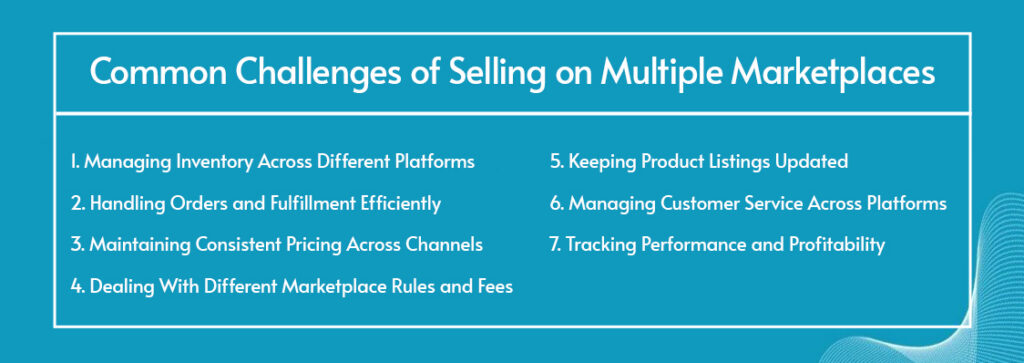
Selling on multiple marketplaces can create more opportunities for growth, but it also comes with challenges like:
1. Managing Inventory Across Different Platforms
One of the biggest challenges of multi channel selling is keeping inventory levels accurate across every marketplace. If inventory is not updated in real time, sellers risk overselling products on one platform while running out of stock on another.
Inventory management becomes even more difficult when you sell high-volume products or seasonal items. Demand can shift quickly between channels, making it harder to forecast stock levels correctly. Using inventory management software that syncs stock across all marketplaces can help reduce manual work and prevent costly errors.
2. Handling Orders and Fulfillment Efficiently
When orders start coming in from multiple marketplaces, fulfillment can quickly become difficult to manage. Sellers often need to coordinate shipments from Amazon, Walmart, Shopify, eBay, and other channels at the same time. Without a clear process, this can create delays, missed orders, and shipping mistakes.
A strong fulfillment system is essential for keeping operations organized. Many sellers use third-party logistics providers or centralized order management tools to streamline fulfillment across channels. This helps ensure that orders are processed quickly, tracking numbers are updated properly, and customers receive their products on time.
3. Maintaining Consistent Pricing Across Channels
Pricing products across multiple marketplaces can be more difficult than it seems. Each platform has different fee structures, shipping costs, and competitive landscapes. A product that is profitable on Amazon may have much lower margins on another marketplace if the pricing is not adjusted correctly.
At the same time, inconsistent pricing can damage customer trust and create marketplace issues. If shoppers see a product listed at very different prices across platforms, it can make your brand look unreliable. Sellers need to regularly review pricing, account for platform-specific fees, and use repricing tools where possible to stay competitive while protecting margins.
4. Dealing With Different Marketplace Rules and Fees
Every marketplace has its own set of rules for sellers, and these requirements can vary significantly. Some platforms have strict policies around shipping speed, return handling, product condition, or customer response times. Failing to follow these rules can result in penalties, listing removals, or account suspensions.
Marketplace fees can also impact profitability more than sellers expect. Referral fees, fulfillment costs, storage charges, advertising spend, and subscription fees all vary by platform. Sellers need to understand the true cost of selling on each marketplace so they can decide where to focus their efforts and which products make the most sense for each channel.
5. Keeping Product Listings Updated
Managing product listings across multiple marketplaces can be time-consuming, especially if you have a large catalog. Product titles, bullet points, descriptions, images, and keywords often need to be customized for each platform. A listing optimized for Amazon may not perform as well on Walmart or Shopify without adjustments.
It is also important to keep listings updated whenever there are product changes, pricing updates, stock changes, or new images. If one marketplace shows outdated information, it can confuse customers and lead to returns or negative feedback.
6. Managing Customer Service Across Platforms
Customer service becomes more challenging when you are selling on several marketplaces at once. Messages, returns, refund requests, and product questions may come through different systems, making it harder to respond quickly and consistently. Delayed responses can hurt customer satisfaction and affect seller ratings.
Each marketplace also has different expectations for response times and return policies. Sellers need to stay organized and make sure they are meeting platform requirements while still delivering a positive customer experience.
7. Tracking Performance and Profitability
Measuring performance across multiple marketplaces can be difficult because each platform provides different reporting tools and metrics. Sellers often need to track sales, advertising costs, conversion rates, return rates, and profit margins separately for every channel. Without a clear reporting system, it becomes hard to understand what is actually driving growth.
Profitability is especially important because not every marketplace will deliver the same return. Some channels may generate high sales volume but lower margins, while others may bring in fewer orders but stronger profits. Regularly reviewing performance data helps sellers identify which marketplaces deserve more investment and which ones may not be worth the effort.
Major Channels Amazon Sellers Should Consider in 2026
The multi-channel retail landscape has evolved far beyond Amazon into a diverse ecosystem where sellers can reach customers across marketplaces. For brands already selling on Amazon, expanding into additional channels creates new ways to capture demand and build a stronger business overall.
These are major sales channels that Amazon sellers should consider:
Walmart
Walmart has become one of the strongest alternatives for Amazon sellers looking to expand their reach. The platform attracts millions of shoppers who are focused on value, convenience, and fast shipping. For sellers in categories like household goods, grocery, beauty, personal care, and everyday essentials, selling on Walmart can offer strong conversion potential with less competition than Amazon.
One major advantage is Walmart Fulfillment Services, which provides storage, packing, shipping, and fast delivery similar to Amazon FBA. However, Walmart is more selective about which sellers it approves, and pricing rules are stricter. Sellers need competitive pricing, reliable fulfillment, and strong operational performance to succeed on the platform.
Shopify
Shopify gives Amazon sellers the ability to build their own branded website and create a more direct relationship with customers. Unlike Amazon, where the marketplace controls most of the customer experience, Shopify allows you to own your email list, retargeting campaigns, customer data, and loyalty programs.
For sellers who want to reduce dependence on Amazon, Shopify can become an important long-term growth channel.
TikTok Shop and Instagram Shops
TikTok Shop and Instagram Shops are changing the way consumers discover products. Instead of searching for products directly, shoppers often come across items through influencers, short-form videos, customer content, or social ads. This makes these channels especially valuable for visually appealing, trend-driven, or impulse-purchase products.
For Amazon sellers, social commerce can work as both a sales channel and a brand awareness tool. Viral content can drive traffic directly to Amazon listings, improve branded search volume, and increase overall demand.
eBay
eBay remains a strong platform for sellers in categories that do not always perform as well on Amazon. Refurbished electronics, automotive parts, vintage products, collectibles, secondhand items, and niche categories often do particularly well on eBay because buyers are more focused on value, and unique inventory.
Unlike Amazon, eBay shoppers are usually willing to spend more time reviewing product details and comparing offers. This gives sellers more flexibility in how they position used, refurbished, or specialized products.
6 Steps to Build Your Amazon Multi-Channel Selling Strategy
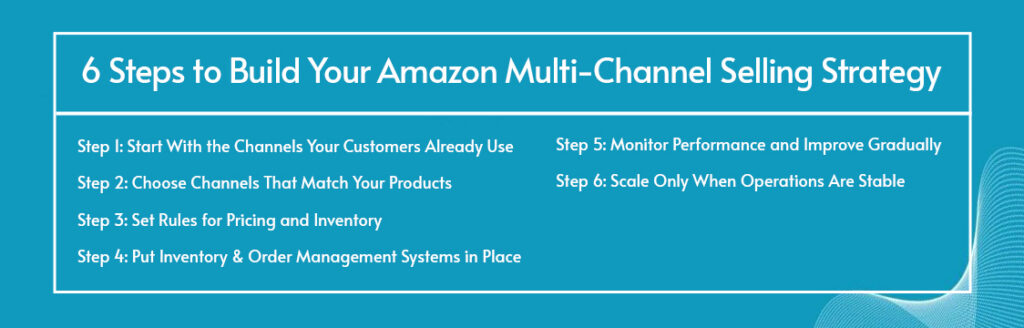
Building a multi-channel selling strategy is not about being everywhere at once. The goal is to expand in a way that increases sales without creating inventory, fulfillment, or operational issues.
Step 1: Start With the Channels Your Customers Already Use
Focus first on the platforms where your target audience already shops. If most of your current sales come from Amazon, consider adding one complementary channel such as your own website, Walmart, Etsy, or social commerce platforms before expanding further.
Step 2: Choose Channels That Match Your Products
Different products perform better on different marketplaces. Visually appealing products often do well on Instagram, TikTok, and Pinterest, while practical everyday products may perform better on Amazon, Walmart, or eBay. Prioritize channels that naturally align with your product type and customer behavior.
Step 3: Set Rules for Pricing and Inventory
Before expanding, create clear guidelines for pricing, stock allocation, discounts, and promotions across all channels. Consistent pricing and accurate inventory help avoid overselling, customer confusion, and pricing conflicts between marketplaces.
Step 4: Put Inventory and Order Management Systems in Place
Manual inventory tracking becomes difficult as you add more channels. Use inventory and order management tools to keep stock levels, product data, and orders synchronized across all marketplaces. This reduces errors and helps you avoid stockouts or duplicate sales.
Step 5: Monitor Performance and Improve Gradually
After launching on a new channel, review performance regularly. Track sales, returns, fulfillment issues, customer feedback, and advertising results. Use this data to improve listings, refine pricing, and decide whether the channel is worth further investment.
Step 6: Scale Only When Operations Are Stable
Expand to additional channels only after your existing processes are working smoothly. Once inventory updates, fulfillment, customer service, and reporting are under control, it becomes much easier to grow without creating unnecessary risk.
Conclusion
In 2026, multi-channel selling is no longer optional for Amazon sellers who want to build a stronger and more stable business. While Amazon remains an important sales channel, relying on one marketplace alone limits your growth potential and increases your exposure to risk. Expanding to platforms like Walmart, Shopify, TikTok Shop, Instagram Shops, and eBay allows you to reach more customers, diversify revenue, and strengthen your brand presence across the market.
At the same time, successful multi-channel selling requires the right strategy. If you need expert assistance to execute the right multi channel ecommerce strategy, you can reach out to us. Prime Retail Solutions as an Amazon growth agency helps sellers expand beyond Amazon. Contact us now for expert help!
Frequently Asked Questions
What is multi-channel selling?
Multi-channel selling is the process of selling products across multiple platforms instead of relying on one marketplace. For Amazon sellers, this can include Amazon, Walmart, Shopify, eBay, TikTok Shop, Instagram Shops, and a brand’s own website.
Why is multi-channel selling important for Amazon sellers?
Multi-channel selling helps Amazon sellers reduce dependence on a single marketplace, reach more customers, increase revenue opportunities, and protect their business from risks like account suspensions, fee increases, or ranking changes.
Which marketplaces should Amazon sellers consider in 2026?
Amazon sellers should consider expanding to platforms such as Walmart, Shopify, eBay, TikTok Shop, Instagram Shops, and Etsy depending on their product category, audience, and growth goals.
Can multi-channel selling increase revenue?
Yes. Multi-channel selling can significantly increase revenue because it gives sellers access to more customers and more sales opportunities. Research shows that multi-channel selling can increase revenue by as much as 38% with one additional channel, 120% with two additional channels, and 190% with three additional channels.
How do sellers manage inventory across multiple channels?
Most sellers use inventory management software that syncs stock levels across all marketplaces in real time. This helps prevent overselling, stockouts, canceled orders, and inventory errors.
Share