Amazon Brand Protection Strategies for 7-Figure Sellers
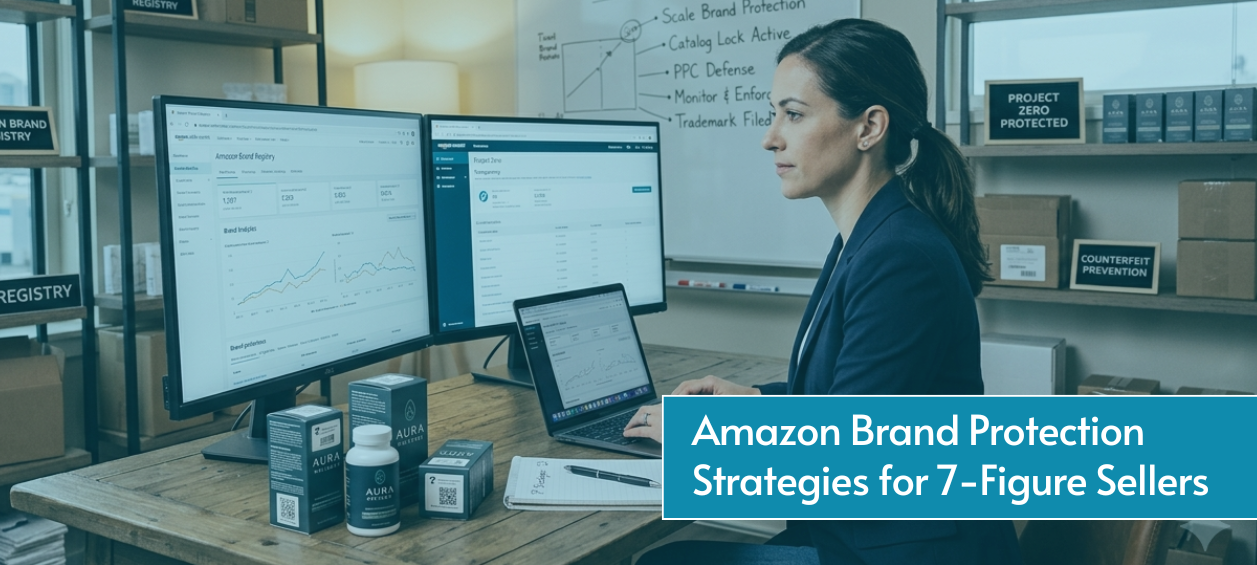
Crossing seven figures on Amazon is a milestone worth celebrating, but it changes the risks your brand faces. The same sales velocity and visibility that got you here also put your listings on the radar of counterfeiters, hijackers, and competitors looking to siphon off some of your traffic.
Crossing seven figures on Amazon is a milestone worth celebrating, but it changes the risks your brand faces. The same sales velocity and visibility that got you here also put your listings on the radar of counterfeiters, hijackers, and competitors looking to siphon off some of your traffic. At lower revenue, these threats are often minor annoyances. At scale, they can quietly erode margin, damage reviews, and put your Buy Box at risk before you even notice.
This is exactly why Amazon brand protection stops being optional once a brand reaches this stage. The question isn't whether you'll encounter a counterfeit listing, an unauthorized reseller, or a hijacking attempt. It's whether you'll have the systems in place to catch it early and shut it down before it affects your bottom line. If you've been wondering how to protect your brand on Amazon as your catalog and sales grow, this guide walks through the strategies that actually hold up at scale.
The Threats Most Brands Actually Face
Success on Amazon attracts attention, and not all of it is good. As a brand grows, it tends to face a fairly consistent set of threats.
Counterfeit products are the most damaging. Bad actors copy your packaging, branding, or product design and sell inferior versions under your listing, which leads to poor reviews and customer complaints that you have no control over.
Unauthorized resellers list your products outside your approved distribution, often undercutting your pricing. This erodes your margins, destabilizes your Buy Box, and can make your brand look inconsistent to shoppers comparing prices across multiple sellers.
Listing hijacking happens when someone alters your product titles, images, or descriptions, sometimes to redirect traffic to a different product or to intentionally damage your conversion rate.
Fake reviews work in both directions: competitors post fraudulent negative reviews on your listings to deter buyers, or fabricate positive reviews on their own listings to compete unfairly against yours.
Branded keyword bidding is a subtler threat. Competitors bid on your brand name in PPC campaigns, hoping to intercept shoppers who are already searching for you specifically.
None of these threats disappears as you grow. If anything, higher visibility and higher sales volume make your brand a more attractive target, which is why brand protection on Amazon needs to scale alongside your catalog rather than staying an afterthought.
Amazon Brand Registry: The Foundation Every 7-Figure Seller Needs
If you haven't enrolled in Amazon Brand Registry yet, this is the starting point for every other strategy in this guide. Without it, you don't have access to the reporting tools, content controls, or advanced protection programs that everything else depends on.
Enrollment requires an active or pending trademark that matches your brand name as it appears on your listings. Once approved, Brand Registry gives you access to infringement reporting tools, Brand Analytics, A+ Content, and eligibility for programs like Project Zero, Transparency, and Brand Gating.
If your trademark is still pending, Amazon's IP Accelerator program can help you access Brand Registry benefits faster by connecting you with vetted IP law firms. For a 7-figure brand, filing early matters: the gap between launching a product and securing trademark protection is often when brands are most exposed, since none of the enforcement tools below are available until registration is complete.
Locking Down Listings: Brand Catalog Lock and Content Control
Once you're enrolled in Brand Registry, one of the most underused protections is Brand Catalog Lock. This feature locks your product titles, images, and descriptions so that only authorized representatives can modify them.
Without this kind of lock, any seller with access to your listing, whether through legitimate co-selling arrangements or hijacking attempts, can alter your content. A changed title or swapped image might seem minor, but it can tank your conversion rate or create confusion that takes days to resolve, especially across a catalog with dozens of active ASINs.
For brands managing a large catalog, locking content isn't just a defensive move. It also protects the investment you've made in optimized titles, professional images, and conversion-tested copy, ensuring that work doesn't get undone by someone else's edits.
Stopping Counterfeits Before They Reach Customers: Transparency and Project Zero
Two of Amazon's most effective tools work together to stop counterfeits at different points in the process.
Transparency assigns a unique serial code to every unit you sell, which gets scanned during fulfillment, whether you use FBA or ship orders yourself. If a unit doesn't have a valid code, it won't pass the check, which stops counterfeit products from reaching customers in the first place. Customers can also scan the code through Amazon's app to verify authenticity themselves, adding a layer of trust to every purchase.
Project Zero takes a different approach: instead of preventing counterfeits before fulfillment, it lets you remove counterfeit listings yourself, instantly, without waiting on Amazon's investigation team. This self-service removal is one of the most powerful tools available, but it's typically reserved for brands with a strong track record of accurate reporting, since Amazon trusts established brands to use this authority responsibly.
Used together, Transparency stops counterfeit units physically, while Project Zero gives you the speed to remove fraudulent listings the moment you spot them. For a brand selling at volume, that combination matters far more than relying on manual reporting alone.
Controlling Distribution: Brand Gating and Managing Unauthorized Sellers
Brand Gating restricts who can list your ASINs in the first place. Once your products are gated, new sellers must request approval or provide invoices proving they're authorized to sell your inventory, which keeps unauthorized resellers from listing alongside you without your knowledge.
Gating solves part of the problem, but it doesn't eliminate the need for ongoing vigilance. Unauthorized sellers can still slip through, particularly if your invoicing requirements aren't strict or if a seller acquires your product through gray-market channels.
Warning signs to watch for include new sellers appearing on your listings without notice, sudden price drops that don't match your pricing strategy, and unexplained shifts in who's winning the Buy Box. When you spot a suspicious seller, placing a test order is one of the most reliable ways to confirm whether the units they're shipping are genuine or counterfeit before you escalate a report.
Monitoring at Scale: Why Manual Checks Break Down at High Volume
For a brand with a handful of ASINs, checking each listing manually for new sellers, content changes, and pricing shifts is realistic. For a 7-figure brand with dozens or hundreds of active listings across multiple marketplaces, it isn't.
This is where most growing brands fall behind on Amazon brand protection, not because they don't know the threats exist, but because manual monitoring simply can't keep pace with catalog size. A hijacked listing or unauthorized seller can sit unnoticed for days if you're relying on spot-checks rather than systematic monitoring.
Automated monitoring tools solve this by continuously scanning your catalog for the same warning signs you'd otherwise have to check manually: new sellers, content edits, Buy Box changes, and pricing anomalies. Amazon Brand Analytics search term reports are also worth reviewing regularly, since a spike in your brand name appearing alongside terms like "fake," "counterfeit," or "authentic" is often an early signal that something is wrong before it shows up in your reviews.
Review sentiment is another early warning sign worth tracking deliberately. A sudden cluster of complaints about quality or authenticity, especially on a listing that previously had a clean review history, often points to a counterfeit or unauthorized unit slipping into the supply chain.
Defending Brand Equity Beyond the Listing: PPC Bidding Defense and Legal/IP Enforcement
Brand protection on Amazon doesn't stop at your product pages. Two other fronts matter just as much at scale.
PPC bidding defense. When competitors bid on your branded keywords, they're trying to intercept shoppers who already searched for you by name. Defending against this usually means adjusting your own bidding strategy to maintain top placement on your branded terms, running Sponsored Brands campaigns that reinforce your storefront presence, and monitoring search term reports for unusual competitor activity tied to your brand name.
Legal and IP enforcement. This extends beyond what Amazon's internal tools can do. A registered trademark gives you the standing to pursue takedowns or legal action against infringement that happens outside Amazon's marketplace entirely, while amazon copyright brand protection specifically covers unauthorized use of your product images, listing copy, and other original content that competitors copy directly. For utility patents, Amazon's Patent Evaluation Express program offers a faster, lower-cost alternative to litigation, using neutral third-party evaluators to determine infringement.
When a hijacker or counterfeiter doesn't respond to standard reporting and warnings, this is typically the point where working with a legal partner or IP attorney becomes necessary. Amazon's internal tools handle most cases, but persistent bad actors sometimes require enforcement that goes beyond what Seller Central can resolve on its own.
Building a Proactive, Layered Brand Protection System
The brands that handle this well don't rely on a single tool. They layer Brand Registry, Catalog Lock, Transparency, Project Zero, Gating, consistent monitoring, and legal backstops into one connected system, where each piece covers a gap the others don't.
A practical structure looks like this:
Stage one: trademark and Brand Registry. Registration comes first, since nothing else is accessible without it.
Stage two: Catalog Lock and Transparency. These secure your listings and your physical supply chain.
Stage three: Brand Gating and Project Zero. These add enforcement authority once your reporting accuracy has established trust with Amazon.
Stage four: ongoing monitoring. Ideally, automated once your catalog grows past what you can check manually, this ties everything together by catching problems early.
Stage five: legal and PPC defenses. These sit on top, handling the threats that fall outside Amazon's internal systems entirely.
This isn't a one-time setup. As your catalog grows, your marketplaces expand, or your product line attracts more competition, the system needs regular review. Brands that treat Amazon brand protection as an ongoing discipline, rather than a checklist completed once, are consistently the ones that catch problems in days instead of weeks.
Conclusion
Reaching seven figures on Amazon means your brand has earned real visibility, but that visibility cuts both ways. The strategies that protect smaller sellers from occasional issues aren't built for the scale and persistence of threats that established brands face. A layered approach, trademark protection, Brand Registry, Catalog Lock, Transparency, Project Zero, Gating, consistent monitoring, and legal enforcement when needed, is what actually holds up as your catalog and sales volume grow.
Building and maintaining that system across a large, active catalog is where Prime Retail Solution's experience as a 3P marketplace partner adds real value. We help growing brands implement and manage brand protection alongside the operational and advertising work that keeps your Amazon business healthy, so threats get caught early instead of being discovered after the damage is done. If you're ready to put a proactive brand protection system in place, get in touch with our team.
FAQs
What is Amazon's brand protection?
Amazon brand protection refers to the combination of strategies, tools, and enforcement processes brands use to prevent counterfeit products, control unauthorized sellers, and safeguard their intellectual property on the platform.
How do I start protecting my brand on Amazon if I haven't registered yet?
Start with trademark registration, since it's required for Amazon Brand Registry enrollment. If your trademark is still pending, Amazon's IP Accelerator program can help you access Brand Registry benefits sooner by connecting you with approved IP law firms.
Does Amazon's brand protection cover copyright issues, or just trademarks?
Both. Amazon copyright brand protection specifically addresses unauthorized use of your original content, such as product images, descriptions, and listing copy, while trademark protection covers your brand name, logo, and related identifiers.
At what point should I switch from manual monitoring to automated tools?
Most sellers find manual checks become unreliable somewhere around 20 ASINs, particularly if you're selling in more than one marketplace. Past that point, automated monitoring catches issues far faster than periodic manual reviews.
Can I stop competitors from bidding on my branded keywords?
You can't prevent competitors from bidding on your brand name entirely, but you can defend against it by maintaining strong placement on your own branded campaigns and running Sponsored Brands ads that reinforce your storefront presence in those search results.
What's the difference between Brand Gating and Brand Registry?
Brand Registry gives you control over your listing content and access to Amazon's reporting and protection tools. Brand Gating specifically restricts which sellers can list your ASINs, requiring unauthorized sellers to request approval or provide proof of authorization before they can sell alongside you.
More from
the brief.
Marketing Strategies to Build Brand Awareness in New Amazon Regions
Expanding into new Amazon regions presents both opportunities and challenges for established brands. While Amazon provides access to a vast customer base, entering a new marketplace requires a solid…
Read article →
Mother’s Day Bundling Tactics That Boost AOV and Retention for Amazon Brands
Why Mother’s Day Bundles Shouldn’t Be an Afterthought Mother’s Day spending hit $35.7 billion last year, and it’s projected to grow. For established Amazon brands, that’s more than just seasonal traf…
Read article →
Should Your Brand Enter Amazon's Emerging Markets? Key Considerations for 2025
Expanding your brand beyond established Amazon marketplaces like the U.S., U.K., or Germany can be a game-changer. With Amazon increasing its presence in high-growth regions such as India, Brazil, an…
Read article →Ready to talk
operations?
Tell us about your marketplace footprint. We'll respond within one business day.
Laguna Beach, CA 92651