Amazon DSP for Mid-Sized Brands: Costs, Benefits, and When to Use It
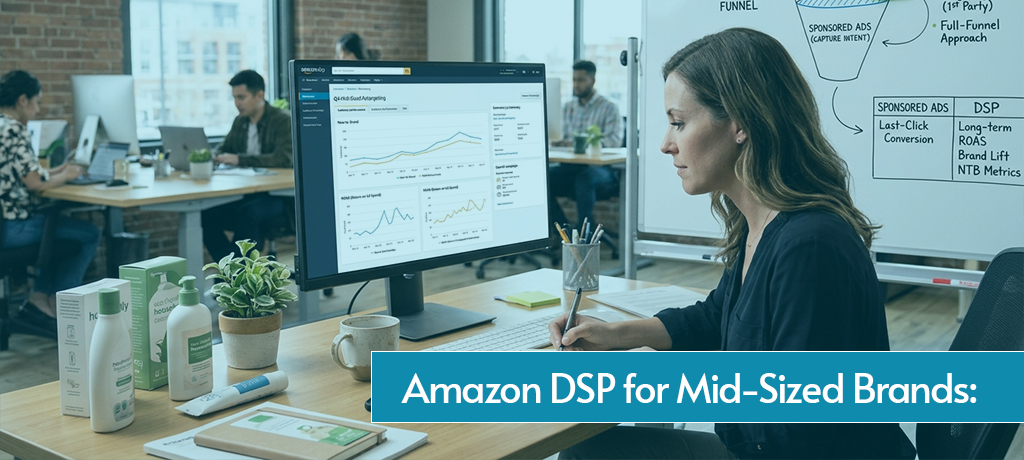
Learn Amazon DSP costs, benefits, and budget requirements for mid-sized brands. Discover when to start, how to retarget shoppers, and measure campaign success.
For years, Amazon DSP carried a reputation as an enterprise-only tool, something reserved for brands with six-figure monthly ad budgets and dedicated media teams. That reputation kept a lot of capable mid-sized brands on the sidelines, assuming DSP simply wasn't built for them.
That assumption is now out of date. As of late 2025, Amazon lowered the barriers to self-service DSP, removing the steep spending minimum that once gated access. Suddenly, Amazon DSP for mid-sized brands isn't a theoretical conversation; it's a practical one, with realistic entry budgets that a growing brand can actually work with.
But accessibility doesn't mean every brand should rush in. DSP is powerful, but it's also easy to waste money on if you start before your foundation is ready or measure it the wrong way. This guide breaks down what Amazon DSP advertising actually is, what it costs now, the benefits it offers mid-sized brands, and most importantly, how to know whether your brand is ready to use it.
What Is Amazon DSP?
Amazon DSP (Demand-Side Platform) is Amazon's programmatic advertising platform. It lets brands buy display, video, and audio ad placements both on Amazon properties and across the wider web, including Prime Video, Twitch, Amazon-owned sites, and third-party apps and websites in Amazon's network.
The defining feature of Amazon DSP advertising is how it targets. Sponsored Products and Sponsored Brands target keywords; they show your ad when someone searches a relevant term. DSP targets audiences, using Amazon's first-party shopping data to reach specific groups of shoppers based on what they've browsed, purchased, and shown interest in. That means you can reach a shopper who viewed your product last week but didn't buy, or a shopper who's been browsing competitor products in your category, even when they aren't actively searching at that moment.
In short: Sponsored Ads meet demand that already exists. DSP creates and re-engages demand, putting your brand in front of the right audiences across their entire journey rather than only at the moment of search.
Amazon DSP vs. Sponsored Ads: The Key Difference
Understanding how DSP differs from Sponsored Ads is essential, because the most common mistake brands make is treating them as competing options when they're actually complementary layers.
Sponsored Ads capture intent. When a shopper searches for a product, Sponsored Products and Sponsored Brands put your listing in front of them at the exact moment they're looking to buy. It's pay-per-click, keyword-driven, and highly efficient at converting active demand. This is the foundation of almost every Amazon advertising strategy, and brands can learn how to leverage Amazon Sponsored Ads to boost profitability before adding DSP to the mix.
DSP builds and re-engages audiences. DSP reaches shoppers across the full journey before they search, while they're comparing options, and after they've visited your listing without buying. It's audience-driven rather than keyword-driven, and it opens up placements Sponsored Ads can't touch, like streaming video on Prime Video and display ads across the web. For a separate advertising format, explore how Amazon Sponsored Display Ads can support product visibility and audience engagement.
They work together, not instead of each other. The brands that get the most from DSP run it on top of a strong Sponsored Ads program, not as a replacement for one. Sponsored Ads convert the shoppers who are ready to buy now; DSP expands your reach to the shoppers who aren't searching yet and re-engages the ones who got away. Trying to use DSP to compensate for weak Sponsored Ads or a poorly converting listing almost always disappoints.
How Much Does Amazon DSP Cost?
Cost is where the most outdated assumptions live, so it's worth being precise.
DSP is priced on CPM. Unlike Sponsored Ads, which charge per click, DSP charges on a CPM basis cost per thousand impressions. You pay for your ads to be shown, whether or not a shopper clicks. This is normal for programmatic display and video advertising, but it's a meaningful mental shift for sellers used to pay-per-click, and it changes how you evaluate performance.
The old minimum that kept mid-sized brands out. Historically, accessing DSP meant going through Amazon's managed service or an agency, which typically required a minimum monthly commitment in the range of $50,000. That floor is what earned DSP its enterprise-only reputation and kept it out of reach for most mid-sized brands.
What changed. As of late 2025, Amazon's self-service DSP no longer carries that steep minimum, which has fundamentally opened the door. Realistic self-service starting budgets now sit in the range of roughly $5,000 to $10,000 per month, a figure a growing mid-sized brand can actually commit to and test with. This single change is why Amazon DSP for mid-sized brands is a live strategy in 2026 rather than an aspiration.
The practical takeaway: DSP still requires a real, sustained budget it isn't a tool to switch on casually, but the entry point is now accessible to brands that are well past startup stage without being enterprise-scale.
Managed Service vs. Self-Service DSP: Which Fits a Mid-Sized Brand?
Amazon DSP comes in two access models, and choosing the right one matters for a mid-sized budget.
Managed service means Amazon's team, or an agency, runs your DSP campaigns for you. It's the higher-commitment path, generally suited to brands spending larger amounts (often $75,000+ in total monthly Amazon ad spend) that want hands-off execution and access to advanced measurement like Amazon Marketing Cloud. The trade-off is the higher spend threshold and less day-to-day control.
Self-service means you or a partner managing your account runs the campaigns directly. With the removal of the old minimum, this is now the realistic entry point for most mid-sized brands. It fits brands with roughly $40,000 to $75,000 in total monthly ad spend who want to start with a focused use case, keep budgets controlled, and scale deliberately.
For most mid-sized brands beginning their DSP journey, self-service run in-house if you have the expertise, or through a partner if you don't offers the right balance of access, control, and cost. Managed service becomes more compelling as your spend and ambitions grow.
The Benefits of Amazon DSP for Mid-Sized Brands
The Amazon DSP benefits that matter most for mid-sized brands cluster around reaching and re-engaging shoppers in ways Sponsored Ads simply can't.
Retargeting non-converters. This is the single most valuable benefit for most brands. DSP can show ads to shoppers who viewed your product detail page but didn't buy a warm audience that already demonstrated interest. Re-engaging those shoppers is often the highest-ROI use of DSP, because you're nudging people who were already close to converting.
New-to-brand customer acquisition. DSP excels at reaching shoppers who've never encountered your brand, using Amazon's audience data to target people whose behavior suggests they'd be interested. This fuels genuine top-of-funnel growth rather than just competing for shoppers who already know you.
Streaming and video reach. DSP unlocks premium placements on Prime Video, Twitch, and other streaming inventory brand-building channels that Sponsored Ads can't access. For mid-sized brands looking to build real brand awareness, not just capture search demand, this is a meaningful expansion of reach.
Competitor conquest defense. DSP lets you reach shoppers browsing competitor products and defend your branded audiences against competitors doing the same to you. It's a way to stay present in the consideration set even when shoppers aren't searching your name.
Audience insights that compound. Running DSP builds a growing understanding of who your customers are and how they behave- insights that sharpen your targeting over time and inform your broader marketing, benefits that keep paying off the longer you run.
Is Your Brand Ready for DSP? A Readiness Checklist
Accessibility isn't the same as readiness. Before committing budget to DSP, work through this checklist honestly.
Your Sponsored Ads are profitable. DSP is a layer on top of a working foundation, not a fix for a broken one. If your Sponsored Products and Sponsored Brands campaigns aren't profitable and well-optimized, that's where your budget belongs first.
Your listings convert well. DSP drives traffic to your product pages, but it can't make a weak listing convert. If your detail pages have thin content, poor images, or weak reviews, fix those before spending on DSP, or you'll be paying to send warm traffic to a page that loses it.
You have enough total ad spend. DSP works best as one layer of a broader advertising program. A common guideline is total monthly Amazon ad spend above roughly $40,000, with DSP taking a measured slice (often 10–15%) rather than dominating the budget. Brands spending well below that are usually better served by strengthening Sponsored Ads first.
You have a specific use case. "We should try DSP" isn't a strategy. "We want to retarget shoppers who viewed our hero product but didn't buy" is. Entering DSP with a clear, specific objective is what separates brands that see results from those that spend and wonder why nothing happened.
If you can check all four boxes, you're in a strong position to start. If you can't, the more valuable move is addressing the gaps first.
When Mid-Sized Brands Should Wait on DSP
Just as important as knowing when to start is recognizing when to hold off. DSP isn't the right move if:
Your advertising funnel has unaddressed waste. If a meaningful share of your Sponsored Ads spend is going to non-converting keywords or poorly targeted campaigns, DSP will amplify that inefficiency rather than solve it. Clean up the funnel first.
Your total ad spend is low. If you're spending well under the rough $40,000 monthly threshold, your dollars will almost always generate a better return by strengthening your Sponsored Ads foundation than by spreading into DSP.
Your category is purely intent-driven. Some product categories are almost entirely about capturing active search demand, with little top-of-funnel or consideration-phase behavior to target. In those cases, the audience-building strengths of DSP deliver less value, and Sponsored Ads may capture nearly all the available opportunity.
Your detail pages don't convert. This bears repeating because it's the most common and costly mistake. DSP sends traffic; your listing has to close the sale. If conversion is the weak point, that's the priority, not DSP.
Waiting isn't a failure; it's often the most financially disciplined decision a mid-sized brand can make.
The Best First Use Case: Why Most Brands Should Start with Retargeting
If your brand is ready for DSP, retargeting is almost always the smartest place to begin.
Here's why: retargeting reaches shoppers who have already visited your product pages but didn't purchase. These are the warmest audiences available people who showed real intent and are statistically far more likely to convert than cold prospects. Starting with retargeting means your first DSP dollars go toward the audience most likely to produce a measurable return, which makes it the lowest-risk, highest-confidence entry point.
Starting here also lets you learn the platform on favorable terms. You build familiarity with DSP's mechanics, measurement, and creative requirements while working with an audience that gives you the best odds of early success. Once retargeting is performing, you can expand deliberately into prospecting, new-to-brand acquisition, and streaming placements the broader, top-of-funnel use cases that take more patience and budget to prove out.
Trying to launch into full-funnel brand awareness as your first DSP move is how many brands burn budget and lose confidence. Retargeting first, then expand, is the proven sequence.
How to Measure DSP Success
Measuring DSP correctly is where many brands go wrong not because DSP underperforms, but because they judge it by the wrong standard.
DSP is measured on ROAS and new-to-brand metrics, not ACoS. Sponsored Ads are typically judged on ACoS (advertising cost of sales) with a tight, last-click lens. DSP, being audience-driven and often top-of-funnel, is measured on return on ad spend and on new-to-brand metrics that capture how many genuinely new customers you're acquiring. Comparing DSP's ROAS to a Sponsored Products ACoS is comparing two different things and will almost always make DSP look worse than it is.
Give it a longer window. DSP works across the customer journey, and much of its impact plays out over days and weeks, not minutes. Judging a DSP campaign on a 7-day last-click window the way you might evaluate a Sponsored Products campaign systematically undercounts its contribution. Plan to evaluate DSP over roughly 30 to 90 days, using multi-touch attribution rather than last-click.
Use Amazon Marketing Cloud where available. For brands that want deeper measurement, Amazon Marketing Cloud (AMC) provides a fuller view of how DSP and Sponsored Ads work together across the customer journey. It's especially valuable as your DSP investment grows and you need to understand the true, blended impact of your advertising rather than siloed channel metrics. For campaigns driving traffic from external marketing channels, Amazon Attribution can help brands measure the impact of their off-Amazon marketing efforts.
The core principle: measure DSP by what it's built to do build audiences, acquire new customers, and re-engage warm shoppers over time not by the immediate-conversion yardstick you use for search ads.
Common Mistakes Mid-Sized Brands Make with DSP
A handful of predictable mistakes account for most DSP disappointment. Avoiding them is often the difference between success and wasted spend.
Starting before Sponsored Ads are profitable. DSP amplifies a working system; it can't rescue a broken one. Build the foundation first.
Comparing DSP ROAS to Sponsored Products ACoS. These are different tools measured in different ways. Holding DSP to a search-ad standard guarantees it looks like it's failing.
Neglecting creative. DSP is a visual, display-and-video medium. Weak creative produces weak results, no matter how good your targeting is. Invest in quality ad creative.
Setting campaigns and forgetting them. DSP rewards ongoing optimization: audience refinement, creative testing, budget reallocation. A set-and-forget approach leaves performance on the table.
Judging too early. DSP's impact builds over weeks. Pulling the plug after a short window, before multi-touch results have materialized, is one of the most common and costly errors.
Using DSP to paper over a slow sales period. DSP is a strategic, long-term investment, not an emergency lever to pull when sales dip. Treating it as a quick fix sets it up to disappoint.
Conclusion
Amazon DSP has crossed an important threshold. What was once an enterprise-only platform, gated behind steep minimums, is now genuinely accessible to mid-sized brands ready to use it well. The audience targeting, retargeting power, streaming reach, and new-to-brand acquisition that DSP offers are no longer out of reach for growing brands but access and readiness aren't the same thing.
The brands that succeed with DSP are the ones that build it on a healthy foundation, start with a focused use case like retargeting, measure it by the right standard, and treat it as the strategic, long-term investment it is. The ones that struggle are usually those that rushed in before their funnel was ready or judged DSP by a search-ad yardstick it was never meant to meet.
Knowing where your brand sits on that spectrum and running DSP alongside Sponsored Ads as one coordinated system rather than disconnected channels is exactly the kind of advertising strategy Prime Retail Solution supports through its PPC management services. If you're weighing whether Amazon DSP is right for your brand, or want a partner to run it alongside the rest of your Amazon advertising, get in touch with our team!
FAQs
What's the difference between Amazon DSP and Sponsored Ads?
Sponsored Ads are keyword-targeted and pay-per-click, showing your product when shoppers actively search. Amazon DSP is audience-targeted and priced on CPM (cost per thousand impressions), reaching shoppers across their journey before, during, and after search using Amazon's first-party data, including on placements like Prime Video that Sponsored Ads can't access.
How much does Amazon DSP cost for a mid-sized brand?
DSP is bought on a CPM basis, so you pay for impressions. The old managed-service minimum (around $50,000/month) kept DSP enterprise-only for years, but self-service access no longer carries that floor. Realistic self-service starting budgets now sit around $5,000 to $10,000 per month, which has made DSP accessible to mid-sized brands.
Do I need to use Sponsored Ads before starting DSP?
Yes, in practice. DSP works best as a layer on top of a profitable, well-optimized Sponsored Ads program. If your Sponsored Ads aren't yet profitable or your listings don't convert well, that's where your budget should go first.
What's the best way for a mid-sized brand to start with DSP?
Retargeting. Reaching shoppers who viewed your product but didn't buy is the warmest, highest-confidence audience available, which makes it the lowest-risk way to begin. Once retargeting performs, expand into prospecting, new-to-brand acquisition, and streaming placements.
How long does it take to see results from Amazon DSP?
Longer than Sponsored Ads. Because DSP works across the customer journey, its impact typically plays out over 30 to 90 days. Judging it on a short, last-click window undercounts its contribution, so plan to evaluate it over a longer period with multi-touch attribution.
Can Amazon DSP run ads off of Amazon?
Yes. One of DSP's key advantages is reach beyond Amazon it can place display and video ads across Amazon-owned properties like Prime Video and Twitch, as well as third-party websites and apps in Amazon's network, all targeted with Amazon's shopper data.
More from
the brief.
3 Essential Tips To Strategically Manage Your Amazon Inventory
Managing your Amazon inventory effectively is essential for every Amazon FBA seller serious about making a living. It helps you avoid two big money-losers: not having enough stock to fulfil orders an…
Read article →
5 Futuristic Trends Reshaping E-Commerce Fulfillment On Amazon
Ecommerce fulfillment, the intricate process that transforms online clicks into delivered packages, is rapidly becoming a top concern for retailers.
Read article →
Amazon's New Product Bundling Policy: What It Means for Sellers
Amazon has introduced a new product bundling policy, creating a significant shift in how brands on the platform can package and promote their items. Product bundling has always been a strategy for se…
Read article →Ready to talk
operations?
Tell us about your marketplace footprint. We'll respond within one business day.
Laguna Beach, CA 92651