Amazon FBA vs 3PL Fulfillment: Which Is More Profitable for Brands in 2026?
Amazon FBA vs 3PL is a hot topic for online sellers trying to choose the right fulfillment partner. A fulfillment service can be a profit lever as it touches conversion rates, return outcomes, storag…
Amazon FBA vs 3PL is a hot topic for online sellers trying to choose the right fulfillment partner. A fulfillment service can be a profit lever as it touches conversion rates, return outcomes, storage cost thus impacting profitability.
Fulfillment decisions are not straightforward anymore as they used to be. Earlier, if you sold on Amazon, you used FBA and if you sold on other e-commerce platforms, you shipped from your location.
But in 2026, brands that sell across multiple channels need faster, more flexible logistics, which makes choosing between Amazon FBA vs 3PL fulfillment a critical profitability decision.
This guide helps you make the right decision with a deep dive into differences between FBA and 3PL. You will learn the difference in terms of cost and operation to choose the best fit for your business.
How Fulfilled By Amazon (FBA) Works?
Amazon FBA (Fulfillment by Amazon) is an in-house Amazon fulfillment service. You as a seller send your inventory to Amazon's warehouse and Amazon handles everything including storage, packaging, shipping, returns and customer service. In exchange, you pay fulfillment, storage, and additional service fees.
When a customer places an order of your product, the Amazon team gets into action by picking the unit from the fulfillment center, packing it, shipping it to the customer, and handling delivery updates, returns, and customer support.
FBA is designed to make selling easier and faster for brands, but the convenience comes with costs. Fulfillment fees and storage charges can significantly impact profit margins.
What is a Third-Party Logistics 3PL?
Third-Party Logistics (3PLs) provider on the other hand is a company that handle storage, packing and shipment of orders across channels. Many 3PLs also handle kitting, bundling, retail compliance, subscription assembly, and returns processing.
You can think of them as an outsourced warehouse team that you fully control. Unlike FBA, their services go beyond Amazon and can support fulfillment for Shopify, Walmart, TikTok Shop, wholesale orders, retail distribution, and direct-to-consumer shipments, all from the same inventory.
Comparing 3PL vs Amazon FBA for E-Commerce Brands
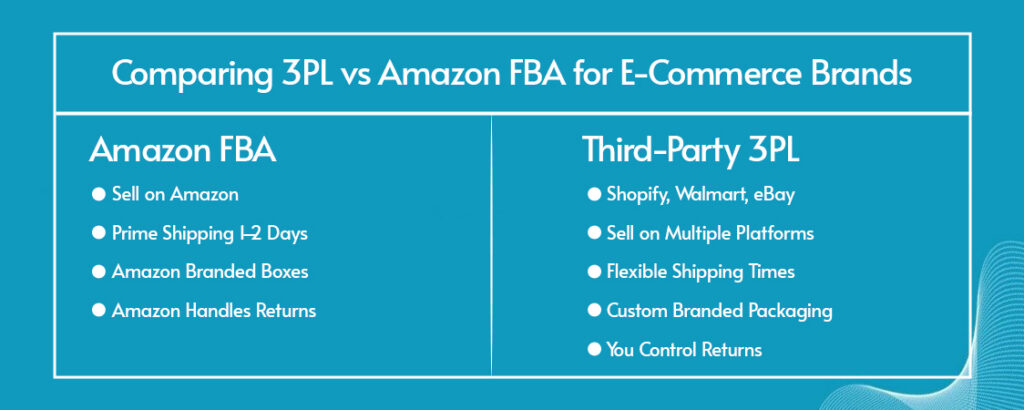
When choosing the right fulfillment method, comparing Amazon FBA vs 3PL side by side can help you see which one fits your business. Each fulfillment option has its own strength and choosing either depends largely on where you sell and how much control you want over the process.
The first difference between the two options starts with platform use. If you are selling on Amazon, FBA is built into Amazon and everything is automated within the Amazon system. But if you use multi channels for selling, 3PL works across many platforms including but not limited to Shopify, Walmart, eBay and many more.
Another big difference in Amazon FBA vs 3PL fulfillment is branding. With FBA, your products are shipped in Amazon boxes which gives you no option for custom touches. This can be important for many sellers. If it is important to you, a 3PL gives you more freedom. You can customize packaging and even add Thank You notes that help you build stronger customer loyalty.
Shipping speed is another noteworthy difference. Amazon has warehouses everywhere, which means your products can reach customers faster. Amazon also offers Prime benefits with shipping in 1-2 days. 3PLs can also offer fast delivery but the shipping time depends on the provider's network.
Customer service is another key factor. Amazon handles returns and customer queries, saving you time. It also means less control. With 3PL on the other hand, you can decide how returns are handled and queries are catered. This gives you more control and allows you to create personal customer experience.
Amazon FBA vs 3PL Cost Comparison
Fulfillment costs are central to determining a business’s profit margin. Higher costs can significantly reduce profitability, so when choosing the right fulfillment strategy, it is essential to evaluate Amazon FBA fees vs 3PL costs 2026.
Amazon FBA includes several core fees, mainly fulfillment fees and storage fees. Fulfillment fee is calculated based on size and weight of each product. The larger or heavier items have higher fees which can impact your profit margins.
Amazon FBA storage fee is another cost factor. These fees are charged monthly based on the volume of inventory stored at Amazon’s fulfillment centers at the end of each month. The typical storage fees can range from $0.50 to $6.90 per cubic foot, depending on the age of the inventory. In addition to basic fulfillment and storage fees, Amazon FBA has several extra costs. Examples include removal fees for unsold inventory, disposal fees per unit, and returns processing fees.
3PL comes with a different approach in terms of cost structure. Unlike Amazon FBA’s fixed costs, 3PLs typically offer customizable logistics solutions with flexibility for sellers to negotiate on pricing. Specialized 3PL providers often offer transparent and flexible pricing structures. In terms of storage fee 3PL providers can offer lower storage fees without penalties like FBA’s, which is particularly beneficial for long-term warehousing. This makes 3PL the best choice to reduce cost and boost efficiency.
Key Factors Influencing Amazon Fulfillment vs Third Party Logistics Decision
The choice between Amazon FBA vs 3PL fulfillment heavily depends on businesses specific needs and goals. These factors play a critical role in determining which option is best for your business.
Business Size and Order Volume
For businesses with high sales volume, Amazon FBA is a smart choice for its efficiency to handle large orders. Amazon’s fulfillment network is designed to process high order volume quickly, making it easier for growing brands to scale with ease.
On the other hand, 3PL providers offer more customized solutions for businesses that need flexibility. They are often a better fit for brands selling across multiple channels or handling large, bulky, or specialized products that require more control over the fulfillment process.
Brand Control and Customization
Brand control and customization are critical for businesses looking to establish a unique identity and enhance customer experience. Amazon FBA limits branding options. 3PL on the other hand offers customization capabilities. This control can impact customer relationships and loyalty as 50% of online shoppers are likely to make a repeat purchase based on positive unboxing experiences.
Businesses prioritizing brand experience may find choosing a 3PL provider advantageous. They allow custom packaging inserts like hand written notes or coupons providing greater control over customer interactions.
International Shipping Needs
International shipping can influence the Amazon FBA vs 3PL decision, especially for brands selling in multiple countries. Amazon FBA makes global fulfillment easier by using its international warehouse network, allowing faster delivery and Prime eligibility in different regions, but fees and storage costs can increase when inventory is spread across countries.
A 3PL is often better for brands that need more control over cross-border shipping and inventory. Many 3PL providers support multi-channel and international orders from one location, which can reduce storage costs and simplify operations, though delivery speed may not always match FBA.
Conclusion
Both Amazon FBA and 3PL providers offer unique advantages and cost structures that can benefit ecommerce businesses in different ways. When comparing outsource fulfillment vs Amazon FBA, think about where you sell, how much control you want, and what your goals are. Both are great but one may fit your business better.
Our guide provides insights that you need to make the right choice so that your fulfillment strategy is directed towards growth. If you are looking for expert advice, you can contact us to get connected with our 3P marketplace service providers.
Frequently Asked Question
Is Amazon FBA worth it for brands?
Yes, Amazon FBA is worth it for many brands because it offers Prime eligibility, fast shipping, and higher conversion rates. It works best for small to medium-sized products with strong margins and consistent sales, but fees can reduce profit for oversized or slow-moving inventory.
When should brands switch from FBA to 3PL?
Brands usually consider switching to 3PL when FBA storage fees become too high, products are bulky, or they start selling on multiple channels. Many growing brands move to a hybrid model where FBA is used for fast-moving SKUs and 3PL is used for storage and multi-channel fulfillment.
What is the best fulfillment option for Amazon sellers?
There is no single best option. FBA is better for conversion and fast delivery, while 3PL is better for cost control and flexibility. Most scaling sellers use a mix of FBA and 3PL to balance profit, speed, and inventory management.
What is the best fulfillment strategy for scaling ecommerce brands?
Scaling ecommerce brands often use a hybrid fulfillment strategy. FBA is used for high-volume products to maintain Prime shipping, while a 3PL handles bulk storage, oversized items, and orders from Shopify, Walmart, or wholesale channels. This setup helps control costs while supporting growth.
Can brands use FBA and 3PL together?
Yes, many brands use FBA and 3PL together to balance conversion and cost. FBA is used for fast-moving products to keep Prime eligibility and high conversion rates, while a 3PL is used for bulk storage, oversized items, and multi-channel orders. This hybrid fulfillment strategy is common for scaling ecommerce brands because it helps you expand your operations without compromising profit margins.
Ready to talk
operations?
Tell us about your marketplace footprint. We'll respond within one business day.
Laguna Beach, CA 92651