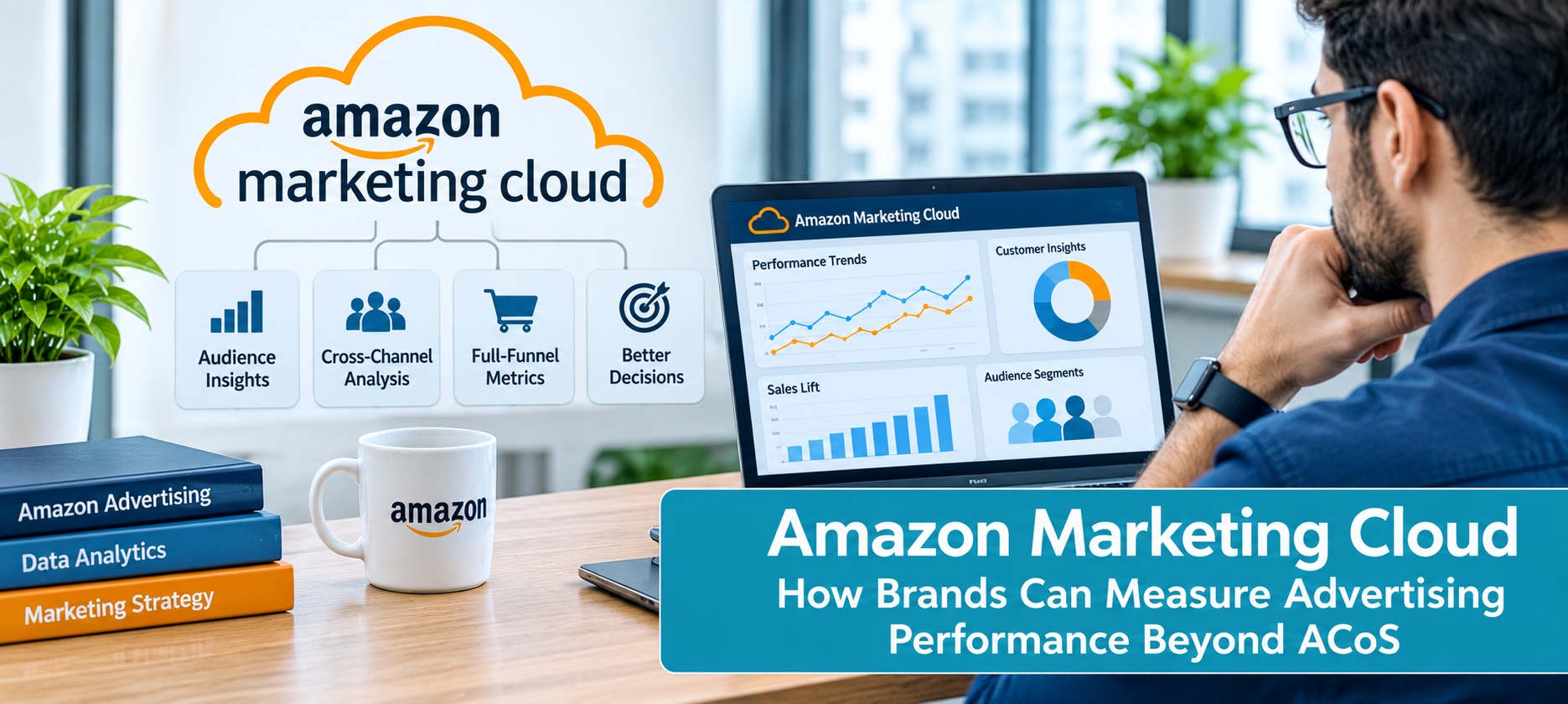
Amazon Marketing Cloud: How Brands Can Measure Advertising Performance Beyond ACoS
Most Amazon brands judge their advertising the same way: open the campaign dashboard, check ACoS, and decide whether a campaign is working. Low ACoS means good. High ACoS means cut it back.
The problem is that ACoS only sees a narrow slice of what your advertising actually does. It gives each sale to the last ad a shopper clicked, treats every campaign as if it worked alone, and has no way to show the awareness ad that introduced a shopper to your brand two weeks before they bought. Judged by ACoS alone, some of your most valuable campaigns can look like your worst ones.
Amazon Marketing Cloud (AMC) exists to fill that gap. It lets brands see how shoppers actually interact with their ads across the full journey, from first exposure to purchase and beyond. And it's no longer a tool reserved for enterprise brands with data science teams. Recent changes have opened it to any brand running Sponsored Ads and made it usable without writing code.
This guide explains what AMC is, what it can measure that ACoS can't, how to get started, and what to watch out for.
What Is Amazon Marketing Cloud?
Amazon Marketing Cloud is a secure, cloud-based data clean room built by Amazon Ads. It gives brands access to detailed advertising and shopping data that standard campaign reports don't show, while protecting shopper privacy.
The key difference from regular reporting is the level of detail. Standard reports in the Amazon Ads console show summarized results: impressions, clicks, spend, and attributed sales for each campaign. AMC works with event-level data. Each ad impression, click, and purchase is recorded as an individual event and linked to a pseudonymized identifier, so you can see sequences of events rather than isolated totals.
That's what makes journey analysis possible. If a shopper saw a Sponsored Display ad on Monday, clicked a Sponsored Brands ad on Thursday, and bought through a Sponsored Products ad the following week, AMC can connect those touchpoints. Standard reporting would give all the credit to the final Sponsored Products click.
Privacy is built in. AMC never shows information about individual shoppers. Every result is aggregated, and results that would describe too few people are suppressed. Brands get insight into patterns across groups of shoppers, never into any one person's behavior.
Why ACoS Isn't Enough: The Limits of Standard Campaign Reporting
ACoS is a useful metric for tuning individual campaigns. But as a measure of overall advertising performance, it has real blind spots.
1: It relies on last-click attribution: Standard Amazon reporting credits a sale to the last ad the shopper engaged with before buying. Every ad that came before, the one that introduced the shopper to your brand or reminded them of it, gets no credit. Over time, this systematically favors bottom-of-funnel campaigns and undervalues everything else.
2: It reports campaigns in silos: Each campaign's ACoS is calculated on its own, as though it had no influence on any other campaign. In reality, campaigns work together. A Sponsored Brands video campaign might be driving shoppers who later convert through a branded Sponsored Products search, but the reporting will never show that connection.
3: It makes upper-funnel ads look worse than they are: Awareness-focused campaigns, like Sponsored Display, Sponsored TV, or DSP, often reach shoppers early, long before they're ready to buy. These campaigns tend to show high ACoS in standard reports because the eventual sale is credited elsewhere. Brands that cut them based on ACoS can end up shrinking the pool of shoppers who later convert through their search campaigns.
4: It can't tell you whether ads caused the sale: A low ACoS on a branded keyword campaign might mean the campaign is efficient. Or it might mean you're paying for clicks from shoppers who were already going to buy from you anyway. ACoS can't distinguish between the two.
5: It says nothing about who's buying: ACoS doesn't tell you whether your ads are bringing in new customers or re-selling to existing ones, or whether those customers come back to buy again.
None of this means ACoS is useless. It means ACoS answers a narrow question, and brands need a different tool to answer the bigger ones.
What Data Lives Inside AMC
AMC pulls together signals from across your Amazon advertising:
- Sponsored Ads: Sponsored Products, Sponsored Brands, Sponsored Display, and Sponsored TV
- Amazon DSP: display, video, and audio campaigns, for brands running DSP
- Streaming TV: ad exposure on Amazon's streaming inventory
- Shopping and conversion events: detail page views, add-to-carts, and purchases linked to ad exposure
A few practical details worth knowing:
History. When your AMC instance is created, it backfills historical data, typically up to about 25 months. That means you can analyze past performance from the start rather than waiting to build up data.
Data lag. New data usually arrives in AMC within 24 to 48 hours. AMC isn't built for real-time monitoring; it's built for analysis over meaningful time periods.
Your own data. AMC also allows brands to bring in their own first-party data, which can be combined with Amazon's signals for deeper analysis. This is typically more relevant for larger brands with established data operations.
What's Changed: AMC Is Now Accessible to Far More Brands
For most of its history, AMC had a reputation as a tool for large brands. Access was effectively tied to Amazon DSP, and getting value from it meant writing SQL queries. Many mid-sized brands assumed it simply wasn't for them. That's no longer accurate.
AMC is open to Sponsored Ads advertisers. In September 2025, Amazon made AMC available to all advertisers running Sponsored Products, Sponsored Brands, Sponsored Display, or Sponsored TV campaigns. You can find it under "Measurement & Reporting" in the Amazon Ads console. A brand that only runs Sponsored Ads can now use AMC directly.
No-code templates. The AMC homepage now includes no-code analysis templates that produce visualized insights on topics like campaign performance and audiences. These give brands a practical way to start using AMC without writing a single query.
The Ads Agent answers questions in plain English. Announced at Amazon's unBoxed conference in November 2025, the Ads Agent for AMC lets you describe what you want to know in plain language. It then generates the SQL query for you. You can review and refine the query before running it, and the agent also helps with building audiences and explains AMC's datasets and features. Anyone with AMC access can use it through the "Ask AI for AMC help" option in the AMC navigation.
SQL is still there when you need it. For custom analysis, AMC still offers a query editor and a library of pre-built use cases. Brands with analysts, or working with a partner, can go as deep as they want.
The result is that AMC has gone from a specialist tool to something most brands actively advertising on Amazon can use.
Key Ways to Measure Performance Beyond ACoS with AMC
This is where AMC earns its place. Each of these analyses answers a question that standard campaign reporting can't.
Path to Purchase and Multi-Touch Attribution
AMC can show the sequence of ad touchpoints shoppers encounter before they buy. You can see which combinations of ad types appear most often in converting journeys, how many touchpoints a typical purchase involves, and how long the path from first exposure to purchase usually takes.
This gives you a far more accurate picture of how your campaigns work together. You might discover, for example, that shoppers who see both a Sponsored Brands ad and a Sponsored Products ad convert at a much higher rate than those who see only one. That kind of insight changes how you allocate budget across campaign types, rather than judging each one on its own ACoS.
New-to-Brand Customer Acquisition
AMC can show whether your advertising is bringing in customers who have never bought from your brand before, or mostly re-selling to existing customers. Both have value, but they serve different purposes, and a campaign with a great ACoS that only converts existing customers isn't growing your brand.
Understanding new-to-brand performance by campaign type helps you see which campaigns are actually expanding your customer base. Upper-funnel and category-level campaigns often perform much better on this measure than their ACoS would suggest.
Upper-Funnel Impact
AMC lets you measure how awareness-focused advertising contributes to later conversions. You can compare shoppers who were exposed to your upper-funnel ads with those who weren't, and see how their likelihood of searching for your brand, viewing your products, or buying differs. Tracking Brand Impression Share on Amazon provides another way to understand how much visibility your brand captures in relevant shopper searches.
This is often the analysis that changes a brand's mind about campaigns that looked unprofitable on ACoS. A campaign using Amazon Sponsored Display ads or Sponsored TV may have a high standalone ACoS while still increasing branded search and conversions elsewhere in your account.
Incrementality
Incrementality asks the hardest question in advertising: which sales happened because of your ads, and which would have happened anyway? AMC supports this kind of analysis, including comparisons using holdout groups that weren't exposed to certain ads.
This is especially useful for branded search campaigns, where low ACoS can hide the fact that many of those shoppers were already intending to buy from you. Knowing true incrementality helps you put budget where it actually drives additional sales.
Repeat Purchases and Customer Value Over Time
AMC can show how customers behave after their first purchase: whether they buy again, how often, and how that differs depending on which ads brought them in. Some campaigns may attract customers who buy once, while others bring in customers who keep coming back.
For brands selling consumable or replenishable products, this is especially valuable. A campaign that looks expensive on first-purchase ACoS may be one of your best investments once repeat purchases are taken into account.
Building Custom Audiences with AMC
Beyond measurement, AMC lets you build custom audiences based on shopper behavior and use them in your advertising. A few common examples:
- Product page viewers who didn't buy: shoppers who showed interest but didn't convert, a strong retargeting audience
- Lapsed buyers: past customers who haven't purchased in a while, especially useful for replenishable products
- Shoppers exposed to upper-funnel ads: people who've already seen your brand and may be ready for a more direct message
- High-value customers: shoppers who purchased multiple times, useful for loyalty messaging or finding similar audiences
Custom audiences turn AMC from a reporting tool into an active part of your advertising strategy. Instead of targeting broadly, you can reach groups of shoppers based on what they've actually done. Keep in mind that audiences must meet minimum size requirements before they can be activated.
ACoS vs. AMC Metrics: What Each One Tells You
| Question | What ACoS Tells You | What AMC Can Tell You |
|---|---|---|
| Is this campaign efficient? | Ad spend relative to attributed sales | Same, plus how the campaign contributes to sales credited elsewhere |
| How do campaigns work together? | Nothing; each campaign is reported alone | Which combinations of ad touchpoints lead to purchases |
| Are upper-funnel ads working? | Usually makes them look unprofitable | How exposure affects later searches, views, and purchases |
| Are we reaching new customers? | Not shown | New-to-brand performance by campaign type |
| Did the ads cause the sale? | Not shown | Incrementality analysis, including holdout comparisons |
| Do customers come back? | Not shown | Repeat purchase behavior by acquisition source |
| Who should we target next? | Not shown | Custom audiences based on real shopper behavior |
ACoS remains the right tool for day-to-day campaign management, like adjusting bids and pruning keywords. AMC is the right tool for deciding how your overall advertising strategy should be structured. Alongside AMC, tracking the essential metrics for every Amazon brand owner can provide a broader understanding of account performance and business health.
How to Get Started with AMC, Step by Step
Step 1: Confirm Your Access
Log in to the Amazon Ads console and look for AMC under "Measurement & Reporting." If you're running Sponsored Ads, you should be able to access it. If you don't see it, check with your Amazon Ads account representative or support.
Step 2: Let Your Instance Populate
Once your AMC instance is set up, it fills with your advertising data automatically, including historical data. You don't need to upload anything to get started.
Step 3: Start with No-Code Templates
Begin with the pre-built analysis templates on the AMC homepage. They're the fastest way to get useful insights and learn what AMC can show you. A new-to-brand analysis and a path-to-conversion analysis are both good first choices.
Step 4: Ask Questions with the Ads Agent
Once you have a sense of what's possible, use "Ask AI for AMC help" to ask your own questions in plain language. Review the query it generates, adjust it if needed, and run it.
Step 5: Use Meaningful Date Ranges
Analyze at least 30 days of data for journey and new-to-brand analysis. Shorter windows often produce small, unreliable result sets.
Step 6: Turn Insights into Action
AMC is only valuable if it changes decisions. Use what you learn to rebalance budgets between campaign types, refine your Amazon Sponsored Ads strategy, rethink campaigns you were planning to cut, and build audiences for retargeting. Review AMC results on a regular schedule, monthly works well for most brands, and tie them to your planning.
Limitations to Know Before You Rely on AMC
- AMC is powerful, but it isn't magic. Knowing its limits helps you use it well.
- Results are aggregated. AMC never shows individual shopper data. You'll always be working with patterns across groups of shoppers.
- Small results get suppressed. To protect privacy, AMC withholds results that would describe too few shoppers. For smaller brands or very narrow analyses, this can mean some questions return no data. Widening the date range or broadening the analysis usually helps.
- Short date ranges are unreliable. Analyses based on a week or two of data often don't have enough volume to be trustworthy. Use at least 30 days where possible.
- Correlation isn't causation. Most AMC analyses show relationships, such as shoppers who saw a certain ad buying more often. That doesn't automatically prove the ad caused the purchase. Before making large budget changes, validate findings with controlled tests where you can.
- Data isn't real-time. With a 24 to 48 hour lag, AMC is for strategic analysis, not live campaign monitoring.
- It covers Amazon advertising. AMC shows what happens within Amazon's ad ecosystem. It doesn't automatically capture marketing activity on other channels unless you bring in your own data.
Common Mistakes Brands Make with AMC
- Not using it at all. Many brands running Sponsored Ads still assume AMC is DSP-only or requires SQL. Neither is true anymore.
- Expecting it to replace ACoS. AMC complements campaign metrics; it doesn't replace them. Use ACoS to manage campaigns and AMC to shape strategy.
- Drawing conclusions from too little data. Short date ranges and narrow analyses lead to misleading results. Give AMC enough data to work with.
- Treating correlation as proof. Acting on every pattern AMC surfaces without validating it can lead to poor budget decisions.
- Running queries without a question. AMC is most useful when you start with a specific business question, like "Are our Sponsored Display campaigns driving new customers?", rather than exploring aimlessly.
- Gathering insights but not acting on them. The value of AMC comes from changing decisions. Reports that don't influence budget or targeting aren't doing much.
Do You Need an Agency or AMC Partner?
With no-code templates and the Ads Agent, brands can now get real value from AMC on their own. For many, the built-in templates and plain-language queries will cover the most important questions.
Outside help becomes more valuable when:
- You want custom analysis beyond what templates provide, especially complex attribution or incrementality work
- You're running a mix of Sponsored Ads, Sponsored TV, and DSP and need to understand how they work together
- You don't have the time to run analyses regularly and turn them into decisions
- You want to act on insights quickly, adjusting budgets, campaigns, and audiences as findings come in
Amazon maintains a Partner Directory that lists certified AMC service providers. Whichever route you take, the goal is the same: making sure AMC insights actually shape how you advertise.
Conclusion
ACoS is a good tool for managing campaigns, but it's a poor way to judge your advertising as a whole. Its reliance on last-click attribution and isolated campaign reporting hides how your ads work together, undervalues upper-funnel campaigns, and says nothing about whether you're reaching new customers or keeping them.
Amazon Marketing Cloud fills those gaps. It shows the full path to purchase, measures new-to-brand acquisition, reveals the real impact of awareness campaigns, supports incrementality analysis, and tracks repeat purchases over time. And with access now open to Sponsored Ads advertisers, plus no-code templates and plain-language queries, it's a tool most Amazon brands can start using today.
The brands that benefit most will be the ones that use AMC alongside their everyday campaign metrics and turn its insights into real budget and targeting decisions. At Prime Retail Solution, we help brands develop data-driven advertising strategies through our Amazon advertising campaigns, focusing on campaign performance and measurable growth.
Get in touch with our team today!.
FAQs
1: What is Amazon Marketing Cloud?
Amazon Marketing Cloud is a privacy-safe data clean room from Amazon Ads. It lets brands analyze event-level, pseudonymized advertising and shopping data to understand the full customer journey, measure performance across campaigns, and build custom audiences.
2: Do I need to run Amazon DSP to use AMC?
No. Since September 2025, AMC has been available to advertisers running Sponsored Products, Sponsored Brands, Sponsored Display, or Sponsored TV. DSP advertisers can use it too.
3: Do I need to know SQL to use AMC?
No. AMC includes no-code templates with visualized insights, and the Ads Agent can turn plain-language questions into queries for you. SQL is still available for custom analysis if you want it.
4: Is AMC free?
Amazon's announcement opening AMC to Sponsored Ads advertisers doesn't list a fee for access through the ads console. Check the current terms in your Amazon Ads account, since pricing and access details can change.
5: Can AMC show me individual customer data?
No. AMC only shows aggregated results and suppresses results that would describe too few shoppers. It's designed to protect individual privacy.
6: How is AMC different from standard Amazon Ads reporting?
Standard reporting shows summarized results for each campaign using last-click attribution. AMC uses event-level data, so it can show how shoppers move across multiple ads before buying, measure new-to-brand and repeat purchases, and support incrementality analysis.
7: How much data do I need for AMC to be useful?
AMC is most reliable with at least 30 days of data and enough ad volume to avoid privacy thresholds. Smaller brands may need longer date ranges or broader analyses to get usable results.
More from
the brief.
Amazon Seller Inventory Management: Complete Framework
Inventory management is one of the most important drivers of long-term success for Amazon sellers. While sales, advertising, and listings often get the most attention, inventory is what keeps your bu…
Read article →
How Amazon is Using AI to Ensure Authentic Customer Reviews
Customer reviews are a critical factor for online shopping, and on Amazon, they can greatly influence purchasing decisions. For Amazon brands and retailers, positive, genuine feedback from real custo…
Read article →
Multi-Channel Ecommerce Marketing Tips: How to Reach More Customers & Boost Sales
For an online store, knowing that buyers aren’t committed to a specific sales channel is crucial. 73% of consumers use numerous channels during their purchasing trip therefore having a strong presence..
Read article →Ready to talk
operations?
Tell us about your marketplace footprint. We'll respond within one business day.
Laguna Beach, CA 92651