Amazon SEO vs Amazon PPC: Which Drives More Sales for Amazon Brands?
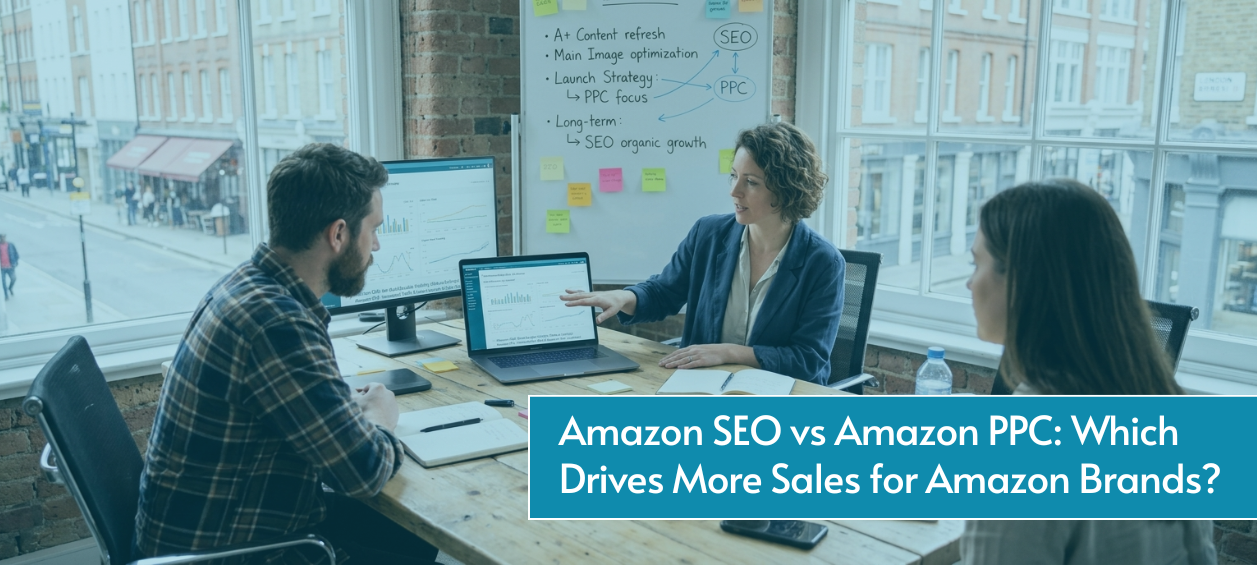
Every Amazon seller eventually runs into the same question: where should the next dollar go, into optimizing the listing or into running ads?
Every Amazon seller eventually runs into the same question: where should the next dollar go, into optimizing the listing or into running ads? It feels like a simple either-or decision, but the answer shapes everything from your margins to how fast you can scale. Get the balance wrong, and you either burn cash on ads that prop up a weak listing or you wait months for organic traffic that never quite arrives.
This decision matters more than most sellers realize, because it compounds. A brand that leans too heavily on PPC for too long can end up with healthy sales but thin margins, propped up entirely by ad spend that has to keep flowing just to maintain the same revenue. A brand that ignores PPC entirely, hoping organic ranking will carry a new or underperforming listing, often waits far longer than necessary for traction that paid visibility could have accelerated. The cost of getting this wrong shows up gradually, in ACoS creep and stalled growth, rather than all at once.
The truth is that Amazon PPC vs Amazon SEO isn't really a competition. They solve different problems, on different timelines, and the strongest Amazon brands use both with intention rather than picking a side. Let's break down how each one actually performs, when to lean on which, and how to build a strategy where they reinforce each other instead of competing for the same budget.
Amazon SEO vs Amazon PPC: Key Differences
Before deciding where to invest, it helps to see the two side by side, because they differ in almost every practical way.
| Factor | Amazon SEO | Amazon PPC |
|---|---|---|
| Cost structure | No per-click cost once the listing is ranking; organic traffic comes at no incremental cost | Every click costs money, regardless of whether it converts |
| Speed to results | Slower build; organic rank depends on sales performance and relevance signals accumulating over weeks or months | Fast; a campaign can start driving traffic within hours of launch |
| Control and predictability | Indirect; you influence ranking through optimization, but Amazon's algorithm decides the outcome | Direct; you control which keywords you target, how much you bid, and how quickly you scale |
| Longevity | Holds its position with far less ongoing investment once established | Disappears the moment you stop paying |
| Best suited for | Mature listings with established reviews, pricing, and a sales track record | New launches, competitive keywords, and time-sensitive promotional windows |
Neither approach is inherently better. The right call depends on what your product needs right now, which is exactly what the next two sections cover.
When Amazon SEO Performs Better
An Amazon SEO strategy tends to outperform paid efforts when a product already has the fundamentals in place. If your listing has strong reviews, competitive pricing, and a consistent sales history, organic visibility becomes the more efficient path forward.
SEO is usually the stronger choice in these situations:
Mature products with steady, established sales:
Once a product has sales velocity and a track record, organic ranking tends to hold without constant ad support. A listing that has been converting consistently for months has already built up the relevance signals Amazon's algorithm weighs most heavily, so it needs far less paid reinforcement to stay visible.
Listings with strong reviews and a clear value proposition:
Shoppers convert well on these pages even without a paid nudge, which reinforces the listing's organic standing. A product sitting at 4.5 stars with a few hundred reviews is doing persuasive work on its own; ad spend on top of that often produces diminishing returns compared to letting organic traffic convert at the same strong rate for free.
Categories where ad costs are climbing:
As competition drives up CPCs, products that can rank organically retain more margin. In saturated categories, sellers competing purely on ad spend often see ACoS rise faster than sales, while a strong organic position keeps acquiring customers without that same cost pressure.
Brands trying to reduce dependence on advertising:
If your profitability is being squeezed by rising ACoS, shifting investment toward listing optimization, content, and keyword relevance pays off over time. This is typically a gradual rebalancing rather than an abrupt cut to ad spend, since pulling PPC too quickly before organic rank has caught up can cause a visible dip in sales.
SEO won't produce overnight results, but it compounds. The stronger your foundation, the less you need to pay for every sale.
When Amazon PPC Performs Better
An Amazon PPC strategy earns its place when speed matters more than efficiency, particularly in situations where organic ranking simply hasn't had time to develop.
PPC tends to outperform SEO in these scenarios:
New product launches:
A brand-new listing has no sales history and no organic authority. PPC gets it in front of shoppers immediately, while Amazon collects the performance data needed to start ranking it organically. Most new listings see little to no organic visibility in the first few weeks regardless of how well the content is written, simply because Amazon hasn't yet accumulated enough sales and conversion data to trust the listing.
Competitive or high-volume keywords:
For terms with heavy competition, organic ranking can take a long time to achieve. Sponsored placements buy visibility while you build that authority. In categories with dozens of established competitors on page one, even a well-optimized new listing can take months to break into organic top results without paid support in the meantime.
Seasonal pushes and major shopping events:
Prime Day, holiday campaigns, and other time-sensitive windows reward fast, controllable visibility, which PPC delivers and SEO cannot. Many advertisers also increase investment in Sponsored Display Ads to retarget shoppers during these high-traffic periods. Organic ranking simply doesn't move fast enough to capture a short, high-traffic window, so increased ad investment around these dates is one of the few reliable ways to capture a larger share of that temporary demand spike.
Testing which keywords actually convert:
PPC campaigns generate real conversion data on search terms before you commit to baking them into your listing's organic optimization. Rather than guessing which keyword variations matter most, sellers can run a campaign, see which terms actually produce sales, and use that evidence to prioritize listing content updates with far more confidence.
The trade-off is straightforward: PPC buys speed, but it becomes expensive fast if the underlying listing isn't ready to convert the traffic it attracts.
How Amazon SEO and PPC Strengthen Each Other
This is where most sellers misunderstand the relationship. Amazon SEO and Amazon PPC aren't separate budgets competing for the same dollar. They feed into each other in a continuous loop.
PPC builds relevance signals that boost organic ranking:
When a PPC campaign drives clicks and conversions on a keyword, Amazon registers that as a relevance signal. Strong, consistent conversions on a search term can help that same keyword gain organic traction over time. In other words, your paid campaigns are quietly doing some of the legwork for your organic ranking. This is one reason many brands use Amazon Sponsored Ads strategically, not just for immediate sales, but also to build the conversion history that supports stronger organic visibility over time.
A stronger listing lowers the cost of your PPC campaigns:
The relationship runs the other way, too. A well-optimized listing, with clear titles, persuasive bullet points, and trustworthy images, converts paid clicks more efficiently. That means a stronger Amazon SEO strategy directly lowers the cost of your PPC campaigns, since better-converting listings win ad auctions more efficiently and waste less spend on clicks that don't turn into sales.
Together, they create a continuous growth loop:
PPC supplies traffic and data, SEO turns that traffic into sustainable rankings, and the improved rankings reduce how much you need to spend on ads to maintain visibility. Brands that treat the two as connected systems consistently get more out of every dollar than those running them in isolation.
Tracking the loop with TACoS:
One useful way to track whether this loop is actually working is Total Advertising Cost of Sale, or TACoS, which measures ad spend against total sales rather than just ad-attributed sales. If TACoS is trending downward while overall revenue holds steady or grows, that's a strong sign your organic SEO is picking up more of the load, and your PPC investment is genuinely building toward something lasting rather than just buying temporary visibility. If TACoS stays flat or climbs over time despite consistent ad spend, it usually signals that the listing isn't converting paid traffic into the organic momentum it should be.
Building a Combined SEO + PPC Strategy
Putting this synergy into practice starts with one principle: research and optimize together, rather than treating SEO and PPC as separate projects with separate teams.
Start with coordinated keyword research: Identify the terms that matter most for your category, then map them across both your listing content and your ad campaigns from day one. This keeps your messaging consistent and your data comparable, since you're measuring how the same keywords perform on both sides rather than tracking two unrelated keyword lists.
Let PPC data inform your SEO decisions: Search term reports reveal exactly which keywords are converting in paid campaigns. When a term consistently performs well, it belongs in your title, bullet points, or backend search terms, not just your ad groups. This is often the fastest, most evidence-based way to refine listing content, since it's based on real shopper behavior rather than estimated search volume.
Optimize the listing before scaling ad spend: Strong content, clear images, and credible reviews make every click, paid or organic, more likely to convert. Brands with a well-developed Amazon Brand Store often create a more cohesive shopping experience that improves conversion rates from both organic and paid traffic. Scaling PPC budget on a weak listing only amplifies wasted spend, since you're simply paying for more visitors to leave without buying.
Track performance across both channels together: Looking at PPC and organic metrics side by side, rather than in separate reports, makes it easier to see where the two strategies are reinforcing or undermining each other. As campaigns mature, brands often expand beyond keyword targeting and incorporate Sponsored Display Ads to stay visible throughout the shopper journey and reinforce the traffic generated through both paid and organic channels. A dashboard or weekly review that pairs ACoS, organic rank movement, and TACoS in one place will surface problems faster than checking advertising reports and ranking trackers separately.
Revisit the strategy regularly: As a product matures, its needs shift. A combined SEO and PPC strategy isn't a one-time setup; it's an ongoing adjustment based on what the data shows, typically reviewed monthly for active campaigns and more closely around major sales events or new launches.
Common Mistakes Sellers Make
A few recurring missteps tend to undercut both strategies at once.
Launching PPC campaigns before fixing a weak listing:
Paid traffic cannot compensate for unclear titles, poor images, or thin content. The clicks arrive, but they don't convert.
Relying on PPC indefinitely instead of building organic strength
Ads can sustain visibility, but without a parallel Amazon SEO strategy, that visibility disappears the moment the budget is paused.
Ignoring organic ranking performance entirely
Some sellers focus so heavily on ACoS and ad metrics that they lose sight of whether their organic position is improving or eroding.
Scaling ad spend before resolving conversion issues
Increasing budget on a campaign with a low conversion rate just increases losses faster. Monitoring metrics like Amazon click-through rate can help identify whether the issue lies with visibility, relevance, or listing quality.
Treating SEO and PPC teams or efforts as disconnected
When keyword research, content, and ad strategy aren't aligned, both channels underperform relative to their potential.
Avoiding these pitfalls usually comes down to one habit: checking listing quality and conversion data before adjusting ad spend, rather than after.
Which Strategy Should You Prioritize First?
There's no universal answer, but the decision becomes clearer once you consider three factors: product stage, competition level, and budget.
By product stage: For new products with no sales history, PPC should generally come first. It's the fastest way to generate the sales velocity and keyword data that organic ranking depends on. For mature products with consistent sales and strong reviews, shifting more investment toward Amazon SEO strategy work, such as content refreshes, backend keyword updates, and conversion optimization, tends to improve margins without sacrificing visibility.
By competition level: In highly competitive categories, expect to lean on PPC longer than you would in a lower-competition niche, simply because organic ranking takes more time and sales volume to achieve.
By budget: With limited budget, prioritize fixing the listing first. A modest, well-targeted PPC campaign on a strong listing will consistently outperform a larger budget spent driving traffic to a weak one.
A lifecycle framework: launch, growth, maturity It helps to think of this as a rough timeline rather than a fixed rule.
Launch phase (roughly months one to three) PPC typically carries most of the weight, since the listing has little to no organic visibility on its own.
Growth phase: As reviews and sales history accumulate, organic rank starts contributing a meaningful share of sales, and PPC budget can gradually shift from broad visibility campaigns toward defending key terms and testing new ones.
Maturity phase: A well-optimized listing in a stable category often sees organic sales make up the larger share of revenue, with PPC playing a more targeted role: protecting branded search terms, defending against competitor ads, and supporting promotions rather than carrying the bulk of traffic.
Most brands shouldn't pick one strategy permanently. The right mix shifts as the product, the competitive landscape, and the budget change.
Conclusion
Amazon PPC vs Amazon SEO was never meant to be a contest with a single winner. PPC gives you speed, data, and immediate visibility. SEO gives you durability, lower costs over time, and a foundation that keeps performing without constant ad spend. Used independently, each has real limitations. Used together, they create a growth loop where paid traffic accelerates organic ranking, and organic ranking makes every ad dollar work harder.
Building that balance, and adjusting it as your products move through different stages, is where Prime Retail Solution's experience as a 3P marketplace partner makes the difference. We help brands align listing optimization with advertising strategy so both channels work toward the same growth goal instead of pulling in different directions. If you're ready to build an Amazon strategy where SEO and PPC actually support each other, get in touch with our team.
FAQs
Is Amazon SEO better than Amazon PPC?
Neither is universally better. Amazon SEO builds long-term, lower-cost visibility, while Amazon PPC delivers immediate traffic and data. Most successful brands use both together rather than choosing one.
Does Amazon PPC actually improve organic rankings?
Indirectly, yes. Strong PPC performance increases sales velocity and conversion signals on specific keywords, which can help those same terms gain organic traction over time.
How long does an Amazon SEO strategy take to show results?
It varies by category and competition, but most sellers see meaningful organic movement over several weeks to a few months, depending on listing quality, review volume, and sales consistency.
Should new product launches start with SEO or PPC?
PPC. New listings lack the sales history needed to rank organically, so paid campaigns are the fastest way to generate early traffic, sales, and the data that organic SEO efforts can build on.
Can I manage Amazon SEO and PPC together without an agency?
Smaller catalogs can often be managed in-house, but as product count, competition, and ad spend grow, coordinating both strategies becomes harder to do effectively without dedicated support.
What is TACoS, and why does it matter for this comparison?
TACoS, or Total Advertising Cost of Sale, measures ad spend against total sales rather than just sales generated by ads. A falling TACoS over time, alongside stable or growing revenue, is a strong sign that organic SEO is increasingly carrying sales that ads used to be responsible for.
Does Amazon SEO cost anything at all?
There's no per-click fee like PPC, but it isn't free in the sense of requiring no investment. Strong Amazon SEO strategy work typically involves time or cost spent on content optimization, professional images, and generating reviews, all of which influence ranking indirectly.
More from
the brief.
Amazon's New Product Bundling Policy: What It Means for Sellers
Amazon has introduced a new product bundling policy, creating a significant shift in how brands on the platform can package and promote their items. Product bundling has always been a strategy for se…
Read article →
Mother’s Day Bundling Tactics That Boost AOV and Retention for Amazon Brands
Why Mother’s Day Bundles Shouldn’t Be an Afterthought Mother’s Day spending hit $35.7 billion last year, and it’s projected to grow. For established Amazon brands, that’s more than just seasonal traf…
Read article →
When Should You Hire an Amazon Management Agency?
Selling on Amazon was once relatively straightforward. You listed a product, optimized a few keywords, and sales came in. That era is long gone. Today, running a successful Amazon business means mana…
Read article →Ready to talk
operations?
Tell us about your marketplace footprint. We'll respond within one business day.
Laguna Beach, CA 92651