TACoS vs. ACoS: How Amazon Brands Should Measure Ad Performance
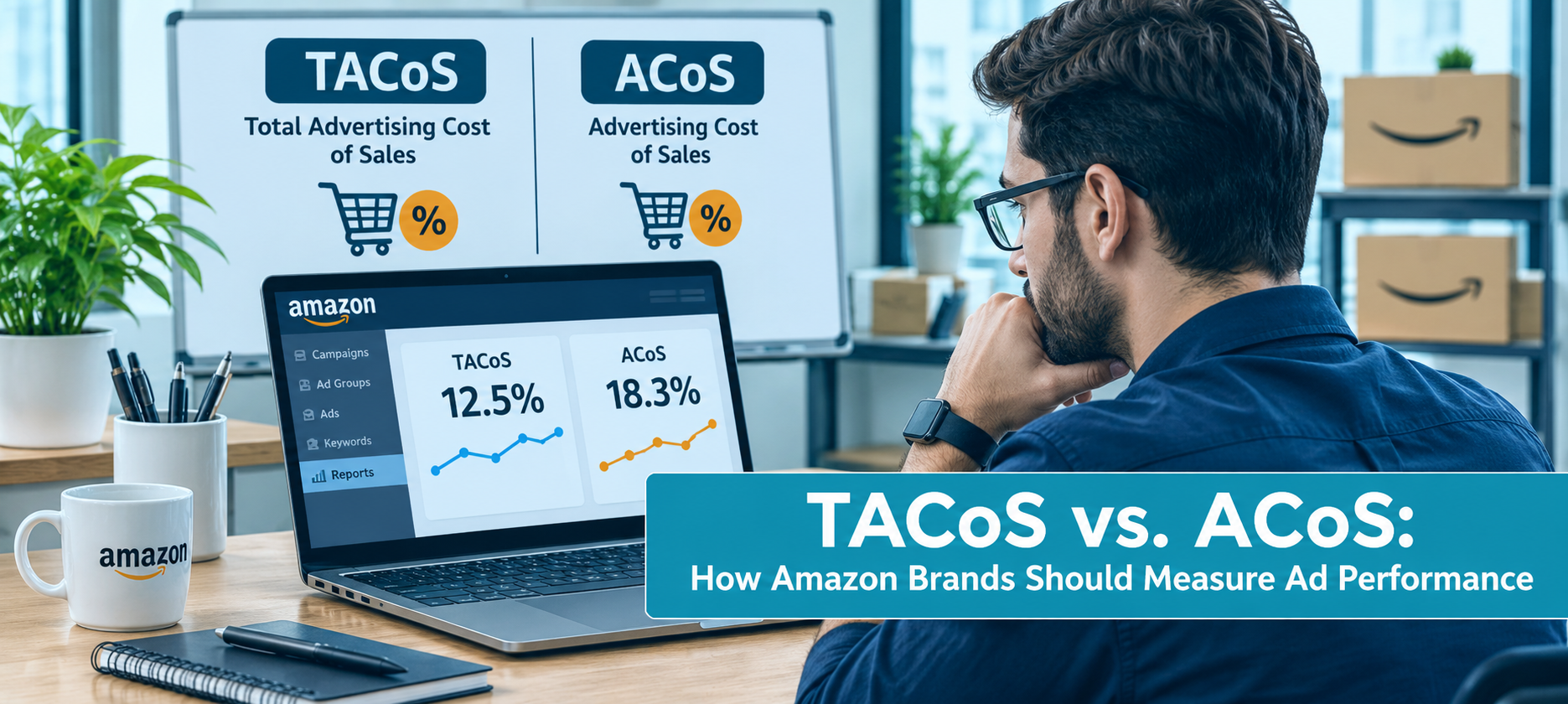
Learn the difference between Amazon TACoS and ACoS, how to calculate each metric, and how to measure ad efficiency, organic growth, and profitability.
Here's a scenario that plays out constantly on Amazon: a seller checks their advertising dashboard, sees a low ACoS, and feels great about it. The ads look efficient. Every dollar of ad spend is returning strong ad sales. And yet, somehow, the business isn't actually growing or, worse, profitability is slipping even as the ad metric looks healthy.
How does a "good" number hide a struggling business? Because ACoS, on its own, only tells you part of the story. It measures how efficiently your ads convert, but it says nothing about whether your brand is actually growing, how dependent you are on paid traffic, or what's happening to your organic sales underneath.
That's where the TACoS vs ACoS conversation becomes essential. These two metrics measure very different things, and the brands that understand the difference make far smarter decisions about where to spend, when to scale, and how to grow profitably. This guide breaks down what each metric means, how they differ, when to use which, and why the best Amazon brands track both together.
What Is ACoS?
ACoS stands for Advertising Cost of Sales. It's the metric most Amazon sellers learn first, and it measures how efficiently your advertising converts spend into sales.
The formula:
ACoS = (Ad Spend ÷ Ad Revenue) × 100
In plain terms, Amazon ACoS tells you what percentage of your ad-generated revenue was eaten up by ad spend. If you spend $30 on advertising and that advertising generates $100 in sales, your ACoS is 30%, meaning 30 cents of every ad-driven dollar went to advertising.
The key thing to understand is what ACoS counts: ad-attributed sales only. It looks exclusively at the revenue your ads directly produced. It doesn't account for the organic sales happening alongside your campaigns, and it doesn't tell you anything about the broader health of your business. A lower ACoS generally signals more efficient campaigns, which is why it's the go-to metric for optimizing bids and keywords at the campaign level.
What Is TACoS?
TACoS stands for Total Advertising Cost of Sales. It takes a wider view, measuring your ad spend against your entire revenue, both paid and organic.
The formula:
TACoS = (Ad Spend ÷ Total Revenue) × 100
The difference is in the denominator. Where ACoS divides ad spend by ad sales only, Amazon TACoS divides ad spend by total sales everything you sold, whether it came from an ad click or an organic search. If you spend $50 on advertising and your total revenue across paid and organic is $500, your TACoS is 10%.
This single change in what you're measuring against transforms what the number tells you. TACoS reveals how much your overall business depends on advertising. And because it includes organic revenue, it can improve over time even if your ad spend stays flat because as your organic sales grow, advertising accounts for a smaller share of your total business. That makes TACoS a far better indicator of long-term brand health than ACoS alone. For brands running external marketing campaigns, Amazon Attribution can help measure how off-Amazon marketing efforts contribute to shopping activity and sales on Amazon.
TACoS vs. ACoS: The Core Difference
| Amazon ACoS | Amazon TACoS | |
|---|---|---|
| Full name | Advertising Cost of Sales | Total Advertising Cost of Sales |
| Formula | Ad Spend ÷ Ad Sales × 100 | Ad Spend ÷ Total Sales × 100 |
| What it measures | Ad campaign efficiency | How much the whole business relies on ads |
| Includes organic sales? | No | Yes |
| Best used for | Campaign-level tuning (bids, keywords) | Brand-level strategy and budgeting |
| Time horizon | Short-term efficiency | Long-term growth and profitability |
| Blind spot | Ignores organic sales and brand health | Less useful for individual campaign tweaks |
The simplest way to hold the two apart: ACoS tells you whether a campaign is efficient; TACoS tells you whether your advertising is actually building a healthier business.
A Worked Example: Same Numbers, Two Very Different Stories
Abstract definitions only go so far, so let's put numbers to it.
Brand A and Brand B both run ads with a 25% ACoS. On the surface, their advertising looks equally efficient. But watch what happens when we add organic sales into the picture.
Brand A:
- Ad spend: $2,000
- Ad sales: $8,000 → ACoS = 25%
- Organic sales: $2,000
- Total sales: $10,000 → TACoS = 20%
Brand B:
- Ad spend: $2,000
- Ad sales: $8,000 → ACoS = 25%
- Organic sales: $8,000
- Total sales: $16,000 → TACoS = 12.5%
Both brands have an identical ACoS, yet they're in very different positions. Brand B is generating far more organic revenue for the same ad spend, which means its advertising is doing more than converting clicks; it's driving sales velocity that feeds organic rank, and the business leans much less heavily on paid traffic. Brand A is more dependent on ads to produce the same relative result.
If you only looked at ACoS, these two brands would look the same. TACoS is what exposes the difference, and that difference is everything when you're deciding how to grow.
Why ACoS Alone Can Mislead You
ACoS is a useful metric, but relying on it by itself leads to some of the most common and costly mistakes on Amazon.
A low ACoS can hide stalled growth. It's entirely possible to drive your ACoS down by cutting ad spend and bidding only on your safest, highest-converting branded terms and, in doing so, quietly shrink your reach, lose visibility on competitive keywords, and stall the sales velocity that drives organic ranking. The ACoS looks beautiful while the business stops growing.
It says nothing about organic performance. Because ACoS ignores organic sales entirely, it can't tell you whether your advertising is building the organic momentum that makes a brand sustainable. You could have a great ACoS and a declining organic rank at the same time, and ACoS would never reveal it.
It can mask ad dependency. A product that sells well but only because every sale is pushed by advertising is a fragile business. ACoS won't flag that dependency, because every sale it sees came from an ad; that's all it measures. The moment you pause the ads, the sales disappear, and ACoS gave you no warning.
Chasing it can hurt long-term profit. Optimizing relentlessly for the lowest possible ACoS often means under-investing in the top-of-funnel and competitive campaigns that build a brand. The short-term efficiency gain comes at the cost of long-term growth.
This is the heart of the issue: a great ACoS can coexist with a struggling business, and without a wider metric, you'd never know.
What TACoS Reveals That ACoS Can't
TACoS fills in exactly the blind spots that ACoS leaves open.
It shows your organic momentum. Because TACoS includes organic sales, a falling TACoS over time while revenue holds steady or grows is a strong signal that your organic sales are increasing and your advertising is successfully building a self-sustaining business. That's the single clearest sign that your ad investment is working as a growth engine, not just a sales tap.
It exposes true ad dependency. A high or rising TACoS, even when ACoS looks fine, tells you that your business is leaning heavily on paid traffic to generate sales. That's a warning worth heeding: it means your organic foundation isn't carrying its weight, and your profitability is exposed to every change in ad costs.
It reflects real profitability. Because it measures ad spend against your total revenue, TACoS is far closer to a true profitability signal than ACoS. It answers the question that actually matters: "How much is advertising costing my business as a whole?" not just "How efficient was this campaign?"
It tracks the flywheel. The healthiest Amazon brands run a flywheel where advertising drives sales velocity, velocity improves organic rank, and better organic rank reduces the need for ads over time. TACoS is the metric that lets you see whether that flywheel is actually turning.
What's a Good ACoS and a Good TACoS?
This is one of the most common questions sellers ask, and the honest answer is that there's no universal number for either, but there are useful ranges and principles.
A good ACoS depends on your margin, goal, and lifecycle stage. A new product launch may intentionally run a high ACoS, sometimes well above its target because the goal at launch is sales velocity and ranking, not immediate profit. A mature product with strong organic rank should see a lower ACoS as organic sales take over more of the work. The right ACoS is the one that aligns with your margin and your current objective, not a fixed benchmark.
A good TACoS typically falls in the 10–20% range, though this varies by category and strategy. A TACoS in that band usually indicates a healthy balance between ad investment and organic sales. But context matters enormously: a brand in aggressive growth mode may accept a higher TACoS to fuel expansion, while a mature, profit-focused brand may push it lower. What matters most is the trend: a TACoS that's steadily falling while revenue grows is almost always a good sign, regardless of the exact figure.
Judge both against your own history, not someone else's benchmark. The most useful comparison isn't against an industry average; it's against your own past performance. Is your TACoS trending the direction you want? Is your ACoS appropriate for where each product sits in its lifecycle? Those questions matter more than hitting a number you read in an article.
When to Use ACoS vs. When to Use TACoS
The two metrics aren't competitors; they're tools for different jobs.
Use ACoS for campaign-level decisions. When you're adjusting bids, pruning non-converting keywords, reallocating budget between campaigns, or evaluating whether a specific ad group is pulling its weight, ACoS is the right lens. It's granular, immediate, and built for optimization work at the campaign level.
Use TACoS for brand-level strategy. When you're deciding how much to invest in advertising overall, judging whether your ad spend is building the business, planning budgets, or evaluating the long-term health of a product or your whole catalog, TACoS is the metric that matters. It's the strategic view that tells you whether all that campaign-level efficiency is actually adding up to growth.
A simple way to think about it: ACoS is how you steer individual campaigns; TACoS is how you know you're driving in the right direction.
Why the Best Brands Track Both Together
The TACoS vs ACoS framing can make it sound like you have to choose one. You don't, and the most successful Amazon brands never do.
ACoS without TACoS leaves you optimizing campaigns efficiently while potentially steering the whole business off course. You could tune every campaign to a beautiful ACoS and still watch your organic rank erode and your ad dependency climb. TACoS without ACoS leaves you with a strategic view but no way to act on it at the campaign level; you'd see that your business was too ad-dependent, but you'd lack the granular metric to fix specific campaigns.
Tracked together, they complete the picture. ACoS keeps your individual campaigns efficient. TACoS confirms that all that efficiency is actually building a healthier, more organic, more profitable business. One is the steering wheel; the other is the map. You need both to reach the destination.
How to Improve Your TACoS
Improving TACoS isn't about slashing ad spend; it's about building a business that relies less on ads to generate each sale. Here's how.
Grow your organic rank. This is the most sustainable lever. As your organic sales grow, advertising accounts for a smaller share of total revenue, and TACoS falls naturally. The way to get there is the flywheel: use advertising to drive sales velocity and reviews, which improve organic rank, which brings in more organic sales that don't cost you ad spend. Strong listing optimization, including titles, images, A+ Content, and backend keywords, helps turn organic traffic into Amazon product listing conversions.
Cut wasted ad spend. Review your search term reports regularly and negate keywords that spend without converting. Every dollar you stop wasting on irrelevant clicks lowers your ad spend without sacrificing valuable sales. This helps you leverage Amazon Sponsored Ads to boost profitability while improving your overall advertising efficiency.
Use promotions strategically. Targeted, modest promotions a coupon or a small Brand Tailored Promotion can drive sales velocity and organic momentum without inflating your ad spend, helping your total sales grow faster than your advertising costs.
Monitor continuously and in context. TACoS is a trend metric, not a one-time snapshot. Recalculate it regularly, compare it against your own history, and adjust your strategy when it drifts. A TACoS spike during a launch is expected; a slow, unexplained climb on a mature product is a signal to investigate.
Other Ad Metrics Worth Watching
ACoS and TACoS are the headline metrics, but a few others round out the picture.
ROAS (Return on Ad Spend). Essentially, the inverse of ACoS it measures revenue generated per dollar of ad spend (Revenue ÷ Ad Spend). Some brands prefer ROAS because a higher number intuitively means better performance.
Conversion Rate (CVR). The percentage of ad clicks that turn into purchases. A low CVR often points to a listing or pricing problem rather than an advertising one; your ads are working, but the detail page isn't closing the sale.
Click-Through Rate (CTR). The percentage of impressions that result in a click. A low CTR usually signals a weak main image, title, or price the elements that determine whether a shopper clicks in the first place.
Watched alongside ACoS and TACoS, these metrics help you pinpoint where in the funnel a problem actually lives.
Conclusion
The TACoS vs ACoS distinction comes down to a single, important idea: ACoS tells you whether your campaigns are efficient, and TACoS tells you whether that efficiency is actually building a healthier business. A great ACoS can mask stalled growth, eroding organic rank, and dangerous ad dependency, and TACoS is the metric that brings those hidden realities into the light.
The brands that grow profitably on Amazon don't choose between the two. They use ACoS to keep their campaigns sharp and TACoS to make sure all that sharpness is adding up to real, sustainable growth. One is the steering wheel; the other is the map.
Reading these metrics correctly and building an advertising strategy that supports organic growth is exactly the kind of work Prime Retail Solution delivers through its Amazon Advertising & PPC services. If you want advertising that doesn't just look efficient but actually builds a stronger, more organic, more profitable business,Get in touch with our team!
FAQs
What's the main difference between ACoS and TACoS?
Amazon ACoS measures ad spend against ad-attributed sales only, showing campaign efficiency. Amazon TACoS measures ad spend against total sales, including organic, showing how much your whole business depends on advertising. ACoS is for campaign tuning; TACoS is for brand-level strategy.
Is a lower TACoS always better?
Generally, a falling TACoS alongside steady or growing revenue is a good sign that organic sales are increasing. But a very low TACoS achieved by cutting ad spend too aggressively can mean you're under-investing in growth. Context and trend matter more than the raw number.
What is a good TACoS on Amazon?
A healthy TACoS often falls in the 10–20% range, though it varies by category and strategy. Growth-focused brands may run higher to fuel expansion; mature, profit-focused brands may push lower. The trend over time matters more than hitting an exact figure.
Can I have a good ACoS and a bad TACoS at the same time?
Yes, and it's common. A low ACoS with a high or rising TACoS usually means your campaigns are efficient but your business is overly dependent on ads, with weak organic sales underneath. That's exactly the situation TACoS is designed to expose.
Should I stop tracking ACoS and only use TACoS?
No. The two serve different purposes. ACoS is essential for optimizing individual campaigns, while TACoS is essential for judging overall business health. The best approach is to track both together.
How do I lower my TACoS?
The most sustainable way is to grow organic sales through strong listing optimization and the advertising flywheel that builds organic rank so your business relies less on paid traffic over time. Cutting wasted ad spend and using strategic promotions also help.
More from
the brief.

How to Report and Remove Counterfeit Listings on Amazon
Counterfeit listings and unauthorized sellers can severely damage a brand’s reputation, impact sales, and erode customer trust. If you’re an established brand selling on Amazon through the 3P marketp…
Read article →
Leveraging Amazon Live in 2024: A Guide to Real-Time Brand Engagement
Did you know that live streaming can boost your product discovery by up to 50%? For Amazon sellers, Amazon Live offers an exciting way to engage with customers in real-time, boosting brand visibility…
Read article →
MAP Pricing vs. MSRP: What's the Difference?
Pricing strategies play a crucial role in the success of any Amazon brand. Two common terms that often confuse sellers and retailers alike are MAP (Minimum Advertised Price) and MSRP (Manufacturer's…
Read article →Ready to talk
operations?
Tell us about your marketplace footprint. We'll respond within one business day.
Laguna Beach, CA 92651