The Complete Checklist for Selecting a Marketplace Management Partner in the USA

Ecommerce marketplaces such as Amazon and Walmart have become essential growth channels for brands selling in the United States. However, success on these platforms requires more than listing product…
Ecommerce marketplaces such as Amazon and Walmart have become essential growth channels for brands selling in the United States. However, success on these platforms requires more than listing products. Brands must manage search visibility, advertising performance, inventory availability, pricing competitiveness, and marketplace compliance simultaneously.
Because these factors directly affect product ranking and sales velocity, many brands partner with specialized agencies to manage their marketplace operations. The challenge is that not all agencies offering marketplace services possess the same level of operational expertise.
Choosing the right e-commerce marketplace management services requires evaluating not just marketing capabilities, but also the agency’s understanding of how marketplace ecosystems actually function. The checklist below highlights the most important factors brands should assess before entering a partnership.
What Is a Marketplace Management Partner?
A marketplace management partner is an agency that helps brands operate and grow their presence on ecommerce marketplaces such as Amazon, Walmart, and other online retail platforms.
Unlike traditional marketing agencies, these partners focus on the operational drivers of marketplace growth, including product visibility, advertising efficiency, conversion rates, and inventory stability.
Strong partners typically support brands through:
- Marketplace listing optimization
- Advertising strategy and retail media management
- Inventory planning and demand forecasting
- Marketplace performance analysis
- Brand protection and compliance monitoring
Their role is to ensure products remain competitive within marketplace algorithms while improving long-term sales performance.
Marketplaces Most Brands Need Help Managing in the U.S.
1. Amazon
Amazon is the most competitive ecommerce marketplace in the U.S., where product visibility is determined by factors such as keyword relevance, sales velocity, and conversion rate. Brands often require Amazon marketplace management company for:
- Listing optimization and keyword strategy
- Amazon PPC campaign management
- Buy Box competitiveness
- Inventory planning to maintain ranking momentum
Without continuous optimization, even established brands can lose visibility in Amazon’s search results.
2. Walmart Marketplace
Walmart Marketplace has grown quickly as a secondary marketplace channel for brands looking to diversify beyond Amazon. Success on Walmart typically depends on:
- Catalog accuracy and listing compliance
- Competitive pricing strategies
- Walmart Connect advertising
- Consistent fulfillment performance
Because Walmart’s algorithm prioritizes price competitiveness and operational reliability, agencies must understand the platform’s distinct ranking factors.
3. Other Emerging Marketplaces
Brands increasingly expand into additional marketplaces such as eBay, Target Plus, or niche category platforms to reach new audiences.
Managing these channels effectively requires coordinating listings, pricing strategies, advertising campaigns, and inventory across multiple platforms.
Marketplace management partners help brands maintain this operational consistency while scaling distribution.
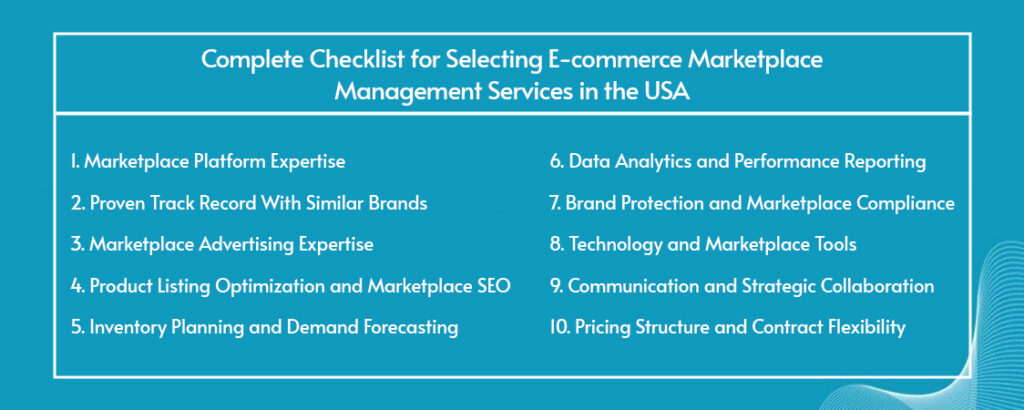
The Complete Checklist for Selecting E-commerce Marketplace Management Services in the USA
Below is the complete checklist for hiring marketplace partner:
1. Marketplace Platform Expertise
Marketplace management is not interchangeable with general ecommerce marketing. Platforms like Amazon and Walmart operate using unique ranking systems where factors such as sales velocity, conversion rate, pricing competitiveness, and inventory stability all influence product visibility.
A strong marketplace partner understands how these signals interact and builds strategies around them.
Quick evaluation test:
Ask the agency how they would respond if one of your top products suddenly lost organic ranking. A well-experienced marketplace management agency for e-commerce brands will discuss factors like advertising momentum, conversion performance, keyword ranking shifts, and inventory disruptions rather than generic marketing tactics.
2. Proven Track Record With Similar Brands
Past results often reveal more about an agency than their service list. Agencies that have worked with brands in similar categories are more likely to understand pricing pressure, competitive advertising dynamics, and customer expectations within that market.
Instead of reviewing general testimonials, focus on performance evidence.
Look for signals such as:
- Documented improvements in organic keyword rankings
- Revenue growth tied to marketplace optimization
- Measurable improvements in conversion rate or advertising efficiency
- Case studies explaining how results were achieved
Results tied to specific marketplace metrics usually indicate genuine operational expertise.
3. Marketplace Advertising Expertise
Advertising on marketplaces serves a different purpose than traditional digital advertising. It is not only a traffic driver but also a mechanism for accelerating sales velocity, which can improve organic product ranking.
Effective marketplace partners know how to structure advertising campaigns to support both visibility and profitability.
Strong agencies typically approach advertising in stages:
- Stage 1: Data Collection:
Launch campaigns to identify high-performing keywords and search terms. - Stage 2: Optimization:
Adjust bids, refine targeting, and eliminate inefficient spend. - Stage 3: Scaling:
Increase investment in keywords that drive profitable growth and support organic ranking improvements.
Agencies that skip this structured approach often generate traffic without improving overall marketplace performance.
4. Product Listing Optimization and Marketplace SEO
Product listings act as both search assets and conversion pages. A listing that ranks well but fails to convert will eventually lose visibility, while a high-converting listing with poor keyword targeting may never receive enough traffic.
Strong agencies know how to optimize listings with both goals in mind.
Key elements typically include:
- Keyword-informed titles that align with marketplace search behavior
- Clear bullet points that highlight product benefits rather than features alone
- Visual content that answers common customer questions before purchase
- Continuous updates based on performance data
When listings are optimized correctly, improvements in conversion rates often translate directly into stronger organic ranking.
5. Inventory Planning and Demand Forecasting
How to manage inventory efficiently is one of the most underestimated factors affecting marketplace performance. When a product goes out of stock, the resulting drop in sales velocity can significantly reduce its ranking within marketplace search results.
Experienced marketplace partners treat inventory planning as part of the growth strategy rather than a separate operational task.
For example, before increasing advertising budgets or launching promotions, agencies should confirm that inventory levels can support the anticipated demand. Without this coordination, aggressive marketing can lead to stockouts that disrupt ranking momentum.
6. Data Analytics and Performance Reporting
Data reporting alone does not create value. The real benefit comes from interpreting marketplace data and turning it into actionable insights.
Strong marketplace partners go beyond sending performance dashboards. They explain what the data means and what actions should follow.
Instead of simply reporting metrics such as conversion rate or advertising spend, experienced agencies often highlight trends such as:
- Declining conversion that may indicate listing issues
- Increasing ad spend with stagnant revenue growth
- Shifts in keyword rankings caused by competitor activity
This analytical approach helps brands make informed decisions rather than reacting to isolated metrics.
7. Brand Protection and Marketplace Compliance
Marketplace platforms expose brands to several risks, including unauthorized sellers, listing hijackers, and pricing violations. These issues can affect both brand reputation and profit margins if left unaddressed.
Marketplace management partners should actively monitor listings to identify these risks early.
Typical responsibilities include monitoring and protecting your brand against unauthorized sellers, enforcing minimum advertised price policies, and resolving listing suppression issues caused by compliance errors. Agencies that prioritize brand protection help brands maintain control over their marketplace presence.
8. Technology and Marketplace Tools
Most experienced marketplace agencies rely on specialized tools to analyze marketplace data and identify growth opportunities.
These tools often support activities such as keyword tracking, advertising optimization, inventory forecasting, and competitive benchmarking.
However, technology alone is not enough. The real advantage comes from how agencies interpret the data these tools generate and apply those insights to improve marketplace performance.
Brands should therefore evaluate not just the tools an agency uses, but also how those tools inform strategic decision-making.
9. Communication and Strategic Collaboration
Marketplace growth requires continuous collaboration between the brand and its agency partner. Changes in pricing, promotions, product launches, or inventory availability all influence marketplace performance.
Effective agencies establish regular communication rhythms to ensure strategies remain aligned.
This may include monthly performance reviews, campaign optimization discussions, and planning sessions for upcoming product launches or promotional events. Agencies that communicate proactively are often better equipped to respond to marketplace changes quickly.
10. Pricing Structure and Contract Flexibility
Pricing structures for marketplace management services vary widely. Some agencies charge a fixed monthly retainer, while others operate on performance-based models tied to revenue or advertising spend.
Each model has advantages depending on the brand’s growth stage.
For example, retainers often provide predictable costs and comprehensive support, while performance-based models may align agency incentives more closely with revenue growth. Brands should evaluate whether the pricing structure supports long-term collaboration rather than short-term results.
Red Flags to Watch When Choosing a Marketplace Agency
Certain warning signs may indicate that an agency lacks the expertise required for marketplace management.
Common red flags include:
- Guaranteed ranking or sales promises
- Limited transparency in reporting
- Generic ecommerce strategies applied to marketplaces
- Minimal experience with Amazon or Walmart operations
Identifying these risks early can prevent costly partnerships.
Questions to Ask Before Hiring a Marketplace Management Partner
Before selecting a partner, brands should ask several key questions:
- How do you diagnose ranking drops or performance issues?
- What metrics do you prioritize when optimizing advertising?
- How do you balance advertising growth with profitability?
- Can you share case studies from similar brands?
These questions help reveal whether an agency truly understands marketplace operations.
Conclusion
Selecting the right e-commerce marketplace management services in the USA requires evaluating more than marketing capabilities. Brands must consider the agency’s operational expertise, data-driven decision-making, and ability to manage the factors that influence marketplace ranking and sales performance.
By using this checklist to evaluate potential partners, brands can identify the best marketplace management agency USA which is capable of supporting sustainable marketplace growth while avoiding partnerships that fail to deliver meaningful results. Finding the right marketplace management partner USA for your brand? Prime Retail Solution is a reliable name in the market. Book a free consultation call now.
Ready to talk
operations?
Tell us about your marketplace footprint. We'll respond within one business day.
Laguna Beach, CA 92651