Walmart WFS vs. Amazon FBA: Fees, Fulfillment, and Key Differences
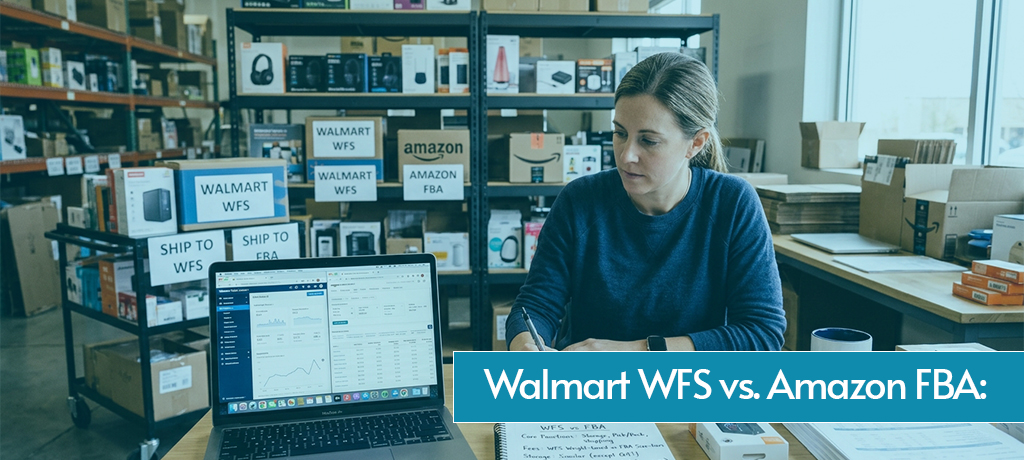
Compare Walmart WFS vs. Amazon FBA fees, storage costs, fulfillment, eligibility, and delivery. Learn which option best fits your products and goals.
When sellers think about where to grow, the conversation usually centers on the marketplace itself: Amazon's reach versus Walmart's momentum. But the fulfillment program you run on each platform shapes your margins just as much as the channel you choose. How your orders get stored, picked, packed, and shipped determines your per-unit costs, your delivery speed, your customer experience, and ultimately how much of each sale you keep.
That's why the Walmart WFS vs Amazon FBA comparison matters so much. Walmart Fulfillment Services (WFS) and Fulfillment by Amazon (FBA) do fundamentally the same job: they take the logistics off your plate so you can focus on selling, but they differ in fee structure, size limits, eligibility, and the audiences they put your products in front of. Understanding those differences is what lets you make an informed decision rather than assuming one program works the same way as the other.
This guide breaks down how each program works, compares them fee by fee, and helps you decide which fits your products and your strategy.
What Is Amazon FBA?
Fulfillment by Amazon (FBA) is Amazon's logistics program. You send your inventory to Amazon's fulfillment centers, and Amazon handles storage, order picking and packing, shipping, returns, and customer service for those orders. In exchange, your products become Prime-eligible, which is one of the strongest conversion signals on the platform. Prime shoppers overwhelmingly favor products that carry the badge.
FBA's biggest advantages are its scale and its maturity. Amazon's fulfillment network is vast, delivery is fast and reliable, and the Prime badge carries significant weight with shoppers. For most sellers on Amazon, FBA is the default path to competitive delivery performance and the conversion lift that comes with it.
Who it suits. Brands selling on Amazon that want Prime eligibility, fast nationwide delivery, and a hands-off fulfillment operation. It's open to any registered seller, which makes it accessible but also means you're competing in a crowded field.
What Is Walmart Fulfillment Services (WFS)?
Walmart Fulfillment Services (WFS) is Walmart's equivalent program. You ship your inventory to Walmart's fulfillment centers, and Walmart handles storage, pick-and-pack, shipping, returns, and fulfillment-related customer service. Listings fulfilled through WFS earn fast, tagged delivery that improves search placement Walmart's answer to the Prime badge.
WFS is newer than FBA, which cuts both ways. The network is less mature, but the marketplace is far less saturated, so sellers often face meaningfully less competition than they would on Amazon. Walmart has also been investing heavily in WFS's capabilities, closing the gap with FBA year over year.
Who it suits. Brands selling on Walmart Marketplace that want competitive delivery badging and a hands-off fulfillment operation, and that can get through Walmart's approval process. One important requirement is that inventory sent to WFS must originate in the U.S., so sellers importing from overseas often use 3PL services for e-commerce businesses to stage inventory domestically before sending it to Walmart.
Walmart WFS vs Amazon FBA: Compared
The fastest way to understand Walmart WFS vs FBA is to see the two programs against each other across the factors that actually affect your business.
The sections below unpack the cost differences in more detail, since fees are where most of the real decision-making happens.
Fulfillment Fees Compared
Fulfillment fees, what you pay each time an order ships, are usually the largest fulfillment cost, and this is where the two programs differ most structurally.
FBA uses size tiers. Amazon classifies each product into a size tier (small standard, large standard, and various oversize tiers) and charges a fulfillment fee based on that tier plus the unit's weight. The tier system means a product sitting just over a size threshold can jump into a noticeably higher fee bracket, so dimensions matter as much as weight.
WFS uses weight. Walmart WFS fees are based primarily on the unit's shipping weight, with rates stepping up as weight increases. Many sellers find this model simpler and more predictable, since you're working from one main variable rather than navigating tier thresholds.
Both use dimensional weight. For lighter, bulkier items, both programs calculate a dimensional weight (length × width × height divided by a fixed divisor) and charge based on whichever is greater: actual weight or dimensional weight. Both also factor packaging into the billable weight, though the specifics differ.
What this means in practice. For many small-to-medium standard-size products, WFS fees and FBA fees land close to each other, with WFS often slightly lower. The bigger gaps appear at the edges, particularly for items FBA classifies as oversize, where the tier system can push fees well above what the same product would cost through WFS. The only reliable way to know is to run your specific product's weight and dimensions through each program's current fee schedule. Understanding common e-commerce shipping challenges and their solutions can also help sellers manage delivery costs and fulfillment operations more effectively.
Storage Fees Compared
Storage fees are what you pay to keep inventory sitting in the fulfillment network, charged per cubic foot per month.
Most of the year, they're comparable. For the bulk of the calendar, standard storage rates on WFS and FBA are broadly similar, so storage isn't usually the deciding factor from January through the early fall.
Q4 is where they diverge. During the October–December peak season, both programs raise storage rates significantly to discourage sellers from clogging fulfillment centers with slow-moving stock. This is where the comparison gets interesting: WFS's peak-season structure tends to reward fast sell-through, while FBA's standard peak rate climbs steeply across the board. For sellers who turn inventory quickly, WFS can be meaningfully cheaper to store in during the holidays; for sellers sitting on aging stock, both programs get expensive fast.
Long-term storage. Both programs add surcharges for inventory that sits too long. The practical takeaway is the same on either platform: storage economics reward disciplined inventory planning, and aged stock quietly erodes margin regardless of which program you use.
Referral Fees and Other Costs
Fulfillment and storage aren't the only line items. A full picture of Walmart WFS fees versus FBA costs has to include the platform-level fees that apply whether or not you use the fulfillment program.
Referral fees. Both Amazon and Walmart charge a referral fee a percentage of each sale that varies by product category, generally falling in a similar 6–15% range depending on the category. This is a marketplace fee, separate from fulfillment, and applies on every order.
Monthly / subscription cost. Amazon's Professional selling plan carries a monthly subscription fee (around $39.99). Walmart Marketplace charges no monthly subscription fee, which is a modest but real structural advantage, especially for lower-volume sellers.
Returns, removal, and prep fees. Both programs may charge for processing returns, removing or disposing of inventory, and prepping units that don't arrive fulfillment-ready. These are easy to overlook when modeling costs but add up across a catalog, so factor them into your unit economics rather than looking at fulfillment fees in isolation.
Size, Weight, and Product Restrictions
Not every product fits neatly into both programs, and the size and weight rules are a common deciding factor.
WFS has firmer caps. Walmart WFS enforces stricter limits on package dimensions and weight. Products above those thresholds simply aren't eligible, which rules WFS out for certain bulky or heavy items.
FBA accommodates more, at a cost. FBA can handle larger and heavier items through its oversize and special-oversize tiers, but those tiers come with substantially higher fulfillment fees. So while FBA is more flexible for big products, that flexibility isn't free.
The practical implication. If your catalog includes oversize or heavy items, check eligibility and fee tiers on both programs before committing. A product that's economical to fulfill through FBA's standard tier might be ineligible for WFS entirely or vice versa, a mid-size product might be dramatically cheaper through WFS than through an FBA oversize classification.
Eligibility and Onboarding Differences
One of the clearest differences between the two programs shows up before you ship a single unit.
FBA is open. Any seller with a registered Amazon account can use FBA. There's no separate vetting process for the fulfillment program itself you enroll, send inventory, and you're live. That accessibility is part of why Amazon is so crowded.
WFS requires approval. To use WFS, you first need to be an approved Walmart Marketplace seller, and Walmart's onboarding is more selective. The application evaluates your e-commerce track record, catalog, and fulfillment capability, and it can take several weeks. The upside of that barrier is exactly what makes Walmart attractive: fewer sellers make it through, so competition on the platform is lower.
The trade-off is straightforward. FBA gets you fulfilling faster with no gatekeeping; WFS takes more effort to access but drops you into a less saturated environment once you're in.
Customer Base and Competition
Where your products get seen matters as much as how they get shipped.
Amazon has the reach. Amazon remains the largest e-commerce destination in the U.S. by a wide margin, with the highest shopper volume and the strongest purchase intent. If raw audience size is your priority, FBA puts you in front of more potential buyers than any other marketplace.
Walmart has the headroom. Walmart's online customer base is smaller but growing quickly, and the lower seller density means your products face less competition for visibility. Many sellers find that listings on Walmart get more eyeballs per listing than comparable Amazon listings, precisely because fewer sellers are competing for the same shoppers.
The strategic read. Amazon is where the volume is; Walmart is where the competitive breathing room is. Neither is objectively better they serve different points on the trade-off between reach and competition, which is exactly why the next section matters.
Which Should You Choose?
There's no universal winner in the Walmart Fulfillment Services vs Amazon FBA question the right answer depends on your products, your margins, and your channel strategy.
Choose Amazon FBA if
You're focused on Amazon, want the largest possible audience and the Prime badge, sell oversize items that need FBA's tier flexibility, or want to start fulfilling immediately without an approval process.
Choose Walmart WFS if
You're established on Walmart Marketplace (or ready to apply), sell standard-size products that fit within WFS's weight-based model, want to compete in a less crowded marketplace, and can source or stage inventory domestically.
Consider product fit first
For standard-size, quick-selling products, WFS often delivers slightly lower fulfillment costs and a less competitive field. For oversize products or sellers who need maximum reach, FBA's scale and flexibility win out. Before expanding across marketplaces, consider how to expand your Amazon operations without compromising profit margins while managing costs as your business grows.
Why not both?
For many scaled brands, the strongest strategy isn't choosing one program it's running both. Selling and fulfilling across Amazon and Walmart diversifies your revenue away from single-platform dependency, reaches two distinct customer bases, and gives you a fallback when one channel's fulfillment or demand fluctuates. A well-planned multichannel e-commerce strategy also helps brands coordinate inventory, fulfillment, and growth across marketplaces. The operational complexity of managing both is real, but with synchronized inventory and the right systems, running WFS and FBA in parallel is how many brands capture the best of each.
Conclusion
The Walmart WFS vs Amazon FBA decision isn't about which program is better in the abstract it's about which one fits your products, your margins, and where you want to grow. FBA offers unmatched reach, the Prime badge, and the flexibility to handle oversize products, at the cost of a crowded, competitive marketplace. WFS offers a simpler weight-based fee model, lower competition, and no monthly subscription, at the cost of a stricter approval process and firmer size limits.
For sellers weighing the two, the real insight is that they aren't mutually exclusive. The brands scaling fastest in U.S. e-commerce are increasingly the ones running both diversifying fulfillment, reaching two large customer bases, and reducing their dependence on any single platform.
Managing fulfillment across Amazon and Walmart requires coordinated inventory, efficient shipping, and cost control across both channels. Prime Retail Solution’s Logistics & Fulfillment services help brands manage FBA and WFS operations as they grow. Whether you're deciding between WFS and FBA or planning to use both, the right fulfillment strategy can help align your operations with your catalog and growth goals.
FAQs
Is Walmart WFS cheaper than Amazon FBA?
It depends on the product. For many standard-size items, WFS fulfillment fees are comparable to or slightly lower than FBA, and WFS can be notably cheaper for products FBA classifies as oversize. The only reliable way to know is to run your specific product's weight and dimensions through each program's current fee schedule.
Do WFS and FBA offer the same delivery speed?
Both offer fast, competitive delivery with badging that improves search placement Prime on Amazon, fast/tagged delivery on Walmart. Amazon's fulfillment network is more mature, but Walmart's has been closing the gap and delivers reliable two-day and faster shipping on eligible items.
Can I use the same inventory for both WFS and FBA?
Not the same physical units each program requires inventory to be stored in its own fulfillment centers. But you can split your inventory across both programs and sell on both marketplaces simultaneously, which is what sellers running a dual-channel strategy do. Real-time inventory syncing is essential to avoid overselling.
Does WFS require a monthly fee like Amazon?
No. Walmart Marketplace charges no monthly subscription fee, whereas Amazon's Professional plan carries one (around $39.99/month). Both charge referral and fulfillment fees per sale.
Can I ship inventory to WFS directly from an overseas supplier?
No. Inventory sent to WFS must originate in the U.S., so sellers importing from overseas typically route shipments through a domestic 3PL or their own facility before sending them to Walmart's fulfillment centers.
Should a new seller start with FBA or WFS?
FBA is generally easier to start with because it's open to any registered seller with no separate approval process. WFS requires Walmart Marketplace approval first, which takes longer but rewards you with a less competitive marketplace once you're in.
More from
the brief.

Amazon Listing Optimization for Higher Conversion Rates
Amazon is the world’s largest online marketplace, attracting billions of shoppers each month and generating hundreds of billions in annual sales. For brands and sellers, it offers a huge opportunity…
Read article →
Brands: Amazon 1P Vs. 3P And Who To Choose?
You may have pondered whether the 1P or 3P model is better for your brand's sales, whether you're a seasoned Amazon seller or just getting your feet wet. We at Prime Retail Solution, a 3P seller with…
Read article →
Full Service Amazon Agency vs In House Team: Which Delivers Better ROI?
Managing an Amazon business is not an easy task especially when the marketplace is evolving at an aggressive pace. As a seller, you have to choose one of the two ways: hiring Amazon marketing managem…
Read article →Ready to talk
operations?
Tell us about your marketplace footprint. We'll respond within one business day.
Laguna Beach, CA 92651