From DTC to Marketplace: A Guide for Shopify Brands Entering Amazon & Walmart
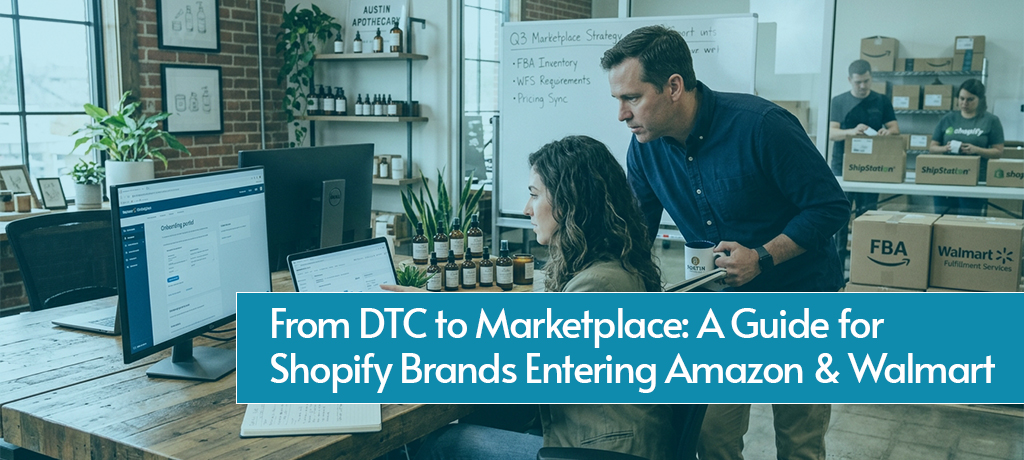
Learn how Shopify brands can expand to Amazon and Walmart, adapt listings, manage inventory, protect margins, and grow marketplaces without hurting DTC sales.
You've built something most sellers only dream of: a direct-to-consumer brand with its own Shopify store, a loyal customer base, an email list you own, and a brand experience you control from the first ad impression to the unboxing. You know your customers by name, you own their data, and every sale deepens a relationship you built deliberately.
So why move onto Amazon and Walmart at all?
Because the customers who will never find your Shopify store are already shopping on those platforms millions of them- every day, with their payment information saved and their trust in the marketplace established. More than half of all U.S. product searches now start on Amazon, not Google. For a DTC brand, marketplaces aren't a replacement for your owned channel; they're a discovery engine that reaches an audience your Shopify store, on its own, never will.
But here's what trips up most DTC brands: they assume that what made them successful on Shopify will translate directly to Amazon and Walmart. It won't, at least not without adaptation. Marketplace selling operates on different rules, different algorithms, and a fundamentally different relationship with the customer. This guide walks through exactly what changes, what to prepare, and how to expand onto Amazon and Walmart without losing the brand equity you worked so hard to build.
The Mindset Shift: How Selling on a Marketplace Is Different from DTC
The hardest part of moving from DTC to marketplace isn't operational it's mental. DTC founders are used to owning every part of the customer journey. Marketplaces require giving up some of that control in exchange for reach, and understanding this trade-off upfront is what separates brands that expand successfully from those that struggle.
You trade control for reach. On Shopify, you control the design, the messaging, the checkout flow, the upsells, and the entire post-purchase experience. On Amazon and Walmart, you operate within the platform's template. Your listing looks structurally similar to every competitor's, your checkout is the marketplace's checkout, and your branding lives within constraints you don't set. What you get in return is access to enormous, high-intent traffic you'd otherwise pay dearly to acquire.
You lose direct customer data. This is the trade-off DTC brands feel most acutely. On Shopify, every order gives you a customer profile email, purchase history, behavior that you can market to for years. On Amazon and Walmart, the customer belongs to the marketplace. You get aggregate sales data, not individual customer relationships. Your retention playbook has to change accordingly.
Discovery replaces loyalty as the primary driver. DTC growth is built on brand loyalty, community, and repeat purchases from customers who chose you. Marketplace growth is built on discovery: showing up when a shopper searches for what you sell, winning the click, and converting on the spot. The shopper may not know or care about your brand story at the moment of purchase. Your job on a marketplace is first to be found, then to convert, and only then to build recognition.
Demand is algorithm-driven. On Shopify, you drive your own traffic through ads, content, and email. On Amazon and Walmart, the platform's algorithm decides how much visibility your products get, based on relevance, conversion rate, sales velocity, and pricing. You influence the algorithm through optimization, but you don't control it the way you control your own paid traffic.
Internalizing these four shifts is the foundation for everything else in this guide. Brands that expect marketplaces to behave like DTC channels make predictable, costly mistakes. Brands that respect the differences build channels that compound.
Is Your Shopify Brand Ready to Expand?
Expanding to marketplaces before your foundation is ready creates more problems than it solves. Work through this readiness check honestly before committing.
A registered trademark. A trademark isn't strictly required to start selling on either platform, but it's essential for serious brand building. On Amazon, Amazon Brand Registry gives you access to A+ Content, Sponsored Brands ads, Brand Analytics, and brand protection tools. Without it, you're exposed to hijackers and unauthorized sellers with limited recourse. If you don't have a trademark yet, start that process before or alongside your marketplace launch.
Brand assets you can adapt. You likely have professional product photography, brand copy, and lifestyle imagery from your Shopify store. That's a significant head start but plan to adapt rather than reuse it directly, since marketplace image and content requirements differ from DTC norms.
Margins that can absorb marketplace fees. Amazon and Walmart each take referral fees (typically 8–15% depending on category), and fulfillment adds more. If your DTC margins are already tight, model out your marketplace unit economics carefully before launching. A product that's profitable at your Shopify price may need repricing to stay profitable on a marketplace.
Inventory capacity. Selling across DTC and marketplaces draws from the same inventory pool unless you separate it deliberately. Make sure your supply chain can support additional volume without starving your Shopify store of stock or risking stockouts on either channel.
Team bandwidth or a partner. Marketplace management is ongoing work; listing optimization, advertising, inventory planning, and customer service all require attention. Someone needs to own the channel, whether that's an internal hire or an external partner. Launching and then neglecting a marketplace channel rarely produces results.
If most of these are in place, you're ready. If several aren't, addressing them first will make your expansion far smoother.
What Transfers from DTC and What Doesn't
One of the most useful things a DTC brand can do before expanding is get clear on which of its existing strengths carry over to marketplaces and which don't. This prevents both over-confidence and unnecessary anxiety.
What transfers:
Your brand story and positioning. The clarity you developed about who your customer is and what your brand stands for translates directly. It informs your A+ Content, your Amazon Storefront, and your Walmart brand presence all places where brand storytelling still matters.
Your creative assets. Product photography, lifestyle imagery, and brand copy are valuable raw material. They need reformatting for each platform, but you're not starting from a blank page the way a new brand would.
Your audience insight. Everything you've learned about your customers' objections, priorities, and language from running a DTC brand is directly applicable to writing marketplace listings that convert. You already know what resonates.
What doesn't transfer:
Checkout and experience control. The custom checkout, the upsells, the post-purchase flows none of that exists on a marketplace. The platform owns the transaction experience.
Customer data and the direct relationship. As covered above, you don't get individual customer data from marketplace sales. The email list you'd normally build doesn't populate from Amazon or Walmart orders.
Your retention flows. The email and SMS sequences that drive repeat purchases on Shopify have no direct equivalent on marketplaces. Repeat purchases on Amazon happen through the marketplace's own mechanisms: Subscribe & Save, brand following, and repeat search not your owned retention stack.
Understanding this split lets you lead with your strengths (brand, creative, insight) while building new systems for the gaps (marketplace-specific retention and discovery).
Entering Amazon: What Shopify Brands Need to Know
Amazon is usually the first marketplace DTC brands target, and for good reason: it's the largest, with the highest purchase intent. But it's also the most competitive and the most demanding operationally.
Brand Registry first. Enroll in Amazon Brand Registry using your trademark before you do anything else. It unlocks the content and protection tools that make a serious brand presence possible, and it protects your listings from hijackers from day one.
FBA vs. FBM. Fulfillment by Amazon (FBA) puts your inventory in Amazon's fulfillment network and makes your products Prime-eligible, which significantly boosts conversion. Fulfillment by Merchant (FBM) means you ship orders yourself. Most DTC brands entering Amazon choose FBA for the Prime badge and the conversion lift, though it means sending inventory into Amazon's system and accepting Amazon-branded fulfillment. Amazon's Multi-Channel Fulfillment (MCF) can also fulfill your Shopify orders from that same FBA inventory, though at a higher per-unit cost.
Listing structure is different. Your Shopify product page is designed for a brand-immersed visitor. Your Amazon listing is designed to win a keyword search and convert a comparison shopper. Titles need to be keyword-rich, bullet points need to lead with benefits and address objections, and your images need to communicate value in a search grid where they appear small alongside competitors.
A+ Content and Storefront. These are where your DTC brand strength shines on Amazon. A+ Content lets you tell your brand story below the fold with rich visuals, and your Amazon Storefront gives you a branded destination that feels closer to the experience you're used to controlling. Invest in both.
The review gap. This is the challenge DTC brands underestimate most. On Shopify, your reviews and social proof live on your site. On Amazon, you start from zero a new listing with no reviews competing against established products with thousands. Plan to build reviews through Amazon's Request a Review tool and the Vine program, and expect the first few months to require patience and advertising investment while you build credibility.
Advertising is essential at launch. A new Amazon listing has no organic ranking. An Amazon PPC campaign is how you generate the initial visibility, sales velocity, and keyword data that organic ranking depends on. Budget for it from day one.
Entering Walmart: What Shopify Brands Need to Know
Walmart Marketplace is the fastest-growing marketplace in the U.S. and often the strongest second step after Amazon. For DTC brands, it offers a somewhat less saturated environment than Amazon, though it comes with its own requirements.
The application and approval process. Unlike Amazon, Walmart Marketplace isn't open to everyone. You apply, and Walmart evaluates your e-commerce track record, product catalog, and fulfillment capability. A professional Shopify store and a clean selling history strengthen your application. Approval can take several weeks, so build that into your timeline.
Walmart Fulfillment Services (WFS). WFS is Walmart's equivalent of FBA: you send inventory to Walmart's fulfillment centers, and they handle pick, pack, and ship. WFS listings get faster delivery badging and tend to perform better in search, similar to how Prime eligibility helps on Amazon.
A value-driven buyer profile. Walmart shoppers skew more price-conscious than Amazon shoppers. If your DTC brand is premium-positioned, this is worth understanding: you may need to reconsider your pricing and value messaging to resonate with a customer who is comparing on price more actively.
Pricing sensitivity is built into the algorithm. Walmart actively monitors whether your product is available cheaper elsewhere online, including on Amazon and your own Shopify store. If it is, Walmart may suppress your listing. This makes cross-channel pricing consistency especially important on Walmart, which leads directly to the next two sections.
Adapting Your DTC Content for Marketplace Algorithms
Here's a hard truth for DTC brands: the beautiful, brand-immersive product pages that convert so well on your Shopify store will underperform if you copy them directly onto Amazon or Walmart. The two contexts reward completely different content approaches, which makes effective Amazon catalog management essential when adapting your Shopify presence for marketplaces.
Titles are for algorithms first, humans second. Your Shopify product titles are probably short, clean, and brand-forward, something like "The Everyday Tee." That title would be invisible on Amazon. Marketplace titles need to lead with the primary keyword and include the attributes shoppers search for: material, size, use case, quantity. The art is making them keyword-complete while still readable.
Images must work in a search grid. On Shopify, your images live in a controlled, spacious layout. On a marketplace, your main image appears small, in a crowded grid, next to dozens of competitors. It needs a clean white background (required), the product filling the frame, and enough clarity to stop the scroll at thumbnail size. Your secondary images then do the persuasive work: infographics, scale references, feature callouts, and lifestyle shots.
Copy answers objections, not just aspirations. DTC copy often leans aspirational and brand-driven. Marketplace copy needs to be more functional: lead each bullet with a concrete benefit, back it with a feature, and pre-empt the questions and objections a comparison shopper has before they leave to improve Amazon product listing conversions. Your DTC audience insight is gold here; you already know what those objections are.
A+ Content vs. your Shopify PDP. A+ Content is the closest marketplace equivalent to your rich Shopify product page, and it's where you can bring more of your brand aesthetic back into play. Use it for the storytelling and visual richness that don't fit in the structured listing fields above the fold. But remember it sits below the fold; the structured, keyword-driven, conversion-focused content above it is what wins the sale first.
Mobile-first, always. The majority of marketplace shopping happens on mobile, where bullet points are often collapsed, and images carry even more weight. Design every listing element to work on a small screen first.
Managing Inventory & Fulfillment Across DTC and Marketplaces
The moment you're selling the same products on Shopify, Amazon, and Walmart simultaneously, inventory management becomes a real operational challenge. A sales spike on one channel can deplete stock and cause overselling on another and overselling damages your seller metrics on marketplaces, which are far less forgiving than your own store.
Sync inventory in real time. Manual stock management stops working the moment you go multichannel. Inventory management tools Shopify's own Marketplace Connect, or platforms like Linnworks, Cin7, or Zentail pull your available inventory into a central pool and update quantities across every channel as orders come in. This is non-negotiable once you're live on more than one platform.
Choose a fulfillment model per channel. Your Shopify orders may be fulfilled by a 3PL or in-house. On Amazon, FBA is usually the strongest option for the Prime lift. On Walmart, WFS plays the same role. You can run different fulfillment methods across channels, but each needs accurate inventory mapping so a sale on one doesn't oversell another. Amazon's MCF is one way to consolidate using FBA inventory to fulfill Shopify orders too, though the per-unit cost and Amazon-branded packaging are trade-offs to weigh.
Build in stock buffers. When the same SKU sells across three channels, reserve a percentage of inventory as a buffer against overselling during demand spikes. A 10–15% buffer is a reasonable starting point, adjusted for your sales velocity and restock lead times.
Account for faster depletion. Multichannel selling depletes inventory faster than single-channel. If your restock lead time was calibrated for Shopify-only demand, recalculate your reorder points to account for the added draw from Amazon and Walmart, or you'll hit stockouts sooner than your historical data predicts.
Pricing Strategy: Protecting Margins and Avoiding Channel Conflict
Pricing is where DTC brands most often create problems for themselves when expanding, usually by treating each channel's price in isolation. On marketplaces, your prices are visible, compared, and algorithmically monitored across platforms, including against your own Shopify store.
Understand price parity and Buy Box suppression. Amazon monitors whether your product is priced lower elsewhere online. If your Shopify store or your Walmart listing offers the same product cheaper, Amazon may suppress your Buy Box, meaning shoppers can't easily add your product to their cart, and your ads keep spending with nowhere to convert. Walmart does the same in reverse. The safest approach is broad pricing consistency across all your channels.
Don't undercut your own DTC store, but don't over-discount the marketplace either. Some DTC brands instinctively price higher on marketplaces to "protect" their Shopify store, or lower to win the marketplace. Both create problems. Pricing significantly higher on Amazon makes you uncompetitive; pricing lower than your Shopify store trains your best customers to buy from the marketplace instead, where you lose the customer relationship. Aim for consistency, with any differences driven by fee structure and margin math rather than channel favoritism.
Build pricing around net margin per channel. Because Amazon, Walmart, and Shopify each have different cost structures, the same list price produces different net margins on each. Build your pricing around your target net margin per channel, which may mean small, deliberate price differences, not arbitrary ones.
Use repricing tools with guardrails. Automated repricing can keep you competitive on marketplaces, but configure minimum price floors that protect your margins and prevent a repricing action on one channel from triggering parity issues on another.
Keeping Your DTC Channel Strong While You Scale on Marketplaces
The biggest fear DTC brands have about marketplaces is that Amazon and Walmart will cannibalize their Shopify sales. Handled well, the opposite happens: marketplaces become a discovery engine that grows your total customer base and even feeds your owned channel.
Use marketplaces for discovery, DTC for retention. Let Amazon and Walmart do what they do best: put your products in front of high-intent shoppers who'd never find your Shopify store. Then use the tools available to move those customers into your owned ecosystem over time: package inserts pointing to your website (within each platform's rules), a superior post-purchase experience on your DTC channel, and brand recognition built through consistent presence across platforms.
Reserve your best experience for DTC. Your Shopify store can offer things marketplaces can't: subscriptions, loyalty programs, bundles, exclusive products, and a richer brand experience. Give customers a reason to buy directly once they know and trust your brand, without undercutting your marketplace pricing to do it.
Protect your brand consistently across channels. A shopper who discovers you on Amazon, sees you on Walmart, and then finds your Shopify store should experience one coherent brand. Consistent imagery, messaging, and quality across all three build the recognition that ultimately drives customers to seek you out directly.
Measure total brand growth, not channel-versus-channel. Resist the urge to view marketplace sales as "stealing" from DTC. The right metric is total customer acquisition and total revenue growth across all channels. Most brands that expand correctly find marketplaces are purely additive, reaching customers who were never going to convert on Shopify anyway.
Common Mistakes DTC Brands Make When Entering Marketplaces
Most expansion missteps fall into a handful of predictable categories. Knowing them in advance is usually enough to avoid them.
Copying Shopify listings directly. Brand-forward titles, aspirational copy, and DTC-style images underperform against marketplace-optimized listings. Each platform needs adapted content.
Underestimating the review gap. DTC brands used to strong on-site social proof are often surprised to start from zero reviews on Amazon. Not planning for review-building leads to a discouraging early stretch.
Pricing inconsistently across channels. Undercutting your Shopify store, or pricing lower on one marketplace than another, triggers Buy Box suppression and channel conflict that's hard to unwind.
Neglecting marketplace advertising. Assuming products will sell on reputation alone, the way they might to a warm DTC audience, ignores that marketplace visibility is earned through PPC and optimization, not brand loyalty.
Overselling from unsynced inventory. Running multiple channels off one inventory pool without real-time syncing is one of the fastest ways to damage seller metrics on Amazon and Walmart.
Treating marketplaces as set-and-forget. Listing products and walking away produces weak results. Marketplaces reward ongoing optimization, inventory management, and advertising attention.
Fearing cannibalization instead of measuring it. Brands that hold back on marketplaces to "protect" DTC often just leave discovery revenue on the table for competitors to capture.
Conclusion
Moving from DTC to marketplace isn't about abandoning what made your Shopify brand successful; it's about extending that success to an audience you can't reach any other way. The brands that do this well understand that Amazon and Walmart operate on different rules than DTC, prepare their foundation before launching, adapt their content to each platform's algorithm, keep pricing consistent across channels, and treat marketplaces as a discovery engine that feeds their owned ecosystem rather than a threat to it.
Done right, marketplace expansion doesn't cannibalize your DTC business. It grows your total customer base, diversifies your revenue away from single-channel dependency, and builds the kind of omnichannel presence that defines the strongest consumer brands today.
The operational complexity of getting there Brand Registry, FBA and WFS logistics, listing adaptation, inventory synchronization, cross-channel pricing, and advertising is real, but it's exactly the kind of work a specialized partner is built to handle. Prime Retail Solution helps DTC brands enter and scale on Amazon and Walmart without losing the brand control and margin discipline that made their Shopify business work in the first place.
FAQs
Will selling on Amazon and Walmart hurt my Shopify sales?
Usually not. Amazon and Walmart reach high-intent shoppers who typically would never have found your Shopify store, so the revenue tends to be additive. The main risk is pricing inconsistency: pricing lower on a marketplace than on your own store can train customers to buy where you make less margin and lose the customer relationship.
Do I need a trademark to sell on Amazon and Walmart?
It's not strictly required to start, but it's strongly recommended. On Amazon, a trademark unlocks Brand Registry and its content and protection tools. On Walmart, it strengthens your application and your ability to defend your listings. For any serious brand, pursuing a trademark is worthwhile regardless of platform.
Can I use my existing Shopify product photos on Amazon and Walmart?
As raw material, yes, but plan to adapt them. Marketplaces require a clean white background on the main image and reward secondary images built for a search-grid context (infographics, scale references, feature callouts). Your DTC lifestyle imagery is valuable for A+ Content and secondary slots, but the main image needs to meet marketplace standards.
Which marketplace should a Shopify brand enter first, Amazon or Walmart?
Amazon is usually the first step for most DTC brands because of its scale and purchase intent, and because it validates demand quickly. Walmart is often a strong second step, offering a less saturated environment. That said, if your products are value-priced and fit Walmart's buyer profile especially well, starting there can make sense.
How do I keep my customer relationship if marketplaces don't give me customer data?
You build new systems for it. Use compliant package inserts to point customers to your DTC store, offer things only your Shopify store can offer- subscriptions, loyalty, exclusives and use Amazon's own brand-following and Subscribe & Save mechanisms. The relationship on marketplaces is different, but consistent brand presence across channels ultimately drives customers to seek you out directly.
How long does it take to see results on Amazon and Walmart after launching?
Most brands see meaningful traction within the first three to six months, though the first few months typically require advertising investment and patience while you build reviews, sales velocity, and organic ranking. Amazon's review gap and ranking curve mean early results are driven more by paid visibility than organic discovery.
More from
the brief.
3 Essential Tips To Strategically Manage Your Amazon Inventory
Managing your Amazon inventory effectively is essential for every Amazon FBA seller serious about making a living. It helps you avoid two big money-losers: not having enough stock to fulfil orders an…
Read article →
5 Futuristic Trends Reshaping E-Commerce Fulfillment On Amazon
Ecommerce fulfillment, the intricate process that transforms online clicks into delivered packages, is rapidly becoming a top concern for retailers.
Read article →
Amazon's Market Expansion: Strategic Considerations for Global Brands Ready to Scale
Why Global Growth Isn’t Plug-and-Play on Amazon For established brands already selling on Amazon in the U.S. or UK, expanding into new Amazon markets seems like a natural next move. But what looks li…
Read article →Ready to talk
operations?
Tell us about your marketplace footprint. We'll respond within one business day.
Laguna Beach, CA 92651