How to Build a 7-Figure Amazon Brand (Step-by-Step Blueprint)
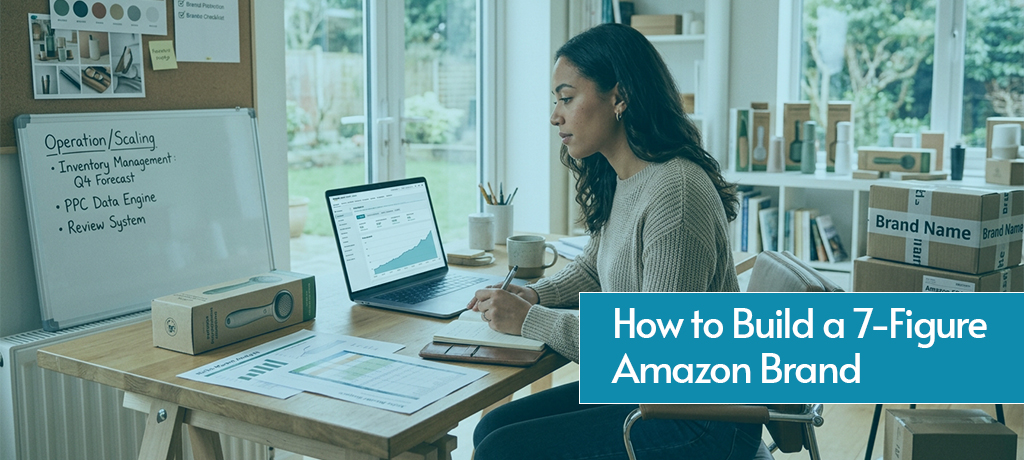
Learn how to build a 7-figure Amazon brand with this step-by-step blueprint covering strategy, PPC, listings, operations, profitability, and scalable growth.
Most sellers who start on Amazon share the same goal: build something that generates real, sustainable revenue. But there's a significant gap between a seller moving product and a seller who has actually managed to build a 7-figure Amazon business. The difference isn't luck, and it isn't just more ad spend. It's a fundamentally different approach to what's being built.
A product seller optimizes for the next sale. A brand builder optimizes for compounding equity: reviews that keep converting, organic rankings that keep delivering traffic, a catalog that cross-sells itself, and a business that holds its value whether Amazon's algorithm shifts or not. Seven-figure sellers understand that the listing is just the front door. The brand is what keeps customers coming back, what protects you from competitors, and ultimately, what creates something worth owning or selling.
This blueprint is built for sellers who are serious about building a 7-figure Amazon brand not overnight, but through the right steps executed in the right sequence.
What Does It Take to Build a 7-Figure Amazon Brand?
Building a 7-figure Amazon brand means more than reaching $1 million in annual sales. At this level, sustainable growth depends on strong margins, reliable inventory, high-converting listings, efficient advertising, and a recognizable brand. The strategy also changes as you scale. What works at $100K may not work at $1M. You need systems across product selection, Amazon SEO, PPC, profitability, inventory, and operations that can support continued growth.
What Does “7 Figures” Actually Mean?
A 7-figure Amazon brand generates at least $1 million in annual revenue, or roughly $83,000 in average monthly sales. But revenue alone doesn't define a healthy business. A brand can exceed $1M while struggling with high ad costs, low margins, stockouts, or excessive returns. The real goal is to build a brand that can generate $1M+ consistently and profitably.
Revenue vs. Profit: Why $1M in Sales Isn't Enough
Your actual profit depends on more than sales. You need to account for:
- Cost of goods and shipping
- Amazon fees
- PPC and other advertising
- Returns, discounts, and promotions
- Storage and operational expenses
Two brands can generate the same revenue but have very different financial results. That's why profitability should remain part of your growth strategy as you scale.
Step 1: Choose a Profitable Niche and Validate Demand
The foundation of every successful attempt to build a 7-figure Amazon business is the same: a niche with real, validated demand and a defensible position within it. Most sellers who stall out at five or six figures made their first critical mistake here, choosing a product based on personal interest, a trending search term, or low competition alone, rather than a combination of strong demand, manageable competition, and room for meaningful differentiation.
What to look for in a niche. Strong niches have consistent search volume that doesn't spike and crash seasonally, a top-seller BSR that indicates healthy category revenue, and enough product variety in the search results to confirm shoppers are actively buying across multiple options rather than gravitating to one dominant brand. You're not looking for a niche with zero competition; you're looking for one where you can win.
Validating demand before committing. Use tools like Helium 10, Jungle Scout, or Brand Analytics to estimate monthly search volume and unit sales for your target keywords. Look at the number of reviews on the top three to five results: if the first page is dominated by listings with tens of thousands of reviews, organic ranking will take longer and cost more in PPC to achieve. If the top sellers have a few hundred to a few thousand reviews, you're looking at a more accessible competitive landscape.
Finding your differentiation angle. Before finalizing a niche, identify specifically what you'll do differently. Better materials, a different size or configuration, improved packaging, a bundle that addresses a gap the category leaders aren't filling, or a superior brand experience any of these can be enough to justify your entry and command a price premium over competitors who are racing to the bottom on price alone.
Step 2: Build a Brand, Not Just a Product
This is the step most sellers skip or delay, and it's the one that most consistently separates the sellers who plateau from those who build a 7-figure Amazon brand. A product is something you sell once. A brand is something customers seek out, return to, and recommend, and it's an asset that compounds in value over time.
Define your brand positioning. Before you design a logo or pick a brand name, get clear on who your customer is, what they care about, and what your brand stands for. A supplement brand for active women over 40 has a completely different positioning, visual identity, and tone than a general wellness brand targeting everyone. The more specific your positioning, the more strongly it resonates with the customers it's built for.
Brand name and visual identity. Your brand name should be memorable, easy to spell, and available as a trademark. Visual identity: logo, color palette, typography, and packaging design should be consistent across every touchpoint: product packaging, listing images, A+ content, and your Amazon Storefront. Consistency builds recognition, and recognition builds trust.
Trademark registration and Amazon Brand Registry. Register your trademark early. This is non-negotiable for anyone serious about building a 7-figure Amazon brand. Trademark registration unlocks Amazon Brand Registry, which gives you access to A+ Content, Sponsored Brands ads, Brand Analytics, Project Zero, and brand protection tools. The filing process takes time in the U.S., typically eight to twelve months, but you can access Brand Registry with a pending trademark through Amazon's IP Accelerator program.
Think in terms of brand equity from day one. Every review you earn, every piece of content you publish, every customer experience you deliver is building equity in your brand. Sellers who think this way from the beginning make different decisions at every step decisions that compound toward seven figures.
Step 3: Source the Right Supplier and Protect Your Supply Chain
Your supplier is not just a vendor. They are a core part of your brand's quality control, your ability to scale, and your protection against supply chain disruptions that can crater your inventory position and your organic rankings at the same time.
Finding reliable suppliers. Platforms like Alibaba, Global Sources, and Made-in-China are the most common starting points for sourcing. When evaluating suppliers, look for verified status, trade assurance coverage, and a track record of working with brands selling in Western markets. Request samples from at least three suppliers before making a decision, and evaluate not just product quality but communication responsiveness, lead times, and willingness to accommodate customization.
Private labeling and product customization. The minimum requirement for building a brand is private labeling: your brand name and logo on the product and packaging. But the sellers building durable 7-figure brands go further than that. They customize the product itself adjusted formulas, improved materials, different configurations, or added features so that competitors can't replicate their listing exactly. The more proprietary your product, the harder it is to copy and the stronger your brand's defensibility.
Protecting your supply chain. Diversify where possible. Over-reliance on a single supplier is a risk that's easy to ignore when things are going smoothly and very hard to manage when they're not. Establish backup supplier relationships, negotiate minimum order quantities that give you flexibility without requiring excessive cash outlay on inventory, and build enough lead time into your reorder cycles to avoid stockouts that damage your ranking and your metrics.
Step 4: Create a Listing That Converts
Your listing is your salesperson. It works 24 hours a day across every device, and its job is to convert browsers into buyers without a human in the loop. A listing built for conversion covers five interconnected elements, and all five need to work together for the listing to perform at its best.
Title. Your title carries the most weight in Amazon's search algorithm and is the first thing a shopper reads. Lead with your primary keyword, include the most important product attributes (size, material, quantity, key feature), and write for both the algorithm and the shopper. A title that ranks but doesn't entice a click is as much of a problem as one that reads well but doesn't rank.
Bullet points. Five bullet points, each one doing a specific job: lead with a benefit, support it with a feature or proof point, and speak directly to your target customer's priorities. Don't use bullets to list generic specifications. Use them to answer the questions and objections a shopper has standing between them and the Add to Cart button.
Images. A high-performing image set includes a clean, compliant hero image on a white background, followed by lifestyle shots that show the product in use, infographic-style images that communicate key features and specifications, a scale reference image so shoppers understand size, and a social proof or results-oriented image if applicable. Images do more persuasive work than text for most shoppers, particularly on mobile where bullets are often collapsed.
A+ Content. A+ Content (available through Brand Registry) expands your listing below the fold with enhanced visuals, comparison modules, and brand storytelling. Well-executed A+ Content consistently lifts conversion rates, particularly for products that benefit from more explanation or products competing in crowded categories where differentiation needs reinforcing.
Backend keywords. The backend search terms section is invisible to shoppers but indexed by Amazon's algorithm. Use it to capture keyword variations, alternate spellings, and related terms that don't fit naturally into your front-end content. This is also where you can pick up relevant long-tail traffic without cluttering your visible listing copy.
Step 5: Launch with a Strategy, Not Just a Listing
Going live on Amazon without a launch strategy is one of the most common and costly mistakes sellers make. The first few weeks of a product's sales history significantly influence how Amazon's algorithm perceives its relevance and conversion quality, which in turn affects how aggressively it's indexed for organic search terms. A weak launch creates a weak organic foundation that costs far more in PPC spend to overcome later.
Pre-launch preparation. Before your inventory hits a fulfillment center, your listing should be fully optimized, your PPC campaigns structured and ready to activate, and your initial inventory level calibrated to cover at least the first 60 to 90 days of projected sales. Running out of stock in the first month destroys the sales velocity and keyword ranking momentum a launch is designed to build.
Generating early sales velocity. The goal of a launch is sales volume and conversion signals, not just visibility. Friends, family, and existing customers purchasing through a natural search-and-buy path, email list launches if you have an audience outside Amazon, influencer seeding for content and awareness, and early deal promotions through Amazon's Vine or coupon programs can all contribute to the initial velocity needed to start gaining organic traction.
The launch window matters. Amazon gives new listings a temporary ranking boost in the first few weeks. Taking advantage of this window with a coordinated push PPC turned on at day one, a promotional price or coupon to lift conversion rate, and active review solicitation through Amazon's Request a Review feature sets up a much stronger organic trajectory than a passive "list it and wait" approach.
Step 6: Master Amazon PPC to Fuel Early Growth
Amazon PPC is the most powerful accelerant available for early-stage growth, and when used correctly, it does two jobs at once: it drives immediate sales, and it generates the keyword conversion data that informs your organic SEO strategy. Sellers who treat PPC purely as an advertising cost are leaving half of its value on the table.
Build a foundational campaign structure. Start with three campaign types working together: an automatic campaign to capture keyword discovery, a broad match manual campaign to test variations at scale, and an exact match campaign targeting your highest-priority keywords with tighter budget control. Each serves a different purpose, and running all three from launch gives you a more complete picture of where your product's search demand actually lives.
Use search term reports to close the loop with SEO. The single most valuable output of your PPC campaigns isn't the sales; it's the search term data. Every week, review which terms are converting, which are spending without converting, and which you haven't targeted yet. Converting terms belong in your listing content as organic keywords. Non-converting terms need to be negated so you stop paying for irrelevant traffic.
Manage ACoS against your margin, not against a generic benchmark. A healthy ACoS varies by category, product margin, and where a product is in its lifecycle. A new product in launch phase may run a higher ACoS intentionally, because the goal is velocity and ranking, not immediate profit. A mature product with strong organic rank should see ACoS come down as organic sales take over a larger share of revenue. Tracking TACoS total ad spend as a percentage of total sales, not just ad-attributed sales, is the clearest way to measure whether your PPC investment is building organic momentum or simply maintaining paid visibility.
Scale what works, cut what doesn't. PPC management is not a set-and-forget activity. Bids need to be adjusted regularly based on performance data, budgets redistributed toward campaigns that are driving the most efficient conversions, and new keyword opportunities tested on a rolling basis. The sellers who build a 7-figure Amazon business through PPC are the ones who treat it as an ongoing optimization discipline, not a one-time setup.
Step 7: Build a Review Engine and Protect Your Reputation
Reviews are the single most powerful trust signal on Amazon. They influence conversion rates, organic ranking, and long-term brand credibility in ways that no ad campaign can replicate. The sellers building a 7-figure Amazon brand at scale don't wait for reviews to accumulate organically; they build a systematic process for generating them.
Use Amazon's native tools first. Amazon's Request a Review feature (available through Seller Central) sends a standardized, Amazon-approved review request to every buyer after their order is delivered. It's the lowest-risk, most compliant way to increase review velocity, and for most sellers it should be automated and applied to every order consistently.
Amazon Vine for new listings. The Vine program enrolls products with fewer than 30 reviews and distributes units to Amazon's network of trusted reviewers in exchange for honest feedback. Vine reviews tend to be detailed and credible, which makes them particularly valuable for building early social proof on new listings.
Protect your review score proactively. A product with a strong review average took significant time and sales to build that reputation. Protecting it requires monitoring for fake negative reviews from competitors, watching for quality complaints that signal a supplier issue before it compounds, and responding to negative feedback promptly and professionally. At scale, automated review monitoring tools that flag new reviews by sentiment and rating provide a much faster early-warning system than manual checks.
Step 8: Nail Inventory Management and Fulfillment Operations
Inventory management is where the most preventable margin losses happen in growing Amazon businesses. Stockouts destroy organic rankings and Buy Box ownership that took months to build. Overstock ties up cash and generates long-term storage fees that quietly erode profitability. Getting this layer right is what allows the rest of the brand-building work to compound rather than reset repeatedly.
Use FBA strategically. Fulfillment by Amazon is the most efficient path to Prime eligibility and competitive delivery performance for most sellers. But FBA isn't passive it requires active inventory planning. Monitor your IPI score, reorder points, and aged inventory levels regularly. Products approaching long-term storage fee thresholds need action: price adjustments, removal orders, or promotional pushes to clear stock before fees accumulate.
Build a reorder system with lead time built in. Most sellers underestimate how quickly multi-SKU catalogs deplete inventory, particularly during seasonal peaks or following a ranking improvement. Build your reorder calculations around your actual lead time: manufacturer production plus shipping, and factor in a safety stock buffer that accounts for demand variability. A buffer of two to four weeks above your average sales velocity is a reasonable starting point for most products.
Track profitability at the SKU level. Gross revenue is not the number that matters. Net margin per unit, after Amazon fees, FBA costs, PPC spend, COGS, and returns, is the number that tells you whether a product is actually contributing to your brand's growth or quietly bleeding cash. Running this analysis regularly across your catalog reveals which products deserve more investment and which need to be reformulated, repositioned, or discontinued.
Step 9: Expand Your Catalog and Cross-Sell Within Your Brand
This is the step where the separation between a product seller and a brand builder becomes undeniable. A single successful product can reach six figures with enough PPC investment and optimization. Building a 7-figure Amazon business consistently requires a catalog a set of complementary products under the same brand that cross-sell to the same customer, reinforce each other's rankings, and give your brand storefront a reason to exist beyond a single listing.
Expand within your niche, not across it. The strongest catalog expansions stay tightly within the original niche. If your first product is a protein supplement for active women, your second product should serve the same customer: a complementary supplement, a related wellness product, a different form factor of the original product. Expanding laterally into an unrelated category dilutes your brand identity and forces you to start over with a new audience rather than building on the trust you've already established.
Use data to identify expansion opportunities. Your Brand Analytics search query performance data, your existing customers' purchase behavior, and category gap analysis are all inputs for identifying which products your audience is already looking for that you could credibly offer. The best catalog expansions solve a problem your existing customers have, which gives you immediate access to a warm audience on launch rather than starting cold.
Leverage cross-selling and brand storefront placement. Once you have multiple products, your Amazon Storefront becomes a genuine marketing asset. Cross-promote products within your A+ Content using comparison modules, set up brand-targeted Sponsored Brands campaigns that showcase the full catalog, and use virtual product bundles to group complementary items. Each of these tactics increases average order value and deepens customer relationships with the brand rather than a single product.
Step 10: Protect and Scale the Brand
Once you've built real revenue and brand recognition on Amazon, three things need to happen simultaneously: protecting what you've built, extending the brand beyond Amazon, and positioning it for long-term value, whether that means continued ownership or eventual exit.
Brand protection at scale. Enroll in Transparency and Project Zero to stop counterfeits before they reach customers or damage your reviews. Use Brand Catalog Lock to prevent unauthorized content edits. Monitor your listings continuously for hijackers, unauthorized sellers, and pricing anomalies manually at first, and through automated tools once your catalog grows past what manual checks can cover reliably. Brand protection isn't a one-time setup; it's an ongoing discipline.
Multichannel expansion. Building a 7-figure Amazon brand doesn't mean staying confined to Amazon forever. Extending your brand to Walmart Marketplace, eBay, your own Shopify storefront, or international Amazon marketplaces reduces your dependency on a single channel and broadens your customer base. Each channel expansion requires platform-specific content and operational adjustments, but the brand equity you've built on Amazon reviews, product development, supplier relationships, and visual identity transfers directly and makes every subsequent launch faster.
Exit readiness and brand valuation. Amazon brands are acquired regularly, and the multiples that brand aggregators and strategic buyers pay are directly tied to factors within your control: revenue growth trajectory, margin health, catalog diversification, brand registry enrollment, clean account history, and supplier contract terms. Even if selling isn't your near-term goal, building as if it is forces the operational discipline that makes a brand more valuable and more resilient.
Common Mistakes That Keep Amazon Brands From Reaching 7 Figures
Scaling to $1M+ on Amazon requires more than increasing sales. Many brands get stuck because they scale the wrong areas, overlook profitability, or fail to build systems that can support higher volume.
1. Scaling PPC Before Fixing Conversion
Increasing ad spend won't solve a weak listing. If your images, pricing, reviews, or product messaging aren't strong enough to convert visitors, you'll simply pay more for the same poor results. Optimize the conversion experience before aggressively increasing traffic.
2. Ignoring Profitability
High revenue can hide weak margins. Brands should track contribution margin at the ASIN level and account for product costs, Amazon fees, advertising, returns, and discounts. Scaling an unprofitable product only makes the problem bigger.
3. Running Out of Inventory
Stockouts can lead to lost sales, weaker organic rankings, and wasted advertising momentum. As sales grow, inventory planning needs to account for lead times, seasonality, promotions, and expected growth. Reliable forecasting becomes essential at the 7-figure level.
4. Launching Too Many Products Too Quickly
Adding more SKUs doesn't automatically create more revenue. Expanding before validating demand can spread your cash, inventory, and marketing resources too thin. Focus first on strengthening your best-performing products before expanding the catalog.
5. Relying Too Heavily on One Product
A business built around one hero ASIN carries significant risk. Competition, changing demand, pricing pressure, or listing issues can quickly impact revenue. Building complementary products and multiple strong revenue drivers creates a more resilient brand.
6. Focusing on Revenue Instead of Sustainable Growth
Reaching $1M in sales is only part of the goal. Brands also need strong margins, healthy organic sales, efficient advertising, and reliable operations. Sustainable growth comes from building a business that can generate revenue consistently—not simply hitting a sales milestone once.
Conclusion
Building a 7-figure Amazon brand is not a shortcut game. It's a sequential process: niche validation, brand identity, supplier relationships, listing quality, launch strategy, advertising, reviews, inventory management, catalog expansion, and brand protection, where each step builds on the one before it. Sellers who try to rush the sequence, skipping brand fundamentals to move faster on product listings or scaling ad spend before the listing is ready to convert, consistently find themselves rebuilding from a weaker position later.
The blueprint works. What separates the brands that execute it successfully from those that stall out is rarely a lack of information; it's a lack of operational infrastructure and strategic partnership at the right moments.
Prime Retail Solution is built for exactly this kind of brand-building journey. As a comprehensive 3P marketplace partner, we work with brands across fulfillment, logistics, advertising, and growth strategy, helping sellers at every stage of the blueprint execute with more precision and less wasted spend. If you're serious about building a 7-figure Amazon brand and want a partner who's done it before, Get in touch with us today!.
FAQs
How long does it take to build a 7-figure Amazon brand?
There's no fixed timeline, but most brands that reach seven figures do so within two to four years of their first product launch, with serious investment in product quality, brand identity, listing optimization, and advertising from the beginning. Brands that treat Amazon as a side experiment typically take much longer or don't get there at all.
Do I need a large starting budget to build a 7-figure Amazon business?
Not necessarily, but you do need enough capital to cover initial inventory, listing photography, PPC launch spend, and brand development costs. Most successful brand builders start with $5,000 to $15,000 in initial capital and reinvest profits aggressively in inventory and catalog expansion rather than pulling cash out early.
Is private labeling required to build a brand on Amazon?
It's not strictly required, but it's strongly recommended. Selling a generic product you don't control makes it nearly impossible to differentiate, protect, or build loyalty around. Private labeling, even at a basic level, gives you the ability to control your product's presentation and improve it over time based on customer feedback.
How important is Amazon Brand Registry for building a 7-figure brand?
It's essential. Brand Registry unlocks A+ Content, Sponsored Brands ads, Brand Analytics, and the suite of brand protection tools that become increasingly important as your catalog and revenue grow. Any seller serious about building a 7-figure Amazon brand should prioritize trademark registration and Brand Registry enrollment from the start.
Can I build a 7-figure Amazon brand in a competitive category?
Yes, but the differentiation bar is higher. In competitive categories, success requires stronger product development, better listing content, a more aggressive launch strategy, and a longer runway to reach organic ranking. Category competitiveness doesn't prevent brand building it just raises the quality threshold at every step.
When should I start thinking about multichannel expansion?
Once your Amazon operations are stable and your primary products have strong, consistent sales history and reviews, typically after your first 12 to 18 months on Amazon with proven catalog performance. Expanding too early multiplies operational complexity before you've built the foundation that multichannel success depends on.
More from
the brief.

3P Fulfillment and Inventory Management: An Overview
At least for once we all have come across such a notification while making a purchase. Now be honest and tell me how often you circle back to that product to check whether it’s restocked or not? The…
Read article →
Amazon Listing Hijacking Explained: A Complete Guide for Sellers
You've spent months building your Amazon business. You've researched your product, optimized your listing, gathered reviews, and finally started seeing consistent sales. Then one day, something feels…
Read article →
Excess FBA Inventory: How It Impacts EBITDA and Cash Flow
When selling products on Amazon, managing inventory correctly is just as important as generating sales. Having enough stock helps keep listings active and prevents lost revenue, but holding too much…
Read article →Ready to talk
operations?
Tell us about your marketplace footprint. We'll respond within one business day.
Laguna Beach, CA 92651