Signs Your Brand Needs a 3P Marketplace Partner to Scale Faster in the USA
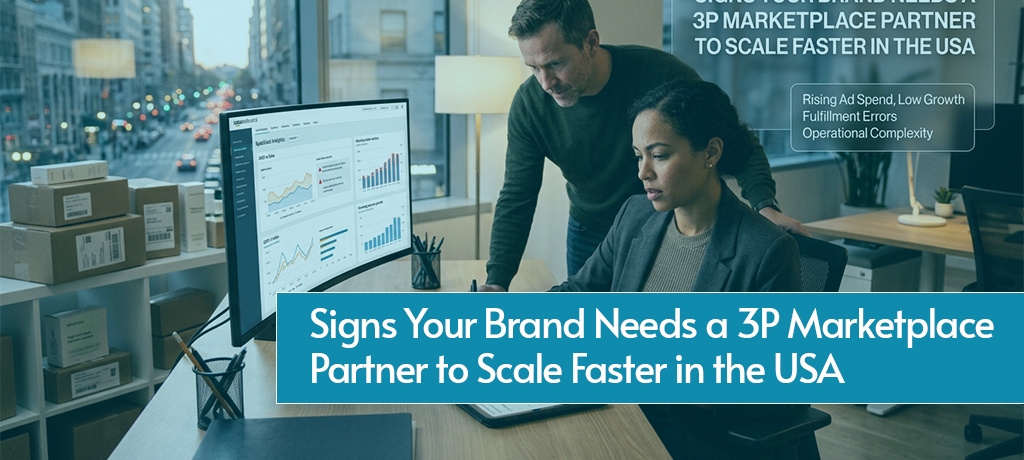
Discover 7 signs your brand needs a 3P marketplace partner to scale faster in the USA, from rising ad costs and inventory issues to margin pressure.
There's a pattern that plays out across hundreds of brands selling on Amazon in the U.S. every year. Sales climb. The catalog expands. Ad spend increases. And then, somewhere between healthy growth and the next revenue milestone, everything starts to feel heavier. Operations get more complex. Margins get tighter. The team that built the business to this point is now spending most of its time maintaining what exists rather than growing what's next.
Most brands interpret this as a product problem or a hiring problem. Sometimes it is. But more often, it's a partnership problem. The brand has outgrown its ability to manage the Amazon channel in-house, and the gap between where the business is and where it could be is getting wider every quarter.
A 3P marketplace partner exists to close that gap. Not by replacing your team, but by taking the operational, logistical, and marketplace execution load off your plate so your team can focus on what actually drives brand growth: product development, wholesale relationships, marketing strategy, and long-term vision.
This blog breaks down the specific, recognizable signs that a brand has reached the point where a 3P marketplace partner isn't just helpful; it's the difference between scaling and stalling.
What Does a 3P Marketplace Partner Actually Do?
A 3P marketplace partner operates as an extension of your brand on Amazon's third-party seller platform. Unlike the Amazon 1P vs. 3P model, where Amazon buys your products wholesale and controls pricing and listing content, the 3P model keeps that control with the brand or with the partner operating on the brand's behalf.
A strong 3P partner handles the full scope of marketplace operations: listing creation and optimization, advertising strategy and management, inventory planning and FBA logistics, pricing strategy, Buy Box defense, brand protection, and customer service. The brand retains ownership of the products, the pricing decisions, and the brand identity. The partner handles the execution infrastructure that makes all of it work at scale.
This isn't the same as hiring a freelancer to manage your PPC campaigns or outsourcing your warehouse. A 3P marketplace partner owns the operational layer end to end, which means they're accountable for results across every function that drives marketplace performance, not just one slice of it.
Sign 1: You're Spending More Time Managing Amazon Than Growing Your Brand
This is usually the first sign, and the easiest to rationalize away. Your founder, e-commerce director, or operations lead is spending the majority of their week inside Seller Central resolving case logs, adjusting bids, troubleshooting suppressed listings, coordinating FBA shipments, responding to customer messages instead of working on the things that actually grow the business.
Why this matters
Amazon operations are necessary work, but they're maintenance work. Every hour your leadership team spends managing day-to-day marketplace tasks is an hour not spent on product development, retail partnerships, brand strategy, or entering new channels. At a certain scale, the opportunity cost of managing Amazon in-house exceeds the cost of partnering with someone whose entire operation is built for it.
What it looks like in practice
Your team knows the listings need better images and A+ Content, but nobody has time to execute it. You're aware your PPC campaigns haven't been optimized in weeks. Inventory planning is reactive rather than strategic. You're always behind, but never on anything urgent enough to feel like a crisis just a constant drag on growth velocity.
The shift a partner creates
A 3P marketplace partner absorbs the entire operational surface area of Amazon management. Your team gets back the bandwidth to focus on brand-level decisions while the partner handles the execution that keeps the marketplace channel performing and improving daily.
Sign 2: Your Advertising Is Burning Budget Without Scaling Revenue
You're spending more on Amazon PPC every quarter, but revenue isn't growing proportionally. ACoS on Amazon is climbing. TACoS is flat or rising. New campaigns aren't producing the returns that earlier ones did. And the person managing your ads, whether it's a team member wearing multiple hats or a narrow-scope agency, doesn't have the bandwidth or the data visibility to diagnose why.
Why this matters
Amazon advertising gets more complex and more competitive every year. What worked eighteen months ago a simple auto campaign and a handful of exact match keywords doesn't produce the same results in a marketplace where CPCs have risen, new ad formats have launched, and Amazon's algorithm weighs more signals than ever. Brands that don't have dedicated, experienced advertising management fall behind gradually and then suddenly.
What inefficient ad spend costs actually
The loss isn't just the wasted dollars. Poorly targeted campaigns send the wrong shoppers to your listings, which lowers your conversion rate, which signals to Amazon's algorithm that your listing is less relevant, which reduces your organic ranking. Bad PPC doesn't just waste money; it actively damages organic performance.
What a partner brings
A 3P marketplace partner with advertising expertise manages campaigns as part of a connected system, not in isolation. They use search term data to inform listing SEO, adjust bids based on inventory position and margin targets, and build Amazon Sponsored Ads campaigns that scale efficiently as the catalog grows. Advertising becomes a growth engine rather than a cost center.
Sign 3: Inventory and Fulfillment Are Creating Bottlenecks You Can't Solve In-House
Stockouts that destroy organic rankings you spent months building. Overstock that racks up long-term storage fees. FBA shipments that arrive at the wrong fulfillment center or get stuck in receiving for weeks. IPI scores that limit your restock capacity at the worst possible time. If any of these sound familiar, your inventory and fulfillment operations have outgrown your current setup.
Why this matters
Inventory management is one of the highest-stakes operational functions on Amazon, and it's one of the first to break as a brand scales. A stockout on your best-selling ASIN doesn't just cost you the missed sales; it resets the organic ranking momentum that took months of advertising and optimization to build. And the cost of rebuilding that ranking is almost always higher than the cost of preventing the stockout in the first place.
The in-house limitation
Most brands managing Amazon inventory internally are working from spreadsheets, rough lead-time estimates, and manual reorder triggers. That works at low SKU counts with predictable demand. Once the catalog grows, demand patterns shift seasonally, and multiple fulfillment channels come into play, manual planning creates gaps that compound quickly.
What a partner brings
A 3P marketplace partner with fulfillment and logistics infrastructure manages inventory planning, FBA shipment coordination, restock timing, and storage optimization as a connected system. They monitor IPI scores, forecast demand against lead times, and ensure that the supply chain supports growth rather than constraining it.
Sign 4: You've Lost Control of Pricing, Buy Box, or Unauthorized Sellers
Your pricing strategy looks clean on paper, but the marketplace tells a different story. Unauthorized sellers are listing your products at undercut prices. Your Buy Box ownership is fluctuating unpredictably. MAP policy violations are going unaddressed. And every price disruption ripples through your advertising efficiency, your margin structure, and your brand perception.
Why this matters
On Amazon, pricing instability doesn't just affect one listing it affects everything connected to it. A lower-priced unauthorized seller wins the Buy Box, which means your PPC campaigns are now driving traffic to someone else's offer. Your conversion rate drops because shoppers see inconsistent pricing across sellers. And your brand's perceived value erodes when the same product appears at wildly different price points from different storefronts.
What losing control looks like
You discover new sellers on your listings that you didn't authorize. Your Buy Box percentage has dropped below 80% on key ASINs. You're spending time filing complaints and placing test orders instead of growing the business. Pricing across channels Amazon, your own website, retail partners is no longer consistent, and you don't have the monitoring infrastructure to catch violations in real time.
What a partner brings
A 3P marketplace partner actively monitors and defends your pricing position. They manage Buy Box strategy, identify and report unauthorized sellers, and help protect your brand against unauthorized sellers by coordinating with your distribution to close the gaps that allow gray-market inventory to reach the marketplace. Brand protection becomes an ongoing operational discipline rather than a reactive firefight.
Sign 5: Your Listings Aren't Optimized, and You Don't Have the Team to Fix Them
You know your titles could be stronger. Your images haven't been updated since launch. Your A+ Content is either missing or was built once and never revisited. Backend keywords are incomplete. And the listings that are converting reasonably well have never been tested against better versions, so you don't actually know how much revenue you're leaving on the table.
Why this matters
Every element of a listing title, bullets, images, A+ Content, and backend keywords is a lever that affects both discoverability and conversion rate. A listing that was "good enough" at launch may be underperforming significantly against competitors who have invested in professional content, tested variations through Amazon Experiments, and optimized for Amazon's evolving algorithm, including AI-driven features like Rufus.
The in-house gap
Most brand teams don't include a dedicated Amazon content specialist. The person who wrote the original listings is usually the same person managing ads, handling customer service, and coordinating shipments. Listing optimization gets deprioritized because it doesn't feel urgent, but the cumulative cost of underperforming listings compounds silently across every session, every ad click, and every organic impression.
What a partner brings
A 3P marketplace partner treats listing optimization as an ongoing discipline, not a one-time project. They audit content against category benchmarks, produce professional images and A+ Content, optimize backend keywords based on PPC conversion data, and test variations systematically. The result is listings that convert more of the traffic they're already getting, which improves every other metric downstream.
Sign 6: You Want to Expand to New Marketplaces but Don't Have the Infrastructure
You've built a strong presence on Amazon, and the next logical step is expanding to Walmart Marketplace, eBay, or international Amazon marketplaces. But every new platform requires its own account setup, listing content adapted to different algorithms, fulfillment infrastructure, pricing strategy, and ongoing management. And your team, already stretched thin on Amazon alone, doesn't have the bandwidth to build and manage a second or third channel properly.
Why this matters
Multichannel expansion is one of the highest-leverage moves a scaled brand can make it reduces single-platform dependency, opens new customer segments, and diversifies revenue. But expansion done poorly creates more problems than it solves: overselling from unsynchronized inventory, listing content that underperforms because it was copied from Amazon without adaptation, and seller metrics that suffer because nobody is actively managing the new channel.
The timing problem
Most brands delay expansion because they know they can't do it well with their current resources. That delay has a real cost every quarter you're not on Walmart or eBay is a quarter where competitors are building the review history, seller reputation, and organic rankings that you'll eventually need to compete against.
What a partner brings
A 3P marketplace partner with multichannel experience already has the infrastructure, the platform knowledge, and the operational systems to launch and manage your brand across multiple marketplaces simultaneously. They handle the platform-specific content, inventory synchronization, fulfillment coordination, and pricing strategy for each channel so expansion accelerates growth instead of overwhelming your team.
Sign 7: Revenue Is Growing, but Profitability Is Flat or Declining
This is often the most alarming sign, and the one that takes the longest to recognize. Top-line revenue is increasing sometimes significantly, but net margins are flat, shrinking, or even negative on certain SKUs. The business looks healthy from the outside, but the unit economics tell a different story.
Why this matters
Revenue growth without proportional profit growth is a structural problem, not a temporary one. It usually signals that one or more cost layers advertising, fulfillment, storage fees, returns, or operational overhead are scaling faster than revenue. And because Amazon's fee structure is complex and changes regularly, the margin erosion often happens gradually enough that it doesn't trigger alarm until it's already significant.
Where the margin leaks typically hide
Rising ACoS on campaigns that haven't been restructured as the catalog grew. Long-term storage fees on slow-moving inventory that wasn't cleared in time. FBA fee increases that weren't reflected in pricing adjustments. Returns on products with listing content that set incorrect expectations. And the hidden cost of internal labor: the hours your team spends on Amazon operations that could be spent on higher-value activities.
What a partner brings
A 3P marketplace partner manages profitability at the SKU level, not just the account level. They track net margin after all Amazon costs referral fees, FBA fees, advertising, storage, returns and make operational decisions that protect margin while scaling revenue. This includes restructuring ad campaigns for efficiency, clearing aged inventory before fee thresholds, adjusting pricing to reflect fee changes, and identifying which SKUs deserve more investment and which need to be repositioned or discontinued.
What to Look for in the Right 3P Marketplace Partner
Not all 3P partners are built the same, and choosing the wrong one can create as many problems as it solves. Before committing, evaluate potential partners against a few critical criteria.
Full-scope marketplace expertise. The right partner manages advertising, listing content, inventory, fulfillment, pricing, and brand protection as connected functions, not isolated services. If a partner only handles PPC but not content, or only content but not inventory, you'll end up coordinating between multiple vendors, which defeats the purpose.
A track record with brands at your stage. A partner who specializes in launching new sellers operates very differently from one built to scale established brands past seven figures. Ask for case studies or references from brands with similar catalog size, revenue level, and category complexity.
Operational transparency. You should have clear visibility into what the partner is doing, what's working, and what the numbers look like not quarterly summary reports, but regular access to performance data, ad metrics, inventory status, and margin analysis. A partner who can't or won't provide this level of transparency is a risk.
Experience in the U.S. marketplace specifically. Amazon's competitive dynamics, fee structures, fulfillment network, and consumer behavior in the USA are different from other regions. A partner with deep U.S.-specific expertise understands the nuances that affect performance here, from FBA placement fees to seasonal demand patterns to category-level advertising benchmarks.
Alignment with your brand's goals. The best partnerships aren't transactional; they're strategic. The right 3P partner understands where your brand is headed, not just where it is today, and builds the marketplace infrastructure to support that trajectory.
Conclusion
The signs that a brand needs a 3P marketplace partner are rarely dramatic. They show up as gradual friction: a team stretched too thin, ad spend that isn't scaling efficiently, inventory problems that keep recurring, pricing instability that erodes margin, listings that haven't been touched in months, and expansion plans that stay on the whiteboard because nobody has time to execute them.
Each of these individually is manageable. Together, they form a pattern that points to a structural gap between where your brand is and where it could be a gap that adding another hire or another tool won't close, because the problem isn't a missing person or a missing feature. It's a missing operational layer.
Prime Retail Solution is built to be that operational layer. As a comprehensive 3P marketplace partner, we manage fulfillment, logistics, advertising, listing optimization, pricing, brand protection, and multichannel expansion under one coordinated strategy. The goal is simple: give brands the infrastructure and marketplace expertise needed to scale efficiently across the U.S.
FAQs
What's the difference between a 3P marketplace partner and an Amazon agency?
A traditional Amazon agency typically provides specific services, PPC management, listing optimization, or consulting on a retainer or project basis. A 3P marketplace partner operates as your brand's execution arm on the platform, managing the full scope of marketplace operations end to end, often including inventory ownership, fulfillment coordination, and pricing strategy alongside advertising and content.
How do I know if I should manage Amazon in-house or use a partner?
If your internal team can manage all aspects of Amazon operations advertising, content, inventory, fulfillment, pricing, and brand protection without it pulling focus from higher-level brand growth activities, in-house management may still be the right fit. If any of the signs in this blog sound familiar, the operational load has likely outgrown what in-house management can handle efficiently.
Will I lose control of my brand if I work with a 3P partner?
No, at least not with the right partner. A good 3P marketplace partner operates under your brand guidelines, with your pricing approval, and with full transparency into every operational decision. You retain ownership of your brand identity, your products, and your strategic direction. The partner handles execution, not decision-making authority.
How long does it take to see results after partnering with a 3P marketplace partner?
Most brands see measurable improvements in advertising efficiency, listing performance, and operational stability within the first 60 to 90 days. Larger gains in improved organic ranking, margin expansion, and multichannel revenue growth typically build over three to six months as the partner's optimizations compound.
Is a 3P partner only useful for brands selling on Amazon?
No. Many 3P marketplace partners, including Prime Retail Solution, support brands across Amazon, Walmart, eBay, and other marketplaces. The value of a partner increases as you expand to multiple platforms, since each channel requires its own operational infrastructure that a partner already has in place.
What size brand benefits most from a 3P marketplace partner?
Brands generating mid-six to seven figures in annual marketplace revenue tend to benefit most, because they've reached the scale where operational complexity outpaces what a small internal team can manage efficiently, but haven't yet built the internal infrastructure that would make a partner redundant.
More from
the brief.
1P vs 3P: What Is Amazon 1P vs 3P and Which Is Better?
When brands begin selling on Amazon, one of the first strategic decisions they must make is choosing between Amazon 1P vs 3P selling models. While both approaches allow businesses to reach millions o…
Read article →
3P Fulfillment and Inventory Management: An Overview
At least for once we all have come across such a notification while making a purchase. Now be honest and tell me how often you circle back to that product to check whether it’s restocked or not? The…
Read article →
A Practical Guide to Brand Impression Share on Amazon
How Tracking and Improving Brand Impression Share Impacts Growth for Established Brands For brands already scaling on Amazon, it’s easy to focus on top-line sales while missing a key metric that dire…
Read article →Ready to talk
operations?
Tell us about your marketplace footprint. We'll respond within one business day.
Laguna Beach, CA 92651