

May
Amazon
The Hidden Costs of Amazon Seller Account Management Without a Marketplace Partner
Here’s a number that should give every independent Amazon seller pause: sellers who manage their own accounts without professional support lose an estimated 20–30% of their potential revenue to preventable operational errors, from wasted ad spend and suppressed listings to account health violations and missed reimbursements.
Most sellers know Amazon is competitive. What they underestimate is how complex it has become. Amazon Seller Central is no longer a dashboard you can check twice a week. It is a living, algorithm-driven environment that punishes inattention, rewards expertise, and changes its rules with little warning.
The real question isn’t “Can I manage my Amazon account myself?” Most sellers can, at a basic level. The real question is: What is that decision actually costing you?
This blog breaks down the six hidden costs that accumulate when sellers operate without professional Amazon seller account management services, and why more brands are turning to marketplace partners to stop the bleed and accelerate growth.
What Is Amazon Seller Account Management And Why It’s More Complex Than You Think
Amazon seller account management refers to the end-to-end oversight of a brand’s presence on Amazon’s marketplace. This includes everything that happens inside Seller Central: product listings, sponsored advertising, inventory planning, account health monitoring, customer service metrics, and compliance with Amazon’s ever-evolving policies.
At its core, Amazon seller central account management covers six operational pillars:
1. Listing Optimisation: Titles, bullet points, descriptions, backend keywords, A+ Content, and images that meet Amazon’s content standards and rank in organic search.
2. Advertising Management: Sponsored Products, Sponsored Brands, Sponsored Display, and Amazon DSP campaigns, including bid strategies, keyword harvesting, and ACOS/ROAS management.
3. Inventory & FBA Operations: Stock planning, replenishment, inbound shipment management, IPI score maintenance, and avoiding long-term storage fees.
4. Account Health & Compliance: Order defect rate (ODR), late shipment rate, valid tracking rate, policy adherence, IP complaints, and suspension prevention.
5. Customer Experience: Voice of the Customer metrics, review management, and A-to-Z claim handling.
6. Marketplace Strategy: New ASIN launches, category expansion, competitor monitoring, Brand Registry management, and international marketplace entry.
A decade ago, a competent seller could handle all of this alone. Today, each of these pillars has become a specialist discipline in its own right. Amazon updates its algorithm, fee structure, and seller policies dozens of times a year. Without someone dedicated to tracking and implementing those changes, gaps appear, and gaps cost money.
What Amazon Seller Account Management Really Costs Without a Marketplace Partner
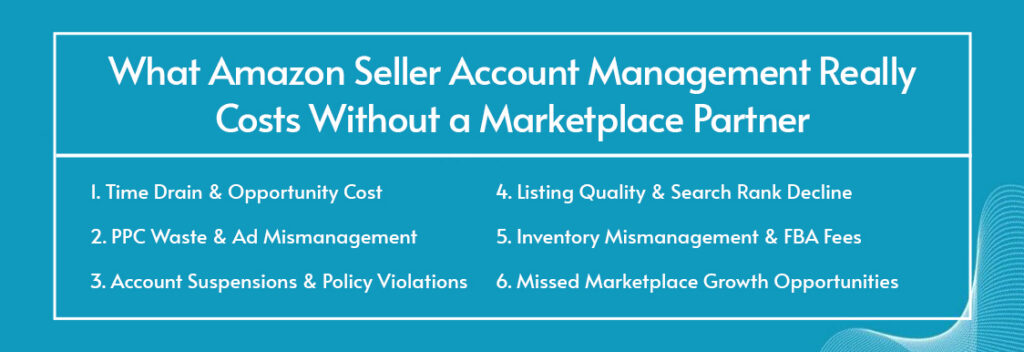
1. Time Drain and Opportunity Cost
Let’s start with the cost that rarely appears on a P&L but is felt every day: time. A realistic estimate of the weekly time required for competent DIY Amazon seller account management looks like this:
| Task | Weekly Hours |
| Listing maintenance & SEO updates | 3–5 hrs |
| PPC campaign monitoring & optimisation | 4–8 hrs |
| Inventory planning & FBA management | 2–4 hrs |
| Account health & policy monitoring | 2–3 hrs |
| Customer communication & case management | 2–4 hrs |
| Reporting & performance analysis | 2–3 hrs |
| Total | 15–27 hrs/week |
For a mid-size seller managing 50–200 SKUs, that’s effectively a full-time job, one that falls on founders, operations managers, or in-house staff who already have primary responsibilities.
The opportunity cost here is enormous. Every hour a founder spends navigating a Seller Central case is an hour not spent on product development, supplier negotiations, brand building, or scaling into new channels. Every hour an operations manager spends manually adjusting bids is an hour not spent optimising the wider supply chain.
Time is the one resource Amazon sellers cannot recover. Professional Amazon marketplace management converts that time back into strategic capacity, which compounds far beyond the cost of the service itself.
2. PPC Waste and Advertising Mismanagement
Amazon advertising has become one of the most sophisticated, and expensive, paid media environments in digital commerce. For sellers without dedicated expertise, it is also one of the biggest sources of invisible margin loss.
The average Amazon seller running self-managed campaigns wastes between 25–40% of their ad spend on poorly targeted keywords, inefficient match types, and stale bids that haven’t been adjusted to reflect changing competition or seasonality.
Here’s what that mismanagement looks like in practice:
Broad Match Keyword Waste Without regular search term report analysis, broad match campaigns serve ads on irrelevant queries. A seller listing premium kitchen knives might be spending budget on “knife crime statistics” or “knife sharpening stone”, neither of which convert.
Ineffective Bid Management. Amazon’s auction dynamics shift constantly. A bid that was profitable in January may be vastly overpaying by April or missing out on high-intent traffic by August. Self-managed accounts rarely adjust at the frequency required.
Funnel imbalance. Most DIY advertisers over-invest in Sponsored Products and underutilise Sponsored Brands and Sponsored Display, missing the upper-funnel brand awareness that feeds long-term organic rank.
No dayparting or placement adjustments. Amazon allows bid multipliers by placement (top of search, rest of search, product pages) and time of day. Without active management, sellers leave significant efficiency on the table.
Professional Amazon seller account management services typically reduce wasted ad spend by 20–35% in the first 60–90 days while maintaining or growing total attributed sales, a direct margin improvement that often exceeds the cost of the service.
3. Account Suspensions and Policy Violations
Of all the hidden costs on this list, account suspension is the most catastrophic, and the most preventable.
Amazon’s seller performance team issues suspensions for a wide range of violations, many of which accumulate quietly over time before triggering a sudden account-level action. The most common triggers include:
- Order Defect Rate (ODR) exceeding 1%: driven by negative feedback, A-to-Z claims, and chargeback disputes
- Late Shipment Rate (LSR) above 4%: a chronic issue for FBM sellers without automated dispatch systems
- Intellectual Property complaints: especially problematic in categories like electronics, apparel, and beauty
- Inauthentic or counterfeit claims: even against legitimate sellers, often from competitors filing bad-faith complaints
- Listing policy violations: restricted keywords in titles, prohibited claims in product descriptions, or category-specific compliance failures
The financial impact of a suspension is severe. Research consistently shows that reinstating a suspended account takes an average of 14–30 days, and during that period, a seller with $100,000 in monthly revenue is losing approximately $3,000–$5,000 per day in foregone sales, before accounting for rank recovery time, which can add months to the true cost.
The hardest part? Many suspensions are entirely avoidable with proper Amazon seller central account management. Monitoring account health metrics daily, responding proactively to policy notifications, maintaining accurate documentation, and submitting well-crafted Plans of Action before issues escalate, these are standard practice for professional marketplace managers, and they rarely feature in DIY workflows until it’s too late.
4. Listing Quality and Search Rank Decline
Your Amazon listing is not a set-and-forget asset. It is a dynamic piece of content that competes in a search algorithm that changes continuously, and one that degrades in performance if left unattended.
The most common symptoms of listing neglect are:
- Keyword indexation gaps. Amazon’s A10 algorithm periodically re-evaluates which keywords a listing is indexed for. Backend keyword terms that worked 18 months ago may no longer be indexed. Without regular audits, listings quietly lose organic reach.
- Content staleness. Competitor listings evolve. If your title, bullet points, and A+ Content haven’t been refreshed to reflect current search behaviour, buyer language shifts, or seasonal demand, your conversion rate erodes, and Amazon’s algorithm notices.
- Image non-compliance. Amazon updates its image policy requirements by category. Main images, lifestyle shots, and infographics that were compliant last year may now result in suppression or reduced visibility.
- Review velocity decline. An aging ASIN with a slowing review acquisition rate loses ranking weight over time. Without a structured post-purchase review strategy built into your Amazon marketplace management, organic rank suffers.
- A+ Content gaps. Brand-registered sellers who haven’t published A+ Content on their key ASINs are leaving a measurable conversion rate uplift, typically 3–10%, on the table on every single product page visit.
The compound effect of listing decay is invisible until it isn’t. A listing that ranked on page one two years ago may now sit on page three, not because of anything dramatic, but because dozens of small optimization opportunities were missed while competitors continued to invest.
5. Inventory Mismanagement and FBA Fees
Inventory management is where many Amazon sellers’ hidden costs reach their peak, because the fees involved are both significant and easy to overlook until they appear on a monthly statement.
- Long-Term Storage Fees. Amazon charges long-term storage fees (LTSF) for units that have been in fulfillment centres for more than 365 days. For slow-moving SKUs, these fees can exceed the value of the inventory itself. Without proactive monitoring and removal orders, LTSF accumulates silently.
- Stranded Inventory. When a listing is suppressed, closed, or has a fulfillment issue, the associated inventory becomes “stranded”, sitting in a fulfillment centre, costing storage fees, but generating zero revenue. Amazon’s stranded inventory reports require regular review and action that most self-managed sellers delay.
- FBA Reimbursements. Amazon loses, damages, or miscounts seller inventory with surprising frequency. The reimbursement process requires sellers to identify discrepancies through Seller Central reports and file cases manually. Industry estimates suggest that the average seller with active FBA shipments is owed between $500–$3,000 in unretrieved reimbursements at any given time, money that disappears permanently after an 18-month claims window.
- IPI Score Penalties. Amazon’s Inventory Performance Index (IPI) score determines how much storage capacity a seller is allocated in fulfilment centres. Scores below 400 trigger storage limits, meaning sellers cannot send in sufficient stock ahead of peak periods like Prime Day or Q4. Maintaining a strong IPI requires consistent sell-through rate management, excess inventory liquidation, and in-stock rate optimization: all tasks that require dedicated bandwidth.
Professional Amazon marketplace management services typically recover FBA reimbursements as a matter of course, maintain IPI scores well above thresholds, and build inventory plans that prevent both overstock and stockout scenarios, directly protecting margin and sales continuity.
6. Missed Growth Opportunities on the Marketplace
The five costs above are all about preventing loss. This one is about the growth that never happens. The Amazon marketplace offers a significant suite of growth levers that most self-managed sellers either don’t know exist or don’t have the bandwidth to activate:
Amazon Brand Registry unlocks access to A+ Content, Sponsored Brands, Brand Analytics, the Brand Dashboard, and Virtual Bundles. Many eligible sellers are either not enrolled or enrolled but not actively using the full toolkit.
Amazon DSP (Demand-Side Platform) allows brands to run programmatic display advertising both on and off Amazon, retargeting shoppers who viewed product pages, reaching new audiences based on Amazon’s first-party purchase data. Almost no solo sellers access this channel.
Amazon Attribution lets brands measure how off-Amazon traffic (Meta ads, Google ads, email campaigns) converts on Amazon, providing the cross-channel data needed to scale blended marketing efficiently.
International Marketplace Expansion. Amazon operates established marketplaces across Europe, the Middle East, Australia, and beyond. For brands with scalable products, international expansion via a connected european or global account can double or triple addressable market, but it requires compliance, localisation, and marketplace-specific optimisation that goes beyond most in-house capabilities.
New ASIN Launch Strategy. Launching a new product on Amazon successfully requires a coordinated approach: pre-launch inventory positioning, launch-day PPC structure, review seeding strategy, and rank-building velocity campaigns. Done correctly, a new ASIN can reach page one within 30–60 days. Done incorrectly, it sits dormant, wasting listing fees and inventory capital.
Every one of these growth opportunities has a direct revenue multiplier attached to it. Without professional Amazon marketplace management, they remain theoretical, opportunities that competitors are already capitalising on.
DIY vs. Marketplace Partner: A True Cost Comparison
When sellers weigh the cost of hiring Amazon marketplace management services against managing in-house, they typically compare agency fees against the salary of an employee. That framing misses the full picture.
| Factor | DIY / In-House | Marketplace Partner |
| Monthly Cost | $3,000–$8,000 (salary + tools) | $1,500–$5,000 (managed service) |
| PPC Expertise Level | Generalist | Specialist (platform-certified) |
| Policy & Algorithm Updates | Reactive | Proactive |
| Suspension Risk | High (reactive monitoring) | Low (daily account health oversight) |
| FBA Reimbursement Recovery | Often missed | Systematically recovered |
| Advertising Efficiency | 30–40% estimated waste | 10–20% typical waste |
| Growth Activation | Limited (bandwidth constrained) | Structured (roadmapped quarterly) |
| Scalability | Bottlenecks at founder/team capacity | Scales with account growth |
| Listing Optimisation Frequency | Quarterly at best | Monthly or continuous |
| International Expansion | Rarely actioned | Built into growth roadmap |
What to Look for in Amazon Marketplace Management Services
If you’re evaluating a marketplace partner for the first time, or reassessing your current one, here are the seven criteria that separate genuinely capable agencies from commodity providers:

1. Verified Amazon Expertise. Look for Amazon Ads Partners (formerly AMG/AMS certified agencies) and team members with demonstrated Seller Central experience across multiple categories. Ask for case studies with specific, attributed results.
2. Transparent Reporting. You should receive regular reporting on account health metrics, advertising performance (including actual ACoS, ROAS, and total ad spend), inventory KPIs, and ranking data. Vague “we’re working on it” updates are a red flag.
3. Full-Funnel Advertising Management. Any provider that only manages Sponsored Products is not providing complete Amazon marketplace management. Look for demonstrated capability across Sponsored Brands, Sponsored Display, and ideally Amazon DSP.
4. Proactive Account Health Monitoring. Ask specifically how they monitor account health and what their suspension response protocol looks like. The best providers have daily monitoring workflows and intervene before issues become violations.
5. Listing Optimisation Process. Understand how often they audit and update listings, what their keyword research methodology is, and whether they have in-house creative capability for A+ Content and image optimisation.
6. Inventory & FBA Expertise. Confirm they have experience managing IPI scores, handling stranded inventory, processing reimbursement claims, and building replenishment models — not just advertising.
7. Clear Communication & Ownership. You need a dedicated point of contact who understands your account, your brand, and your goals, not a rotating team of account managers following a script.
The right Amazon marketplace management services partner functions as an extension of your team: bringing platform expertise, bandwidth, and strategic perspective that most brands cannot build internally at a comparable cost.
Conclusion
Every day that a growing Amazon brand operates without professional account management is a day those six hidden costs are quietly compounding: wasted ad spend, missed reimbursements, rank decay, compliance risk, operational inefficiency, and foregone growth.
None of these costs appear as a line item on a Seller Central report. They show up instead as stagnant revenue, eroding margins, and the nagging sense that competitors are pulling away — not because they have better products, but because they have better management of the same marketplace.
The decision to engage professional Amazon seller account management services is not an admission that you can’t manage the platform. It is the strategic recognition that your time and expertise have a higher value deployed elsewhere, and that the platform rewards those who invest in operational excellence.
If you’re ready to understand exactly where your hidden costs are accumulating and what a structured marketplace management partnership could recover and unlock for your brand, the first step is an account audit.
Book a free account audit with Prime Retail Solution.
FAQs
What does Amazon seller account management include?
Amazon seller account management covers the full operational scope of a brand’s Amazon presence: product listing creation and optimisation, PPC advertising management, inventory and FBA oversight, account health monitoring, compliance management, customer metrics, and marketplace growth strategy. The scope varies by provider, so always confirm which services are included before engaging an agency.
How much do Amazon marketplace management services cost?
Pricing varies by account size and scope. Most professional Amazon marketplace management services charge between $1,500–$5,000 per month for mid-market brands, often combined with a percentage of ad spend (typically 10–15%) for advertising management. Some agencies offer performance-based structures. For larger accounts (above $500K monthly revenue), enterprise retainers or revenue-share models are common.
Is it worth hiring an Amazon agency for a small seller?
For sellers generating less than $10,000 per month, a full-service agency may not be cost-justified, though specialist consultants or fractional management services can still provide significant value. The inflection point where professional Amazon seller account management services typically pay for themselves is around $20,000–$30,000 in monthly revenue, where PPC waste reduction and listing optimisation alone tend to cover the management fee.
What is Amazon Seller Central account management?
Amazon Seller Central account management refers specifically to the operational management of a brand’s account within Amazon’s Seller Central portal, the primary interface through which third-party sellers manage listings, orders, advertising, inventory, and account health. It encompasses everything from day-to-day operations to strategic growth decisions made within the platform.
How do I know if my Amazon account needs a marketplace partner?
Key indicators include: your ACoS has been rising without a corresponding increase in revenue; your organic rankings have declined over the past 6–12 months; you’ve received account health warnings or performance notifications; your advertising accounts for more than 25% of revenue but isn’t growing efficiently; or you simply don’t have the time or expertise to manage the complexity of the platform at the level your competitors are operating.
What’s the difference between an Amazon account manager and an Amazon agency?
An Amazon account manager is typically an individual, either an in-house hire or a freelancer, who manages specific aspects of your account. An Amazon agency is a team-based service provider offering multi-disciplinary expertise across advertising, operations, content, and strategy. For most growing brands, the team-based model of a professional agency offers more consistent coverage, broader expertise, and greater resilience than relying on a single individual.
Can a marketplace partner help if my Amazon account has been suspended?
Yes. Experienced Amazon marketplace management services providers have typically handled numerous suspensions across a range of violation types. They can audit the root cause, draft a compelling Plan of Action (POA), and manage the appeals process with Amazon’s Seller Performance team. Acting quickly and professionally in a suspension scenario significantly improves reinstatement outcomes and timeline.
Share