Wholesale vs. 3P Selling: Which Model Fits Your Brand?
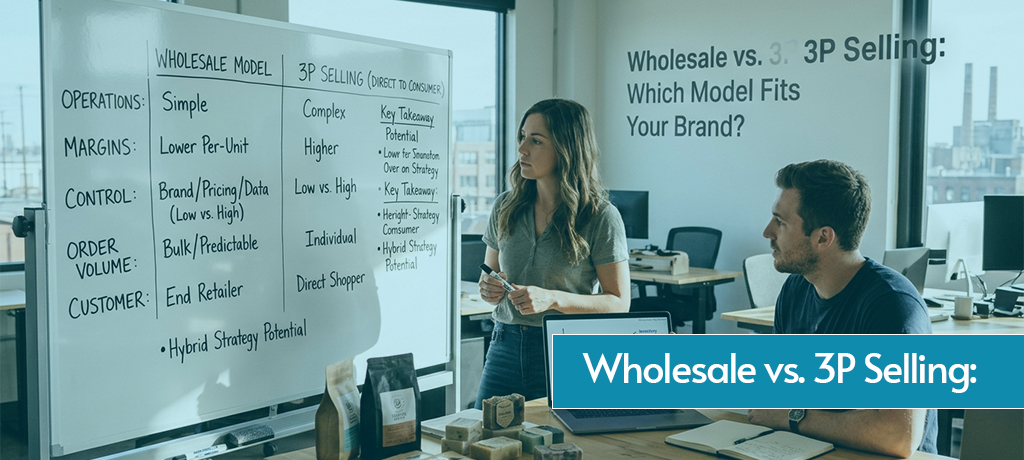
Compare wholesale vs. 3P selling to understand margins, pricing control, operational costs, and customer data, and choose the right model for your brand.
Few decisions shape a brand's trajectory on Amazon as much as the selling model it chooses. It determines who sets your prices, who owns your customer relationships, how much margin you keep, how predictable your cash flow is, and how much operational work lands on your team. Get it right, and the model becomes a quiet advantage that compounds. Get it wrong, and you can spend years fighting your own structure, surrendering margin you didn't need to, or drowning in operational complexity you weren't built for.
The choice usually comes down to two paths. In a wholesale distribution model, you sell your products in bulk to a buyer Amazon itself, a retailer, or a distributor who then resells them to the end customer. In third-party marketplace selling, you keep ownership of your products and sell directly to shoppers on the marketplace, setting your own prices and managing your own presence.
Understanding the real trade-offs in wholesale vs 3P selling is what lets you match the model to your brand rather than defaulting to whatever feels easiest. This guide breaks down how each model works, where each one makes or costs you money, and how to decide which fits your brand today.
What Is Wholesale Selling?
In a wholesale distribution model, you sell your products in bulk, at a wholesale price, to a buyer who then takes on the job of reselling them to the end customer. That buyer might be Amazon itself through the first-party (1P) Vendor Central relationship, where Amazon purchases your inventory on purchase orders and retails it under the "Ships from and sold by Amazon" badge, or it might be a traditional retailer or distributor that stocks your products across its own channels.
How it works
You receive a purchase order, you ship the agreed quantity, and you get paid on the buyer's payment terms. Once the goods leave your dock, the buyer owns the inventory and controls how it's priced, presented, and sold. Your revenue is wholesale revenue a lower price per unit than retail, but typically on larger, more predictable order volumes.
Who is it for
Wholesale tends to fit brands that value simplicity and scale over control. If you'd rather move large volumes through a few big buyers than manage thousands of individual customer transactions, wholesale is operationally lighter. It's also a natural fit for established brands with the production capacity to fulfill large orders and the margin structure to absorb wholesale pricing while staying profitable.
What Is 3P Selling?
In third-party marketplace selling, you remain the seller. Using Amazon's Seller Central platform, you list your own products, set your own prices, manage your own advertising, and sell directly to shoppers. Amazon provides the marketplace and the traffic; you retain ownership of the offer and the margin.
How it works
You create or join product listings, decide how to fulfill orders, and sell to consumers at retail prices, paying Amazon a referral fee on each sale. Fulfillment is flexible: you can use Fulfillment by Amazon (FBA), where Amazon stores and ships your inventory and makes it Prime-eligible, or Fulfillment by Merchant (FBM), where you handle shipping yourself. Either way, you hold the inventory until it sells, and you capture the full retail price minus Amazon's fees.
Who is it for
The 3P model fits brands that want control over pricing, branding, and the customer experience, and that have the capacity in-house or through a partner to run the operational side. It's particularly strong for brands with distinct identities, niche or premium products, frequent launches, or a need to protect pricing and margin that a wholesale relationship would erode.
Wholesale vs. 3P Selling: Key Differences
This table summarizes the trade-off, but the three factors that matter most margin, control, and operational load deserve a closer look, since they're where the real decision lives.
Margins and Cash Flow: Where Each Model Makes or Costs You Money
The most immediate difference between wholesale vs. direct selling shows up in your unit economics.
Wholesale margins are lower but simpler. When you sell wholesale, you're selling at a discount to retail, often 40% to 55% off the retail price, depending on category and buyer. That's a meaningful margin give-up. In exchange, you typically move larger volumes in fewer transactions, you don't carry advertising or fulfillment costs on those units, and your revenue is more predictable. For brands that value stability and lower operational cost over maximum margin per unit, that trade can be worth it.
3P margins are higher, but you fund the execution. In third-party marketplace selling, you capture the full retail price and pay Amazon a referral fee (commonly 8–15% by category) plus any fulfillment costs. That leaves a higher gross margin per unit than wholesale, but you're also paying for advertising, listing optimization, storage, and customer service out of that margin. The ceiling is higher, but so is the operational spend required to reach it.
Cash flow works differently in each. Wholesale often means larger orders paid on the buyer's terms, which can stretch 30 to 90 days predictable but slower. The 1P relationship with Amazon is known for longer payment cycles in particular. The 3P model generally pays out on faster, more frequent cycles, which can ease cash flow for growing brands, though it comes with the trade-off of holding inventory risk until each unit sells.
Control: Pricing, Branding, and the Customer Relationship
If margin is the most immediate difference, control is the most strategic one, and it's usually the factor that tips the decision for brand-focused sellers.
Pricing control. In a wholesale distribution model, once you sell to the buyer, they control the retail price. With Amazon 1P specifically, Amazon's pricing algorithms may discount your products to stay competitive, which can undercut your pricing on other channels and break MAP (minimum advertised price) agreements with other retail partners. In 3P, you set and control your own prices, which protects your brand's price positioning and your relationships across channels. Brands reconsidering the 1P model can learn how transitioning from Vendor Central to Seller Central may offer greater control over pricing and brand management.
Branding and listing control. Wholesale typically hands content control to the buyer. On Amazon 1P, the vendor submits content, but Amazon's merchandising team controls the final product pages. In 3P, you own your listings end to end: titles, images, A+ Content, and your Storefront, which matters enormously for brand consistency and conversion.
Customer relationship and data. This is often the deciding factor for brands building long-term equity. Wholesale selling puts a buyer between you and the end customer, so you get limited visibility into who's buying and why. Third-party marketplace selling keeps that relationship closer, giving you access to Amazon Brand Analytics, search and conversion data, and the insight needed to optimize your catalog over time. For brands that treat data as a competitive weapon, that visibility is hard to give up.
Operational Load: What Each Model Actually Requires From Your Team
Margin and control are the upside of 3P; operational load is its cost. Understanding what each model demands of your team is essential to choosing one you can actually execute.
Wholesale is operationally lighter. The wholesale model concentrates your effort into fewer, larger transactions. You manage buyer relationships, fulfill purchase orders, and handle the terms and deductions that come with wholesale accounts. You don't run advertising campaigns, optimize listings daily, manage FBA inventory, or field customer service inquiries on individual orders. For a lean team, that simplicity is a genuine advantage.
3P is operationally demanding. Third-party marketplace selling asks your team to run the full marketplace operation: listing creation and optimization, PPC advertising, inventory planning and FBA logistics, pricing strategy, Buy Box defense, brand protection, and customer service. Each of these is a discipline in its own right, and together they require real, ongoing attention. This operational weight is exactly why many 3P brands work with a specialized partner rather than trying to build every function in-house.
The honest way to frame it: wholesale trades margin for simplicity, and 3P trades simplicity for margin and control. Neither is "easier" in the abstract; the right one depends on what your team is actually built to do.
Pros and Cons of Wholesale Selling
Pros:
- Predictable, high-volume orders. Fewer, larger transactions make revenue easier to forecast and plan production around.
- Lower operational overhead. No advertising, listing management, or per-order customer service to run.
- Faster scale through established buyers. A single retail or distribution relationship can move significant volume without you building a direct sales operation.
- Reduced inventory risk after sale. Once the buyer purchases, the inventory risk shifts to them.
Cons:
- Lower margins. Wholesale pricing means giving up a substantial share of retail value.
- Little pricing or brand control. The buyer decides how your products are priced and presented, which can create channel conflict and MAP issues.
- No direct customer relationship or data. A buyer sits between you and the end customer, limiting your insight and your ability to build loyalty.
- Dependence on a few large buyers. Losing one major account can create a significant revenue gap.
Pros and Cons of 3P Selling
Pros:
- Higher margins. You capture retail price rather than wholesale, even after Amazon's fees.
- Full control of pricing and branding. You protect your price positioning and own your listings, content, and brand presentation.
- Direct customer relationship and data. Access to Brand Analytics and sales data lets you optimize continuously and build brand equity.
- Flexibility across your catalog. You can list your full range, including niche and seasonal SKUs a wholesale buyer wouldn't stock deeply.
Cons:
- Higher operational load. You own advertising, listings, inventory, fulfillment coordination, and customer service.
- You carry inventory risk. Unsold stock ties up cash and can accrue storage fees.
- More exposure to marketplace dynamics. You manage competition, Buy Box pressure, and advertising costs directly.
- Requires expertise to do well. The margin advantage only materializes if the operation is run competently.
The Hybrid Approach: Why Many Brands Run Both
For a large share of established brands, the wholesale vs 3P selling question doesn't resolve to a single answer because the smartest structure often uses both. A hybrid model matches each product to the operating model that fits its economics best.
How brands typically split it. Core, high-volume SKUs with steady, predictable demand often go through wholesale or 1P, where the fulfillment velocity and predictable large orders add value and the margin give-up is acceptable at scale. New launches, bundles, seasonal items, niche products, and higher-margin SKUs go through 3P, where you control price and margin and can react quickly to performance data.
Why it works. The hybrid model gives you the predictability and reach of wholesale on the products that benefit from it, while preserving the margin, control, and data advantages of third-party marketplace selling on the products where those matter most. It also adds resilience: when a wholesale buyer's purchase orders slow or create stock gaps, which happens regularly in the 1P relationship, your 3P listings keep revenue flowing.
The caveat. Running both models well is more complex, not less. It requires careful inventory allocation, consistent cross-channel pricing to avoid undercutting yourself, and the operational capacity to manage two different relationships with Amazon simultaneously. The payoff is real, but so is the coordination it demands.
How to Choose the Right Model for Your Brand
There's no universal answer, but a few questions tend to settle the wholesale vs marketplace selling decision for most brands.
What are your margins? If your unit economics can comfortably absorb a 40–55% discount to retail and still leave acceptable profit, wholesale is viable. If your margins need retail capture to work, lean toward 3P.
How much control does your brand strategy require? If protecting pricing, brand presentation, and customer relationships is central to your strategy, especially if you enforce MAP across retail partners, 3P is often the only model that fully supports it. If control is less critical than reach and simplicity, wholesale fits comfortably. Understanding MAP policy violations can help brands recognize pricing conflicts that may arise when selling through multiple channels.
What's your operational capacity? If you have the team or a partner to run advertising, listings, inventory, and customer service, 3P's margin advantage is within reach. If you're lean and prefer fewer, larger transactions, wholesale's simplicity is a real benefit.
How large and varied is your catalog? Brands with large or complex catalogs (think 250+ SKUs), frequent launches, or many niche and seasonal items usually get more value from 3P's flexibility, since a wholesale buyer rarely stocks that full range deeply.
What stage is your brand at? Early-stage and growth-stage brands often favor 3P for the control and data they need to build momentum and prove their model. Established brands with strong production capacity and a strategic reason to move volume through big buyers may find wholesale or a hybrid the better fit.
A useful default: if you can't point to a specific, quantifiable reason that wholesale serves your brand better, 3P's combination of margin, control, and data makes it the stronger starting point for most brands. But the right answer is the one that matches your actual numbers, catalog, and capacity, not a generic rule.
Conclusion
The choice between wholesale and 3P selling isn't about which model is better in the abstract; it's about which one fits your brand's margins, catalog, operational capacity, and appetite for control. Wholesale offers simplicity, predictable volume, and lower operational overhead, at the cost of margin and control. Third-party marketplace selling offers higher margins, full control of pricing and branding, and direct access to customer data, at the cost of running a more demanding operation. And for many established brands, the strongest answer is a deliberate hybrid that captures the best of both.
What matters most is choosing with intention rather than defaulting into a model and living with its constraints. The brands that thrive are the ones whose selling model is a deliberate match for how they actually operate and where they want to grow.
Prime Retail Solution works across both sides of this decision, offering wholesale and distribution services as well as full 3P marketplace management, which means we can help you weigh the trade-offs honestly and build the model, or the hybrid, that actually fits your brand.
FAQs
What's the main difference between wholesale and 3P selling?
In wholesale selling, you sell your products in bulk to a buyer (Amazon, a retailer, or a distributor) who resells them to the end customer and controls pricing. In 3P selling, you sell directly to shoppers on the marketplace, set your own prices, and keep the customer relationship, while paying the platform a fee.
Which model has better margins, wholesale or 3P?
3P generally delivers higher margins per unit because you capture retail price rather than a wholesale discount, even after marketplace fees. However, you fund advertising, fulfillment, and operations out of that margin, whereas wholesale has lower margins but far lower operational cost.
Can I sell both wholesale and 3P at the same time?
Yes, and many established brands do. A common hybrid approach uses wholesale or 1P for high-volume core products and 3P for new, niche, seasonal, or higher-margin items. The main requirements are careful inventory allocation and consistent cross-channel pricing.
Does wholesale selling mean I lose control of my brand?
Largely, yes for the products you sell wholesale. The buyer typically controls retail pricing and, in the Amazon 1P relationship, the final listing content. If maintaining pricing discipline and brand presentation is a priority, third-party marketplace selling preserves far more control.
Is wholesale or 3P better for a new brand?
Most new and growth-stage brands benefit from starting with 3P, because the control over pricing, branding, and customer data helps them build momentum and understand their market. Wholesale tends to suit more established brands with the capacity and margin structure to support bulk selling.
What is the hybrid model, and who is it for?
The hybrid model runs both wholesale and 3P simultaneously, matching each product to the model that fits it best. It's generally for established brands with the operational capacity to manage both relationships, and it offers a balance of predictable wholesale volume and higher-margin, brand-controlled 3P sales.
More from
the brief.

3P Marketplace Management for Brands in 2025: Everything You Need to Know
What Every Brand Needs to Know About 3P Marketplace Solutions in 2025 In 2025, the way brands used to sell on 3P marketplaces has transformed and a prominent shift from 1P to 3P has been observed. St…
Read article →
A Practical Guide to Brand Impression Share on Amazon
How Tracking and Improving Brand Impression Share Impacts Growth for Established Brands For brands already scaling on Amazon, it’s easy to focus on top-line sales while missing a key metric that dire…
Read article →
Amazon Brand Identity Guide: How to Get Noticed Online
There have been major changes in the Amazon marketplace recently, such as updated low-inventory fee, storage fee, requirements for button cells or coin batteries products and more are predicted to ke…
Read article →Ready to talk
operations?
Tell us about your marketplace footprint. We'll respond within one business day.
Laguna Beach, CA 92651